Question: c. Question 3: Think about all the costs that should be considered and why would you consider these costs. d. Also calculate the probability of
c. Question 3: Think about all the costs that should be considered and why would you
consider these costs.
d. Also calculate the probability of a stockout risk using the single period model. What
types of food items would this model be useful?
think about all the costs that should be considered and why would you consider these costs?
also calculate the probability of a stockout risk using the single period model. what types of food items would this model be useful?
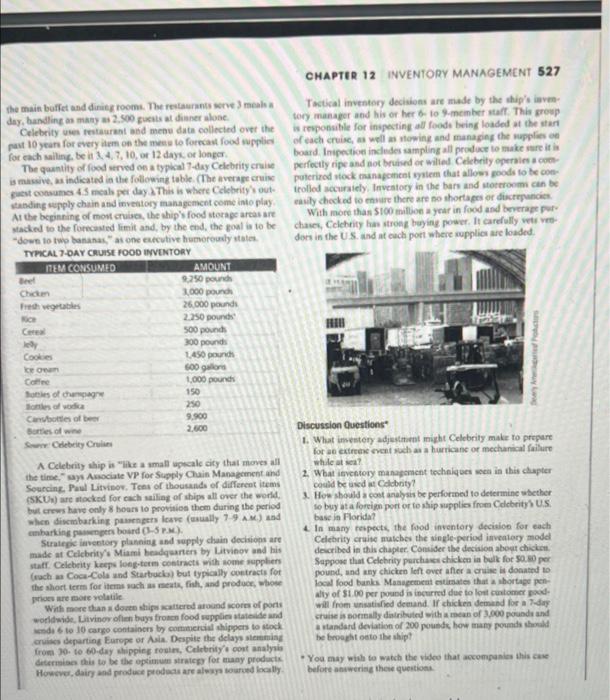
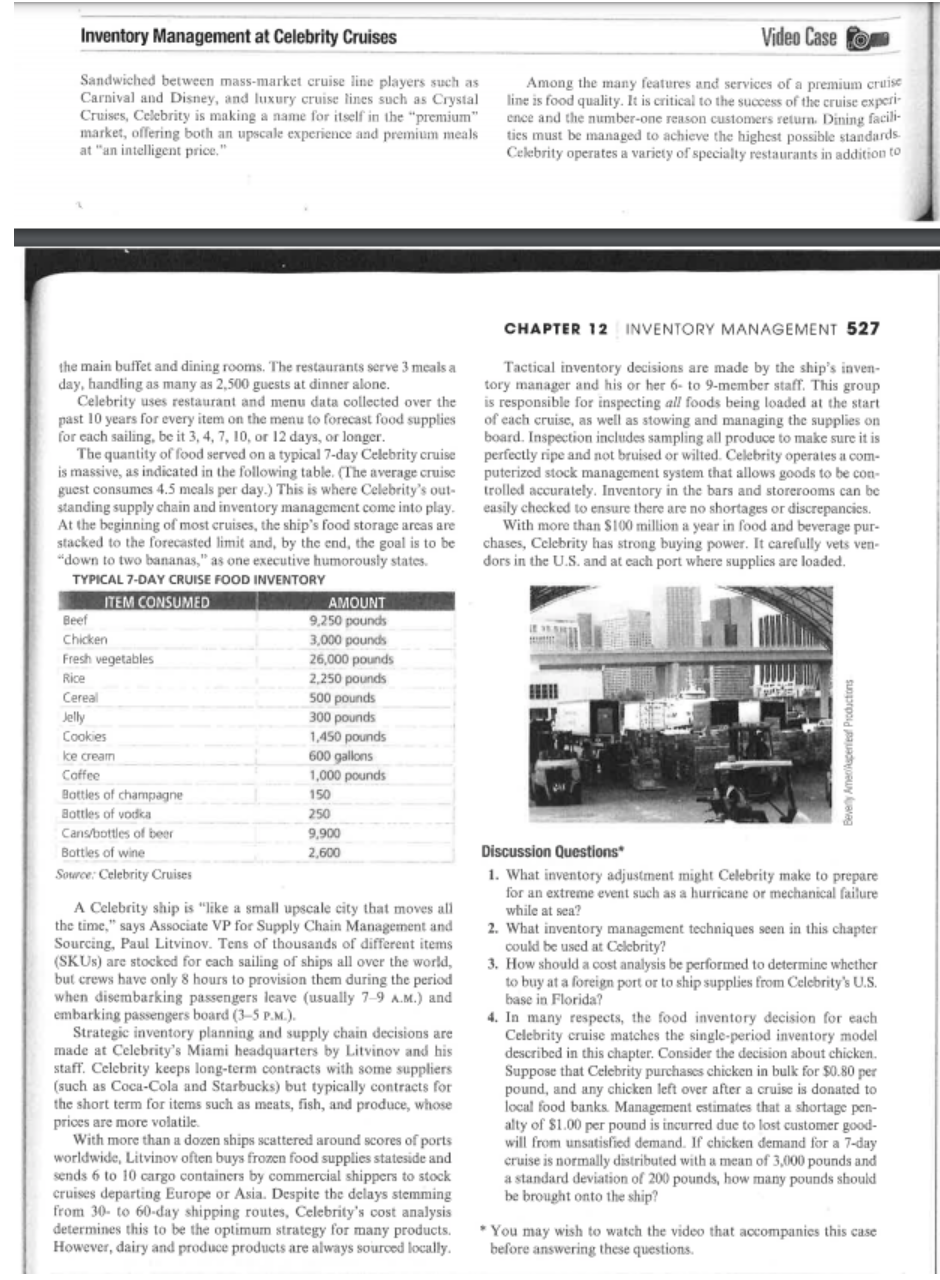
Inventory Management at Celebrity Cruises Sandwiched between mass-market cruise line players such as Carnival and Disney, and luxury cruise lines such as Crystal Cruises, Celebrity is making a name for itself in the "premium" market, offering both an upscale experience and premium meals at "an intelligent price." the main buffet and dining rooms. The restaurants serve 3 meals a day, handling as many as 2,500 guests at dinner alone. Celebrity uses restaurant and menu data collected over the past 10 years for every item on the menu to forecast food supplies for each sailing, be it 3, 4, 7, 10, or 12 days, or longer. The quantity of food served on a typical 7-day Celebrity cruise is massive, as indicated in the following table. (The average cruise guest consumes 4.5 meals per day.) This is where Celebrity's out- standing supply chain and inventory management come into play. At the beginning of most cruises, the ship's food storage areas are stacked to the forecasted limit and, by the end, the goal is to be "down to two bananas," as one executive humorously states. TYPICAL 7-DAY CRUISE FOOD INVENTORY ITEM CONSUMED AMOUNT 9,250 pounds Beef Chicken 3,000 pounds Fresh vegetables 26,000 pounds Rice 2,250 pounds Cereal 500 pounds Jelly 300 pounds Cookies 1,450 pounds kce cream 600 gallons 1,000 pounds Coffee Bottles of champagne 150 Bottles of vodka 250 Cans/bottles of beer 9,900 2,600 Bottles of wine Source: Celebrity Cruises A Celebrity ship is "like a small upscale city that moves all the time," says Associate VP for Supply Chain Management and Sourcing, Paul Litvinov. Tens of thousands of different items (SKUS) are stocked for each sailing of ships all over the world, but crews have only 8 hours to provision them during the period when disembarking passengers leave (usually 7-9 A.M.) and embarking passengers board (3-5 P.M.). Strategic inventory planning and supply chain decisions are made at Celebrity's Miami headquarters by Litvinov and his staff. Celebrity keeps long-term contracts with some suppliers (such as Coca-Cola and Starbucks) but typically contracts for the short term for items such as meats, fish, and produce, whose prices are more volatile. With more than a dozen ships scattered around scores of ports worldwide, Litvinov often buys frozen food supplies stateside and sends 6 to 10 cargo containers by commercial shippers to stock cruises departing Europe or Asia. Despite the delays stemming from 30- to 60-day shipping routes, Celebrity's cost analysis determines this to be the optimum strategy for many products. However, dairy and produce products are always sourced locally. Video Case Among the many features and services of a premium cruise line is food quality. It is critical to the success of the cruise experi- ence and the number-one reason customers return. Dining facili- ties must be managed to achieve the highest possible standards. Celebrity operates a variety of specialty restaurants in addition to CHAPTER 12 INVENTORY MANAGEMENT 527 Tactical inventory decisions are made by the ship's inven- tory manager and his or her 6- to 9-member staff. This group is responsible for inspecting all foods being loaded at the start of each cruise, as well as stowing and managing the supplies on board. Inspection includes sampling all produce to make sure it perfectly ripe and not bruised or wilted. Celebrity operates a com- puterized stock management system that allows goods to be con- trolled accurately. Inventory in the bars and storerooms can be easily checked to ensure there are no shortages or discrepancies. With more than $100 million a year in food and beverage pur- chases, Celebrity has strong buying power. It carefully vets ven- dors in the U.S. and at each port where supplies are loaded. MI Discussion Questions* 1. What inventory adjustment might Celebrity make to prepare for an extreme event such as a hurricane or mechanical failure while at sea? 2. What inventory management techniques seen in this chapter could be used at Celebrity? 3. How should a cost analysis be performed to determine whether to buy at a foreign port or to ship supplies from Celebrity's U.S. base in Florida? 4. In many respects, the food inventory decision for each Celebrity cruise matches the single-period inventory model described in this chapter. Consider the decision about chicken. Suppose that Celebrity purchases chicken in bulk for $0.80 per pound, and any chicken left over after a cruise is donated to local food banks. Management estimates that a shortage pen- alty of $1.00 per pound is incurred due to lost customer good- will from unsatisfied demand. If chicken demand for a 7-day cruise is normally distributed with a mean of 3,000 pounds and a standard deviation of 200 pounds, how many pounds should be brought onto the ship? * You may wish to watch the video that accompanies this case before answering these questions. Beverly Amer/Asperial Productions On any given day, Celebrity Cruises, Inc. has tens of thousands of passengers at sea on more than a dozen spectacular ships, spanning 7 continents and 75 countries. With this level of capital investment along with the responsibility for the happiness and safety of so many passengers, excellence in operations is required. To make it all work, the 10 operations management decisions must be executed flawlessly. From product design (which encompasses the ship's layout, the food, and 300 destinations), to scheduling, supply chain, inventory, personnel, maintenance, and the processes that hold them together, OM is critical. Cruise lines require precise scheduling of ships, with down-to-the-minute docking and departure times. In addition to ship and port scheduling, some 2,000 plus crew members must be scheduled. And there are many schedule variations. Entertainers may arrive and leave at each port, while officers may have a schedule of 10 weeks on and 10 weeks off. Other crew members have onboard commitments varying from 4 to 9 months. With $400 million invested in a ship and more than 5,000 lives involved in a cruise, detailed processes to ensure maintenance and reliability are vital. The modern ship is a technological marvel with hundreds of electronic monitors operating 24/7 to track everything from ship speed and location, to sea depth, to shipboard power demand and cabin temperature. Celebrity's ship layout, destinations, and routing are adjusted to meet seasonal demands and the expectations of its premium market segment. With destinations from Alaska to Europe to Asia, crews are recruited worldwide, with as many as 70 nationalities represented. Instilling a quality culture requires an aggressive quality service orientation and, of course, meticulous cleanliness and attention to detail. Processes for food preparation, laundry, quality, and maintenance are complete and detailed. Summary: Operations and Productivity A cruise ship, as a moving city, requires a comprehensive and precise supply chain that replenishes everything from food to fuel to soap and water. Land-based buyers support Celebrity's annual food and beverage purchases that exceed $110 million. Included in these expenditures are weekly shipments of 6 to 10 containers from the Miami headquarters destined for ships in European ports. An onboard staff organizes inventories to support this massive operation. The logistics effort includes hedging the weekly use of 24,000 gallons of fuel per ship with purchases years into the future. Reliable global supply chains have been developed that deliver the required inventory on a tight time frame. es 6 These crucial shipboard systems typically represent the best of operations management. Such is the case at Celebrity Cruises. the main buffet and dining rooms. The restaurants serve 3 meals a day, handling as many as 2,500 guests at dinner alone. Celebrity uses restaurant and menu data collected over the past 10 years for every item on the menu to forecast food supplies for each sailing, be it 3, 4, 7, 10, or 12 days, or longer. The quantity of food served on a typical 7-day Celebrity cruise is massive, as indicated in the following table. (The average cruise guest consumes 4.5 meals per day This is where Celebrity's out- standing supply chain and inventory management come into play. At the beginning of most cruises, the ship's food storage areas are stacked to the forecasted limit and, by the end, the goal is to be "down to two bananas," as one executive humorously states. TYPICAL 7-DAY CRUISE FOOD INVENTORY ITEM CONSUMED AMOUNT 9,250 pounds Beef Chicken 3,000 pounds Fresh vegetables 26,000 pounds Fice 2.250 pounds Cereal 500 pounds 300 pounds Cookies 1,450 pounds ke crean 600 gallora Coffee 1,000 pounds Bottles of champagne 150 Bottles of vodka 250 Cans/bottles of beer 9,900 2,600 Bottles of wine Swe Celebrity Cruises A Celebrity ship is "like a small upscale city that moves all the time," says Associate VP for Supply Chain Management and Sourcing, Paul Litvinov. Tens of thousands of different items (SKU) are stocked for each sailing of ships all over the world. but crews have only 8 hours to provision them during the period when disembarking passengers leave (usually 7-9 AM) and ambarking passengers board (1-5 PM). Strategic inventory planning and supply chain decisions are made at Celebrity's Miami beadquarters by Litvinov and his staff. Celebrity keeps long-term contracts with some suppliers (such as Coca-Cola and Starbucks) but typically contracts for the short term for items such as meats, fish, and produce, whose prices are more volatile With more than a dozen ships scattered around scores of ports worldwide, Litvinov often buys frozen food supplies stateside and sends 6 to 10 cargo containers by commercial shippers to stock cruises departing Europe or Asia. Despite the delays stemming from 30 to 60-day shipping routes, Celebrity's cost analysis determines this to be the optimum strategy for many products However, dairy and produce products are always sourced locally. CHAPTER 12 INVENTORY MANAGEMENT 527 Tactical inventory decisions are made by the ship's inven tory manager and his or her 6- to 9-member staff. This group is responsible for inspecting all foods being loaded at the start of each cruise, as well as stowing and managing the supplies on board. Inspection includes sampling all produce to make sure it is perfectly ripe and not bruised or willed Celebrity operates a com puterized stock management system that allows goods to be con trolled accurately. Inventory in the bars and storerooms can be easily checked to ensure there are no shortages or discrepancies With more than $100 million a year in food and beverage pur- chases, Celebrity has strong buying power. It carefully vets ven- dors in the US and at each port where supplies are loaded. Discussion Questions 1. What inventory adjustment might Celebrity make to prepare for an extree event such as a hurricane or mechanical failure while at sea? 2. What inventory management techniques seen in this chapter could be used at Celebrity? 3. How should a cost analysis be performed to determine whether so buy at a foreign port or to ship supplies from Celebrity's U.S. base in Florida? 4 In many respects, the food inventory decision for each Celebrity cruise matches the single-period inventory model described in this chapter. Consider the decision about chicken Suppose that Celebrity purchases chicken in bulk for $0.80 per pound, and any chicken left over after a cruise is donated to local food banks Management estimates that a shortage pen alty of $1.00 per pound is incurred due to lost customer good will from unsatisfied demand. If chicken demand for a 7-day cruise is normally distributed with a mean of 3,000 pounds and a standard deviation of 200 pounds, how many pounds should be brought onto the ship? You may wish to watch the video that accompanies this case before answering these questions y Lang