







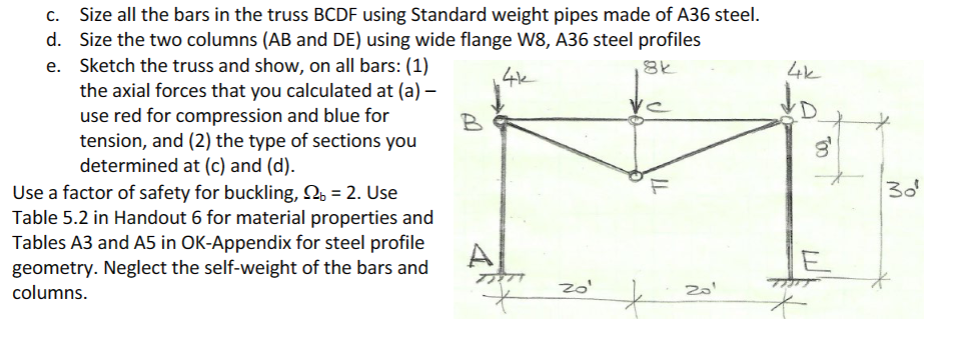
Question: c . Size all the bars in the truss BCDF using Standard weight pipes made of A 3 6 steel. d . Size the two
c Size all the bars in the truss BCDF using Standard weight pipes made of A steel.
d Size the two columns AB and DE using wide flange W A steel profiles
e Sketch the truss and show, on all bars:
the axial forces that you calculated at a
use red for compression and blue for
tension, and the type of sections you
determined at c and d
Use a factor of safety for buckling, b Use
Table in Handout for material properties and
Tables A and A in OKAppendix for steel profile
geometry. Neglect the selfweight of the bars and
columns.
Problem All members of the Howe truss discussed in Homework Problem are made of Doug Fir wood
with x nominal sections. You are required to check if the selected member section is safe for the
loading shown in that problem. Check for the maximum forces in top and bottom chords and in braces that
you calculated in Problem HW For members in compression look at both crushing resistance and
buckling resistance.
See Table in Handout posted on Canvas under Triangulated Structures for modulus of elasticity, E
allowable tension stress, F t and allowable compression stress, F c Use the values listed for Beams and Posts.
These allowable stresses denoted by F a in the lecture already include a factor of safety, namely F t Fy
and F c Fyc Use a factor of safety b only for buckling analysis.
The actual dimensions and sectional properties for lumber are listed on the last page of Handout posted
on Canvas under Loads and Load Flow
Hint: When you check for buckling for a rectangular crosssection, use the smaller moment of inertia I yy in
Handout c Size all the bars in the truss BCDF using Standard weight pipes made of A steel.
d Size the two columns AB and DE using wide flange W A steel profiles
e Sketch the truss and show, on all bars: the axial forces that you calculated at a use red for compression and blue for tension, and the type of sections you determined at c and d
Use a factor of safety for buckling, Use Table in Handout for material properties and Tables A and A in OKAppendix for steel profile geometry. Neglect the selfweight of the bars and columns.
Step by Step Solution
There are 3 Steps involved in it
1 Expert Approved Answer
Step: 1 Unlock

Question Has Been Solved by an Expert!
Get step-by-step solutions from verified subject matter experts
Step: 2 Unlock
Step: 3 Unlock
 Study Help