







Question: c++ This exercise involves printing out the generations of a series of processes created using fork(). You will create a program that accepts a single
c++
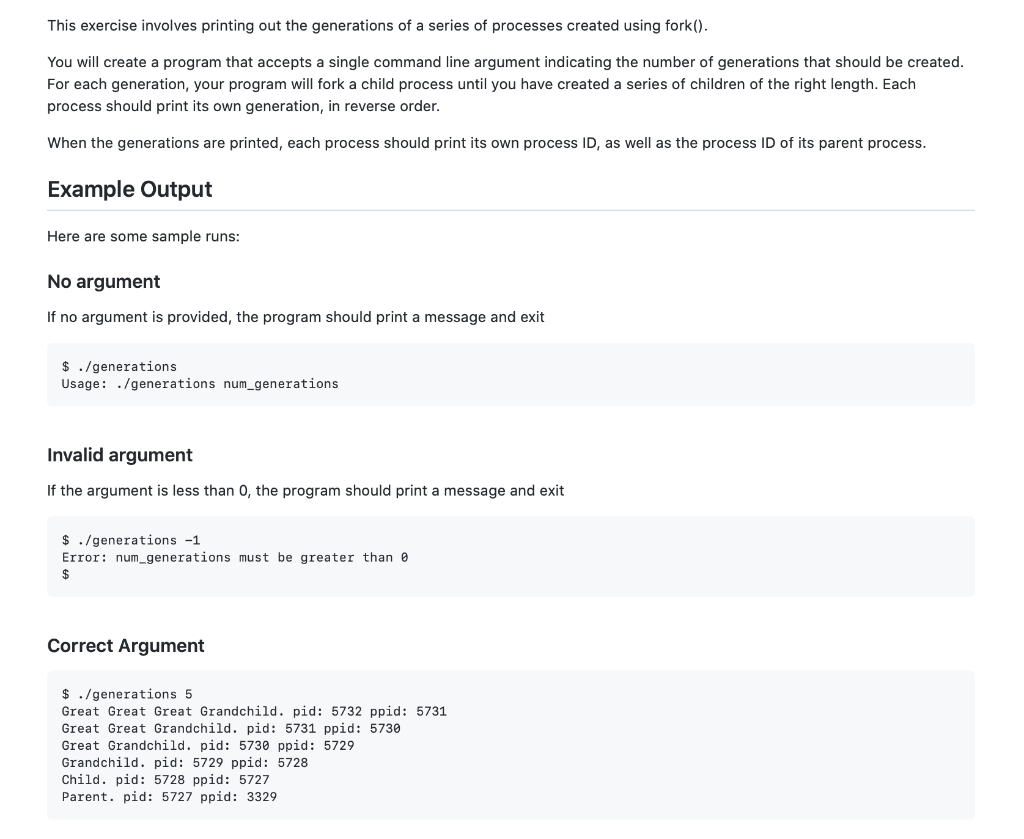
This exercise involves printing out the generations of a series of processes created using fork(). You will create a program that accepts a single command line argument indicating the number of generations that should be created. For each generation, your program will fork a child process until you have created a series of children of the right length. Each process should print its own generation, in reverse order. When the generations are printed, each process should print its own process ID, as well as the process ID of its parent process. Example Output Here are some sample runs: No argument If no argument is provided, the program should print a message and exit $ ./generations Usage: ./generations num_generations Invalid argument If the argument is less than 0, the program should print a message and exit $ ./generations -1 Error: num_generations must be greater than $ Correct Argument $ ./generations 5 Great Great Great Grandchild. pid: 5732 ppid: 5731 Great Great Grandchild. pid: 5731 ppid: 5730 Great Grandchild. pid: 5730 ppid: 5729 Grandchild. pid: 5729 ppid: 5728 Child. pid: 5728 ppid: 5727 Parent. pid: 5727 ppid: 3329
Step by Step Solution
There are 3 Steps involved in it

Get step-by-step solutions from verified subject matter experts
 Study Help