







Question: (c) When attempting to parallel a program P, the ideal speedup is proportional to the number of processor cores, e.g. 4 cores should provide a
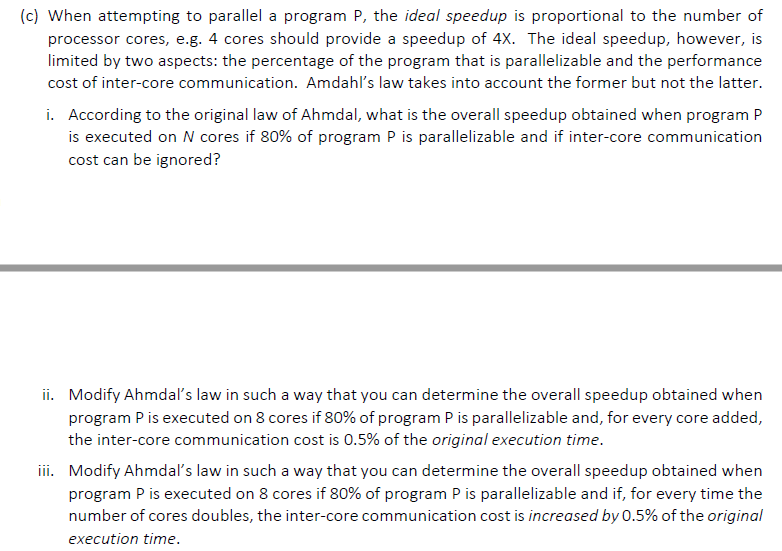
(c) When attempting to parallel a program P, the ideal speedup is proportional to the number of processor cores, e.g. 4 cores should provide a speedup of 4X. The ideal speedup, however, is limited by two aspects: the percentage of the program that is parallelizable and the performance cost of inter-core communication. Amdahl's law takes into account the former but not the latter. i. According to the original law of Ahmdal, what is the overall speedup obtained when program P is executed on N cores if 80% of program P is parallelizable and if inter-core communication cost can be ignored? ii. Modify Ahmdal's law in such a way that you can determine the overall speedup obtained when program P is executed on 8 cores if 80% of program P is parallelizable and, for every core added, the inter-core communication cost is 0.5% of the original execution time. iii. Modify Ahmdal's law in such a way that you can determine the overall speedup obtained when program P is executed on 8 cores if 80% of program P is parallelizable and if, for every time the number of cores doubles, the inter-core communication cost is increased by 0.5% of the original execution time
Step by Step Solution
There are 3 Steps involved in it

Get step-by-step solutions from verified subject matter experts
 Study Help