







Question: C.11 (a, b, c, & d) and C.12 C.11 (a, b, & c) and C.12 Ignore the top part Out C.11) Given the following present-state
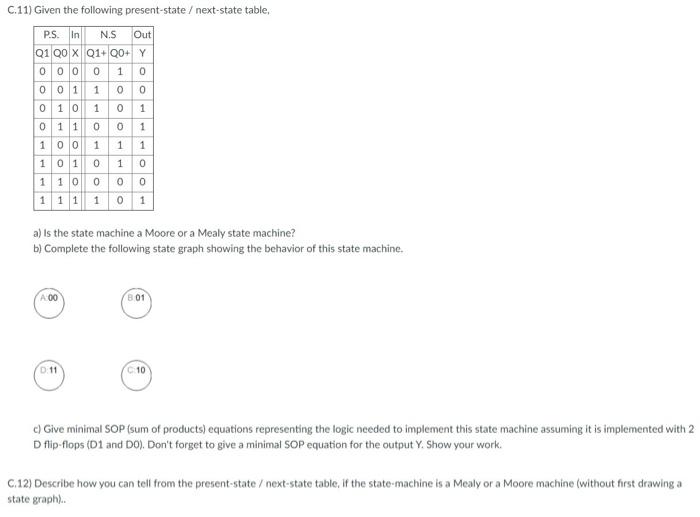
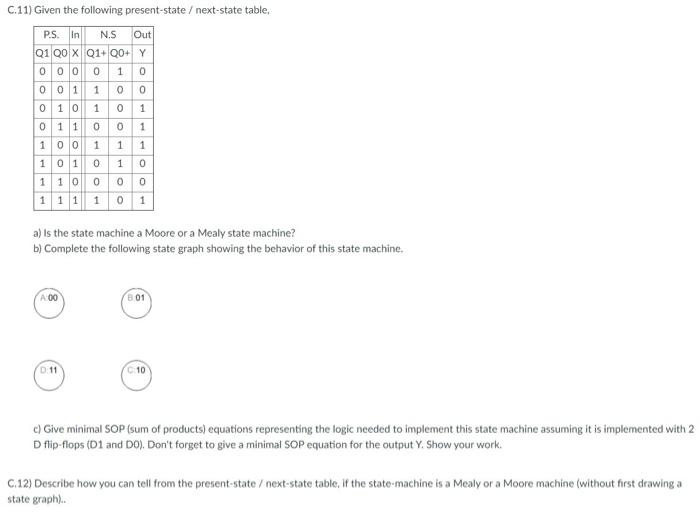
Out C.11) Given the following present-state / next-state table, P.S. IN NS Q1 20 X 21+ Q0+ Y 0 0 0 0 1 0 0 0 1 1 0 0 0 1 0 1 0 1 0 1 1 0 0 1 1 0 0 1 1 1 1 0 1 0 1 0 1 1 0 0 0 0 1 1 1 1 0 1 a) Is the state machine a Moore or a Mealy state machine? b) Complete the following state graph showing the behavior of this state machine. A 00 B01 0:11 C10 c) Give minimal SOP (sum of products) equations representing the logic needed to implement this state machine assuming it is implemented with 2 D flip-flops (D1 and Do). Don't forget to give a minimal SOP equation for the output Y. Show your work. C.12) Describe how you can tell from the present-state / next-state table. If the state-machine is a Mealy or a Moore machine (without first drawing a state graph). Out C.11) Given the following present-state / next-state table, P.S. IN NS Q1 20 X 21+ Q0+ Y 0 0 0 0 1 0 0 0 1 1 0 0 0 1 0 1 0 1 0 1 1 0 0 1 1 0 0 1 1 1 1 0 1 0 1 0 1 1 0 0 0 0 1 1 1 1 0 1 a) Is the state machine a Moore or a Mealy state machine? b) Complete the following state graph showing the behavior of this state machine. A 00 B01 0:11 C10 c) Give minimal SOP (sum of products) equations representing the logic needed to implement this state machine assuming it is implemented with 2 D flip-flops (D1 and Do). Don't forget to give a minimal SOP equation for the output Y. Show your work. C.12) Describe how you can tell from the present-state / next-state table. If the state-machine is a Mealy or a Moore machine (without first drawing a state graph)
Step by Step Solution
There are 3 Steps involved in it

Get step-by-step solutions from verified subject matter experts
 Study Help