







Question: C7-1 Computing and Evaluating Financial Statement Effects of Alternative Inventory Costing Methods (Chapters 2 and 7) (LO2- 5, LO 7-3] {The following information applies to
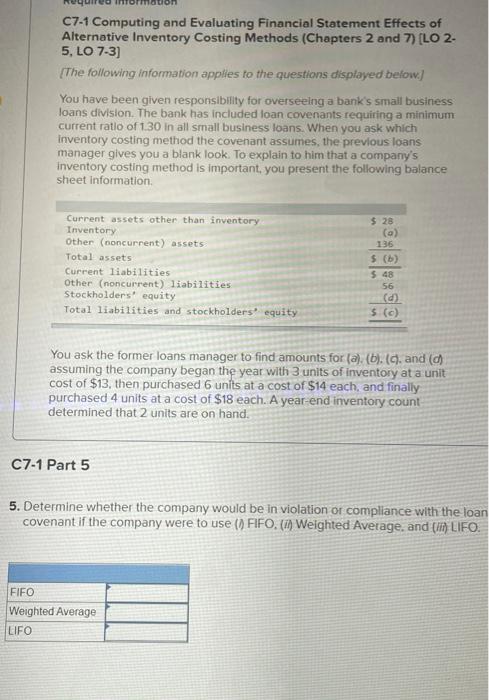
C7-1 Computing and Evaluating Financial Statement Effects of Alternative Inventory Costing Methods (Chapters 2 and 7) (LO2- 5, LO 7-3] {The following information applies to the questions displayed below.) You have been given responsibility for overseeing a bank's small business loans division. The bank has included loan covenants requiring a minimum current ratio of 130 in all small business loans. When you ask which inventory costing method the covenant assumes, the previous loans manager gives you a blank look. To explain to him that a company's Inventory costing method is important, you present the following balance sheet Information Current assets other than inventory Inventory Other (noncurrent) assets Total assets Current liabilities Other (noncurrent) liabilities Stockholders' equity Total liabilities and stockholders' equity $ 28 (a) 136 $ (b) $ 48 56 (d $ (0) You ask the former loans manager to find amounts for (a), (b). (9. and assuming the company began the year with 3 units of inventory at a unit cost of $13, then purchased 6 units at a cost of $14 each, and finally purchased 4 units at a cost of $18 each. A year-end inventory count determined that 2 units are on hand. C7-1 Part 5 5. Determine whether the company would be in violation or compliance with the loan covenant if the company were to use () FIFO, (1) Weighted Average, and ( LIFO. FIFO Weighted Average LIFO
Step by Step Solution
There are 3 Steps involved in it

Get step-by-step solutions from verified subject matter experts
 Study Help