







Question: Caches Question 1 : An n - way set - associative cache consists of several sets, each of which consists of n blocks. Each block
Caches
Question :
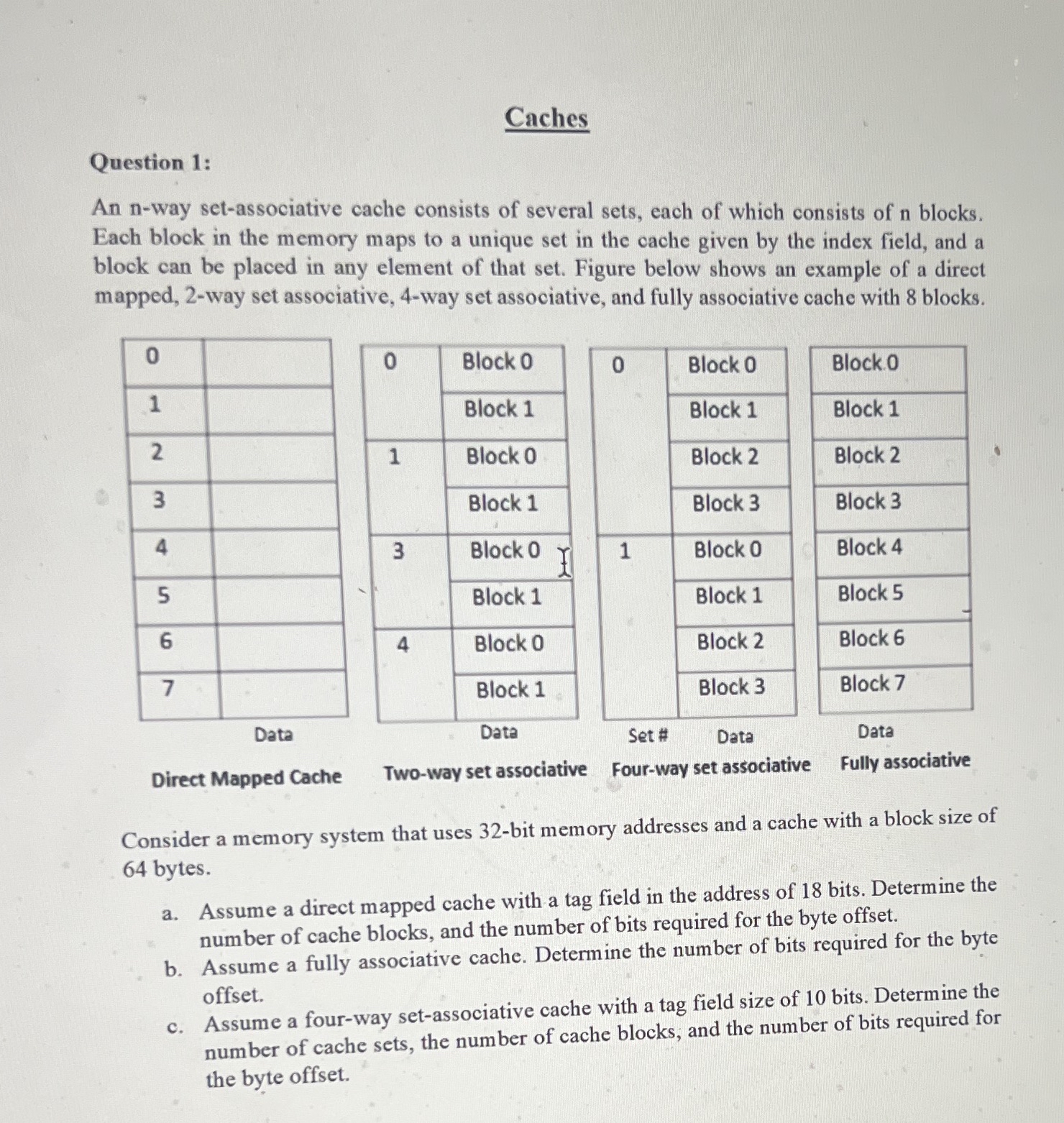
An nway setassociative cache consists of several sets, each of which consists of n blocks. Each block in the memory maps to a unique set in the cache given by the index field, and a block can be placed in any element of that set. Figure below shows an example of a direct mapped, way set associative, way set associative, and fully associative cache with blocks.
table
Data
tableBlock Block Block Block Block Block Block Block
Data
tableBlock Block Block Block Block Block Block Block
Set #
tableBlock Block Block Block Block Block Block Block
Data
Direct Mapped Cache
Twoway set associative
Fourway set associative
Fully associative
Consider a memory system that uses bit memory addresses and a cache with a block size of bytes.
a Assume a direct mapped cache with a tag field in the address of bits. Determine the number of cache blocks, and the number of bits required for the byte offset.
b Assume a fully associative cache. Determine the number of bits required for the byte offset.
c Assume a fourway setassociative cache with a tag field size of bits. Determine the number of cache sets, the number of cache blocks, and the number of bits required for the byte offset.
Step by Step Solution
There are 3 Steps involved in it
1 Expert Approved Answer
Step: 1 Unlock

Question Has Been Solved by an Expert!
Get step-by-step solutions from verified subject matter experts
Step: 2 Unlock
Step: 3 Unlock
 Study Help