Question: Calculate the optimal unit commitment program using forward dynamic programming for the power system described below over a day's operation. The power system has PV,
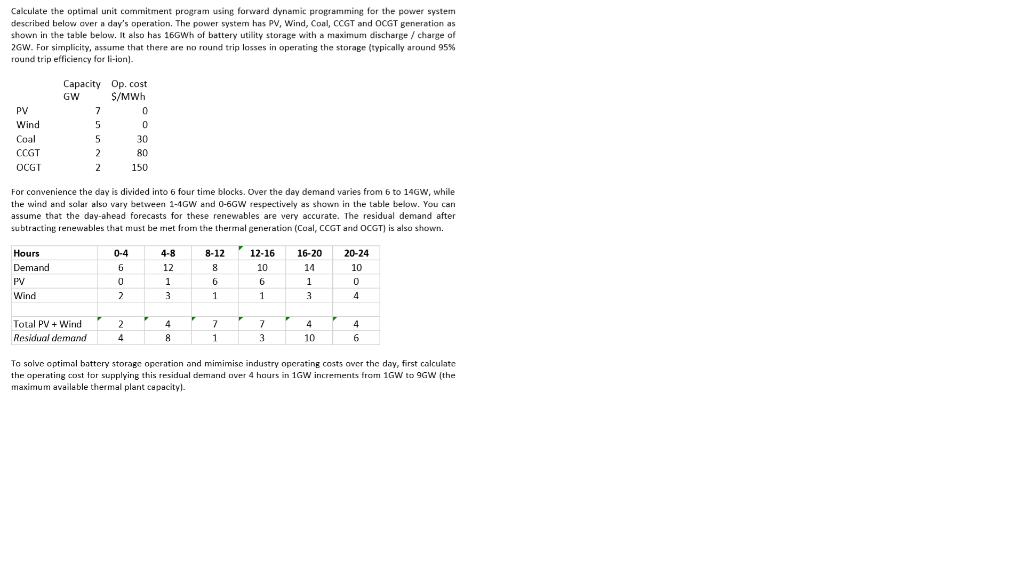
Calculate the optimal unit commitment program using forward dynamic programming for the power system described below over a day's operation. The power system has PV, Wind, Coal, CCGT and OCT generation as shown in the table below. It also has 16GWh of battery utility storage with a maximum discharge / charge of 2GW. For simplicity, assume that there are no round trip losses in operating the storage (typically around 95% round trip efficiency for li-ion). Capacity Op. cost GWS/MWh PV 30 Wind Coal CCGT OCGT 150 For convenience the day is divided into 6 four time blocks. Over the day demand varies from 6 to 146W, while the wind and solar also vary between 1-4GW and 0-6GW respectively as shown in the table below. You can assume that the day ahead forecasts for these renewables are very accurate. The residual demand after subtracting renewables that must be met from the thermal generation (Coal, CCGT and OCGT) is also shown. 0-4 4-8 8-12 20-24 12-16 10 16-20 14 10 Hours Demand PV Wind 1 1 3 4 7 Total PV + Wind Residual demand To solve optimal battery storage operation and mimimise industry operating costs over the day, first calculate the operating cost for supplying this residual demand over 4 hours in 1GW increments from 1GW to 9GW (the maximum available thermal plant capacity Now you can solve optimal battery storage operation using dynamic programming. For convenience, you can assume that the battery storage is at 50% state-of-charge (8GWh of electricity) just before the first four hour block (0-4 hours). Also, the battery can only operate at 0, 1GW or 26W for the entirety of any four hour period, and must be returned to 50% state-of-charge at the end of the last time block (20-24 hours) - otherwise, the lowest cost option would always be to empty the storage at the end of the day. You may find the table in the assignment spreadsheet of assistance in solving the dynamic programming, including the way it lays out the state space. Note that not all states at all time periods are feasible (due to charge/discharge limits) or acceptable (you can assume that residual demand must always be met). What is the optimal charging / discharging trajectory for the battery storage over the day, and the lowest possible operating cost for the power system over the day? To assist, I have solved the State transition costs for the first time step (0-4 hours) and there is space for you to calculate the total cost of getting to each State from every other feasible or acceptable State, making it easy to then identify the least cost path to each State, and use these when calculating the least cost for the next time step. Discuss your findings and their implications for energy storage in a power system with lots of PV, wind that mainly blows in the early morning and late evening, and demand that is low overnight with a morning and then early evening peak. Calculate the optimal unit commitment program using forward dynamic programming for the power system described below over a day's operation. The power system has PV, Wind, Coal, CCGT and OCT generation as shown in the table below. It also has 16GWh of battery utility storage with a maximum discharge / charge of 2GW. For simplicity, assume that there are no round trip losses in operating the storage (typically around 95% round trip efficiency for li-ion). Capacity Op. cost GWS/MWh PV 30 Wind Coal CCGT OCGT 150 For convenience the day is divided into 6 four time blocks. Over the day demand varies from 6 to 146W, while the wind and solar also vary between 1-4GW and 0-6GW respectively as shown in the table below. You can assume that the day ahead forecasts for these renewables are very accurate. The residual demand after subtracting renewables that must be met from the thermal generation (Coal, CCGT and OCGT) is also shown. 0-4 4-8 8-12 20-24 12-16 10 16-20 14 10 Hours Demand PV Wind 1 1 3 4 7 Total PV + Wind Residual demand To solve optimal battery storage operation and mimimise industry operating costs over the day, first calculate the operating cost for supplying this residual demand over 4 hours in 1GW increments from 1GW to 9GW (the maximum available thermal plant capacity Now you can solve optimal battery storage operation using dynamic programming. For convenience, you can assume that the battery storage is at 50% state-of-charge (8GWh of electricity) just before the first four hour block (0-4 hours). Also, the battery can only operate at 0, 1GW or 26W for the entirety of any four hour period, and must be returned to 50% state-of-charge at the end of the last time block (20-24 hours) - otherwise, the lowest cost option would always be to empty the storage at the end of the day. You may find the table in the assignment spreadsheet of assistance in solving the dynamic programming, including the way it lays out the state space. Note that not all states at all time periods are feasible (due to charge/discharge limits) or acceptable (you can assume that residual demand must always be met). What is the optimal charging / discharging trajectory for the battery storage over the day, and the lowest possible operating cost for the power system over the day? To assist, I have solved the State transition costs for the first time step (0-4 hours) and there is space for you to calculate the total cost of getting to each State from every other feasible or acceptable State, making it easy to then identify the least cost path to each State, and use these when calculating the least cost for the next time step. Discuss your findings and their implications for energy storage in a power system with lots of PV, wind that mainly blows in the early morning and late evening, and demand that is low overnight with a morning and then early evening peak









 Study Help