Question: CALCULATING INVENTORY CARRYING CHARGES AT FLEXCON FlexCon, a $3 billion maker of industrial engines, has made a decision to out- source engine pistons, a part
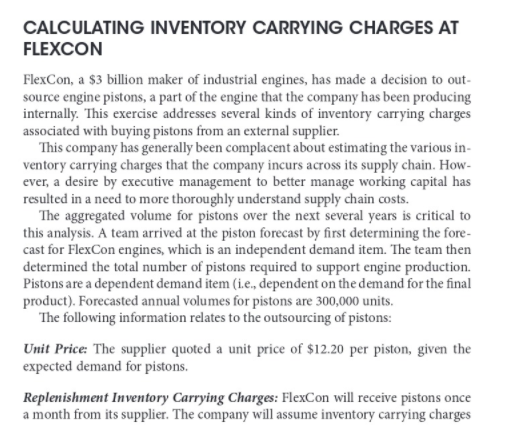
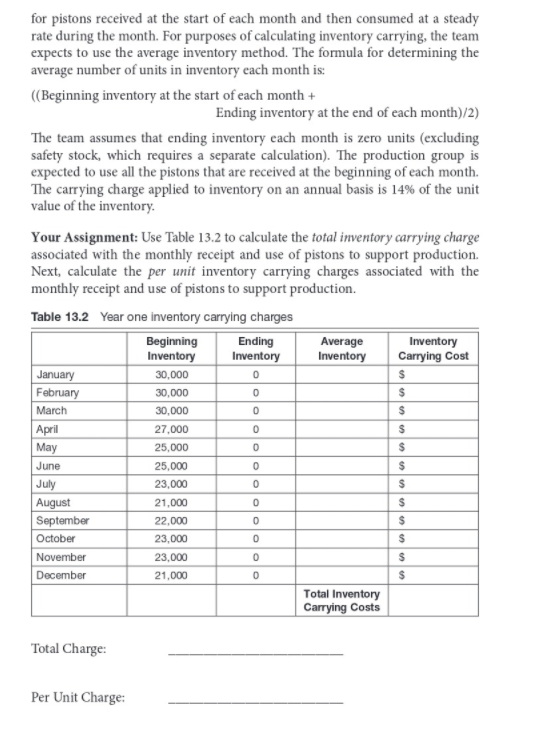
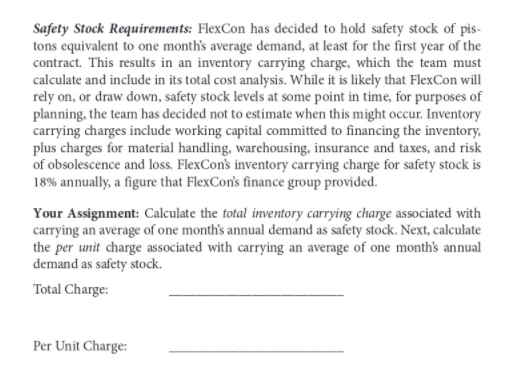
CALCULATING INVENTORY CARRYING CHARGES AT FLEXCON FlexCon, a $3 billion maker of industrial engines, has made a decision to out- source engine pistons, a part of the engine that the company has been producing internally. This exercise addresses several kinds of inventory carrying charges associated with buying pistons from an external supplier. This company has generally been complacent about estimating the various in- ventory carrying charges that the company incurs across its supply chain. How- ever, a desire by executive management to better manage working capital has resulted in a need to more thoroughly understand supply chain costs. The aggregated volume for pistons over the next several years is critical to this analysis. A team arrived at the piston forecast by first determining the fore- cast for FlexCon engines, which is an independent demand item. The team then determined the total number of pistons required to support engine production. Pistons are a dependent demand item (i.e., dependent on the demand for the final product). Forecasted annual volumes for pistons are 300,000 units. The following information relates to the outsourcing of pistons: Unit Price: The supplier quoted a unit price of $12.20 per piston, given the expected demand for pistons. Replenishment Inventory Carrying Charges: FlexCon will receive pistons once a month from its supplier. The company will assume inventory carrying charges for pistons received at the start of each month and then consumed at a steady rate during the month. For purposes of calculating inventory carrying, the team expects to use the average inventory method. The formula for determining the average number of units in inventory each month is: ((Beginning inventory at the start of each month + Ending inventory at the end of each month)/2) The team assumes that ending inventory each month is zero units (excluding safety stock, which requires a separate calculation). The production group is expected to use all the pistons that are received at the beginning of each month. The carrying charge applied to inventory on an annual basis is 14% of the unit value of the inventory Your Assignment: Use Table 13.2 to calculate the total inventory carrying charge associated with the monthly receipt and use of pistons to support production. Next, calculate the per unit inventory carrying charges associated with the monthly receipt and use of pistons to support production. Table 13.2 Year one inventory carrying charges Beginning Ending Average Inventory Inventory Inventory Inventory Carrying Cost January 30,000 February 30,000 $ March 30,000 $ April 27,000 May 25,000 25,000 $ July 23,000 August 21,000 September October 23,000 November $ December 21,000 Total Inventory Carrying Costs 0 $ 0 0 0 $ $ 0 June 0 0 $ 0 22.000 0 $ $ $ 23,000 OOO $ Total Charge: Per Unit Charge: Safety Stock Requirements: FlexCon has decided to hold safety stock of pis- tons equivalent to one month's average demand, at least for the first year of the contract. This results in an inventory carrying charge, which the team must calculate and include in its total cost analysis. While it is likely that FlexCon will rely on, or draw down, safety stock levels at some point in time, for purposes of planning, the team has decided not to estimate when this might occur. Inventory carrying charges include working capital committed to financing the inventory, plus charges for material handling, warehousing, insurance and taxes, and risk of obsolescence and loss. FlexCon's inventory carrying charge for safety stock is 18% annually, a figure that FlexCon's finance group provided. Your Assignment: Calculate the total inventory carrying charge associated with carrying an average of one month's annual demand as safety stock. Next, calculate the per unit charge associated with carrying an average of one month's annual demand as safety stock. Total Charge: Per Unit Charge









 Study Help