







Question: Calculation of equilibrium concentrations given initial concentrations. In this handout we are going to describe how to determine equilibrium concentrations of products and reactants, given
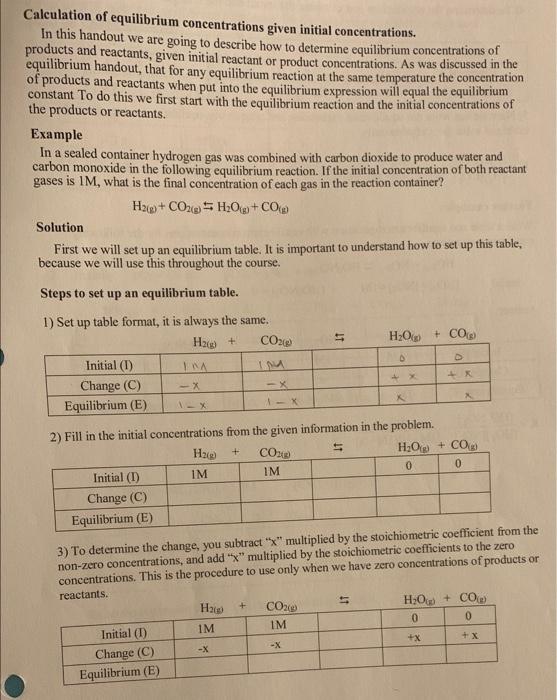
Calculation of equilibrium concentrations given initial concentrations. In this handout we are going to describe how to determine equilibrium concentrations of products and reactants, given initial reactant or product concentrations. As was discussed in the equilibrium handout, that for any equilibrium reaction at the same temperature the concentration of products and reactants when put into the equilibrium expression will equal the equilibrium constant To do this we first start with the equilibrium reaction and the initial concentrations of the products or reactants. Example In a sealed container hydrogen gas was combined with carbon dioxide to produce water and carbon monoxide in the following equilibrium reaction. If the initial concentration of both reactant gases is 1M, what is the final concentration of each gas in the reaction container? H2(g)+CO2(g)H2O(g)+CO(k) Solution First we will set up an equilibrium table. It is important to understand how to set up this table, because we will use this throughout the course. Steps to set up an equilibrium table. 1) Set un table format. it is always the same. a) Dill in tha initial concentrations from the given information in the problem. 3) To determine the change, you subtract " x " multiplied by the stoichiometric coemcient uom the non-zero concentrations, and add " x " multiplied by the stoichiometric coefficients to the zero concentrations. This is the procedure to use only when we have zero concentrations of products or
Step by Step Solution
There are 3 Steps involved in it

Get step-by-step solutions from verified subject matter experts
 Study Help