







Question: Calculus 3 : Highlight the final answer please ! Section 11.3: Problem 5 (1 point) Find the first partial derivatives of f(x, y, 2) =
Calculus 3 :
Highlight the final answer please !
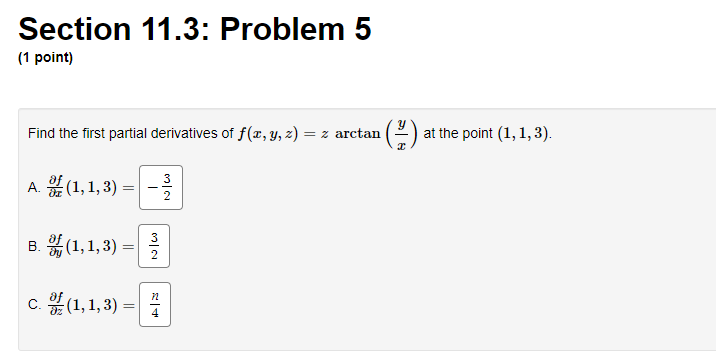
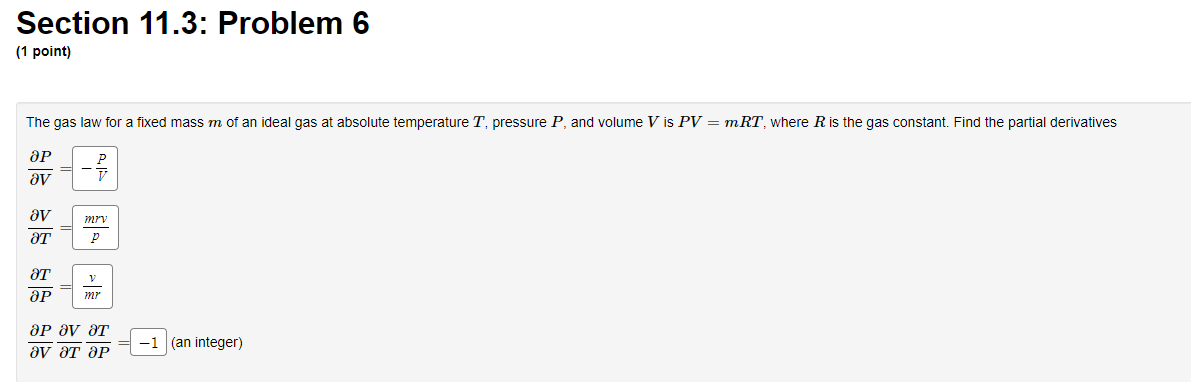
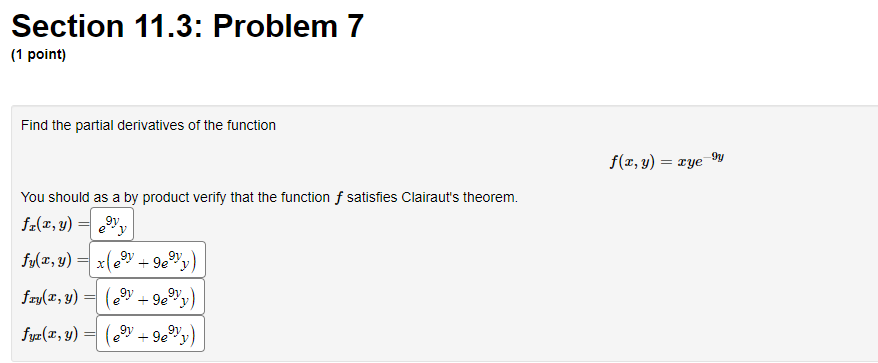
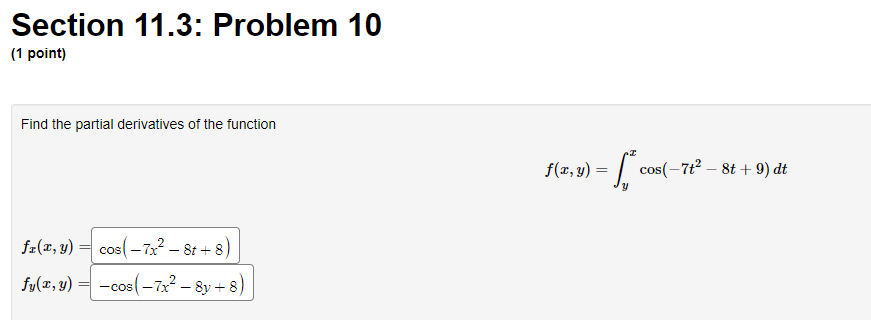
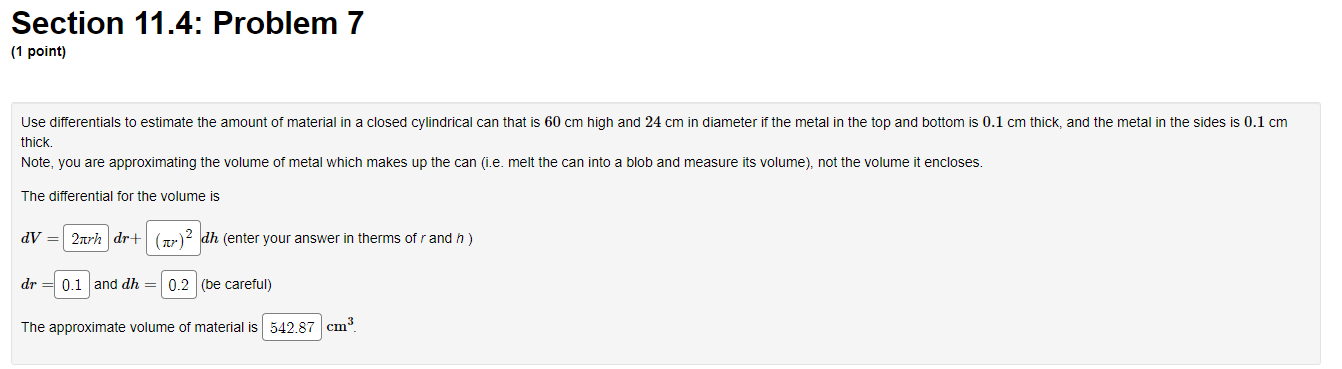
Section 11.3: Problem 5 (1 point) Find the first partial derivatives of f(x, y, 2) = > arctan at the point (1, 1, 3). A. #7 (1, 1, 3) = B. 97 (1, 1,3) = C. 95 (1, 1, 3) =Section 11.3: Problem 6 (1 point) The gas law for a xed mass m of an ideal gas at absolute temperature T, pressure P, and volume V is PV = mRT, where R is the gas constant, Find the partial derivatives 8P__3 8V_ V 3V_m W_ p 3T_ 1- _5 8_P 8_V E 1 (an integer) Section 11.3: Problem 7 (1 point) Find the partial derivatives of the function f(x, y) = rye ly You should as a by product verify that the function f satisfies Clairaut's theorem. fx(I, y) fulx, y) xle 97 + 9e By V fry(I, y) (2 + ge v fyr(I, y)Section 11.3: Problem 10 (1 point) Find the partial derivatives of the function f(x, y) =/ cos( -7t- - 8t + 9) dt y fx(x, y) cos (-7x- - 8+ + 8) fy(x, y) -COS -7x- - 8y + 8)Section 11.4: Problem 7 (1 point) Use differentials to estimate the amount of material in a closed cylindrical can that is 60 cm high and 24 cm in diameter if the metal in the top and bottom is 0.1 cm thick, and the metal in the sides is 0.1 cm thick. Note, you are approximationg the volume of metal which makes up the can (i.e. melt the can into a blob and measure its volume), not the volume it encloses. The differential for the volume is dV = 2nch dr+ (my ) 2 dh (enter your answer in therms of r and h ) dr 0.1 and dh = 0.2 (be careful) The approximate volume of material is 542.87 cm
Step by Step Solution
There are 3 Steps involved in it

Get step-by-step solutions from verified subject matter experts
 Study Help