







Question: Calculus Assignment full solutions with complete justifications (step by step/ explained using words) thank you 3. C is a radioactive isotope of carbon found at
Calculus Assignment
full solutions with complete justifications (step by step/ explained using words)
thank you
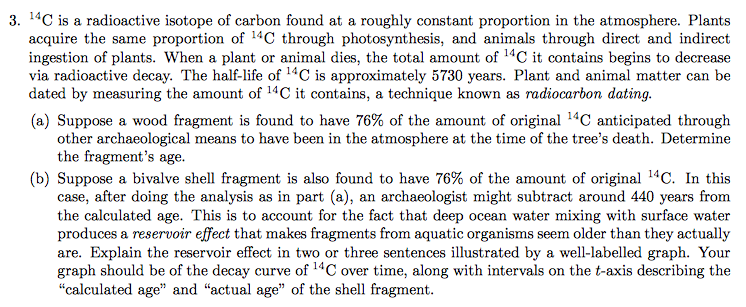
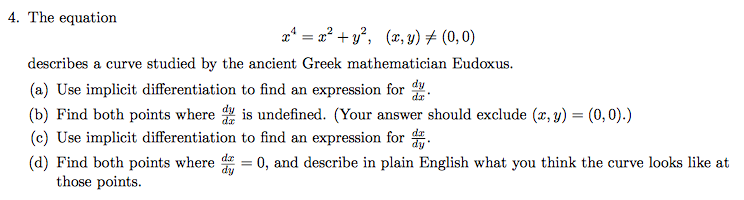
3. \"C is a radioactive isotope of carbon found at a roughly constant proportion in the atmosphere. Plants acquire the same proportion of \"C through photosynthesis. and animals through direct and indirect ingestion of plants. When a plant or animal dies, the total amount of \"C it contains begins to decrease via radioactive decay. The half-life of \"C is approximately 5T3 years. Plant and animal matter can be dated by measuring the amount of \"C it contains, a technique known as radiocarbon dating. (a) Suppose a wood fragment is found to have ff': of the amount of original \"C anticipated through other archaeological means to have been in the atmosphere at the time of the tree's death. Determine the fragrnent's age. (b) Suppose a bivalve shell fragment is also found to have 713% of the amount of original \"C. In this case. after doing the analysis as in part [a], an archaeologist might subtract around 440 years from the calculated age. This is to account for the fact that deep ocean water mixing with surface water produws a memoir e'ect that makes fragments from aquatic organisms seem older than they actually are. Explain the reservoir effect in two or three sentences illustrated by a well-labelled graph. Your graph should be of the decaar curve of \"C over time, along with intervals on the f-axis describing the \"calculated age" and \"actual age" of the shell fragment. 4. The equation x\" = $2 + if\
Step by Step Solution
There are 3 Steps involved in it

Get step-by-step solutions from verified subject matter experts
 Study Help