







Question: Calculus Lab Write-up Week 10 (Population Curves) 1. (80 points) Demonstrate and Explain: Clearly and thoroughly explain your answers to these questions based on the
Calculus Lab Write-up Week 10 (Population Curves) 1. (80 points) Demonstrate and Explain: Clearly and thoroughly explain your answers to these questions based on the work you did on labs this week. These questions refer to Lab 10A: Population Curves. Recall, the world population in 1999 was approximately Po = 6.067 billion people. In 2000, it was approximately Pi = 6.145 billion people. (a) (Parts 1a and 2a) Show how to model the world population with an exponential curve, P(t) (including how you find the value of Ro), and with a logistic growth curve, L(t) (where K = 15 and Rb = 0.022.) (b) (Parts 1b & 2b) Create an accurate, well-labeled graph that shows the world populations predicted by both P(t) and L(t) from 1999 to 2049. (c) (Parts 1d and 2d) According to each of these models, how fast (in billions of people per year) is the world population growing in 2019? In 2049? Show very clearly how you are finding these solutions. (d) (Part 3) Compare the two models P(t) and L(t). As t gets large (e.g. the year 2099), what do P'(t) and L'(t) tell you about how each of the models is growing? Which of these models do you find more realistic? Explain your reasoning. For reference-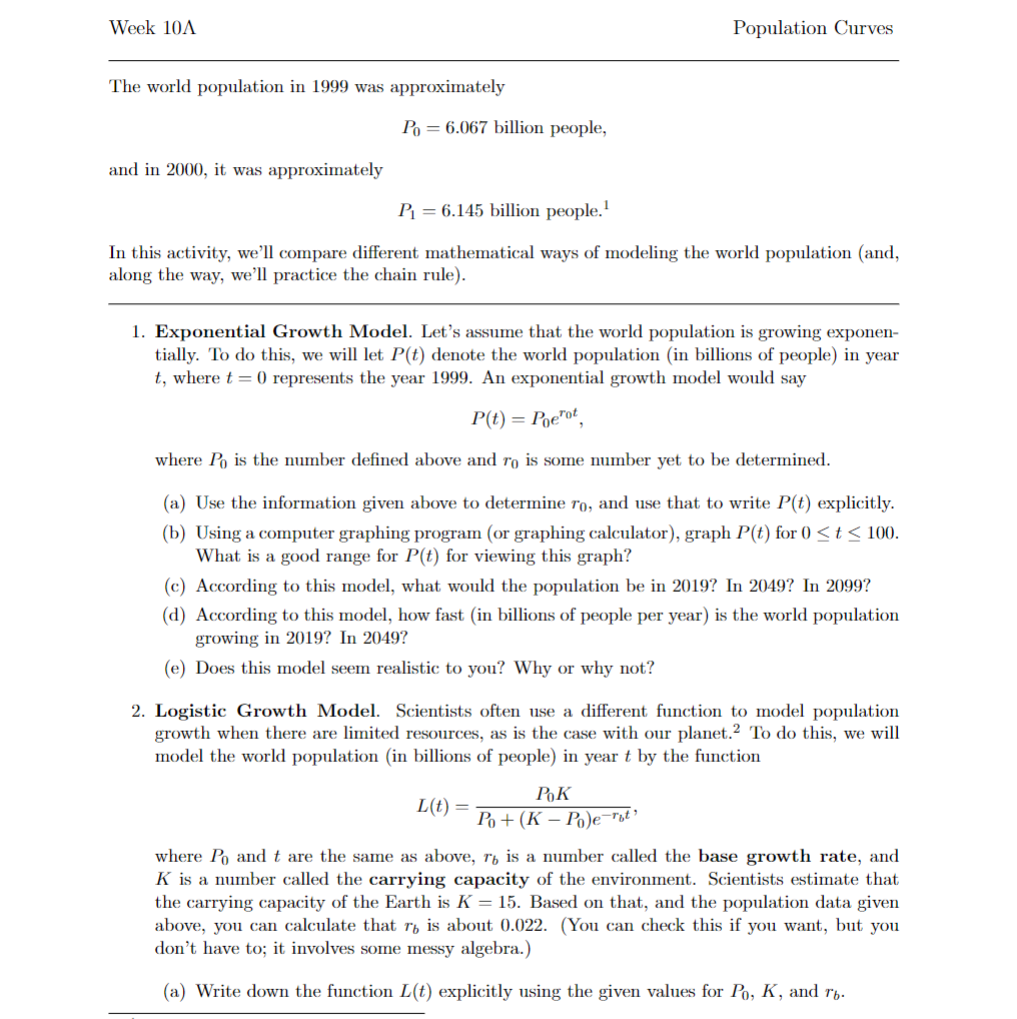
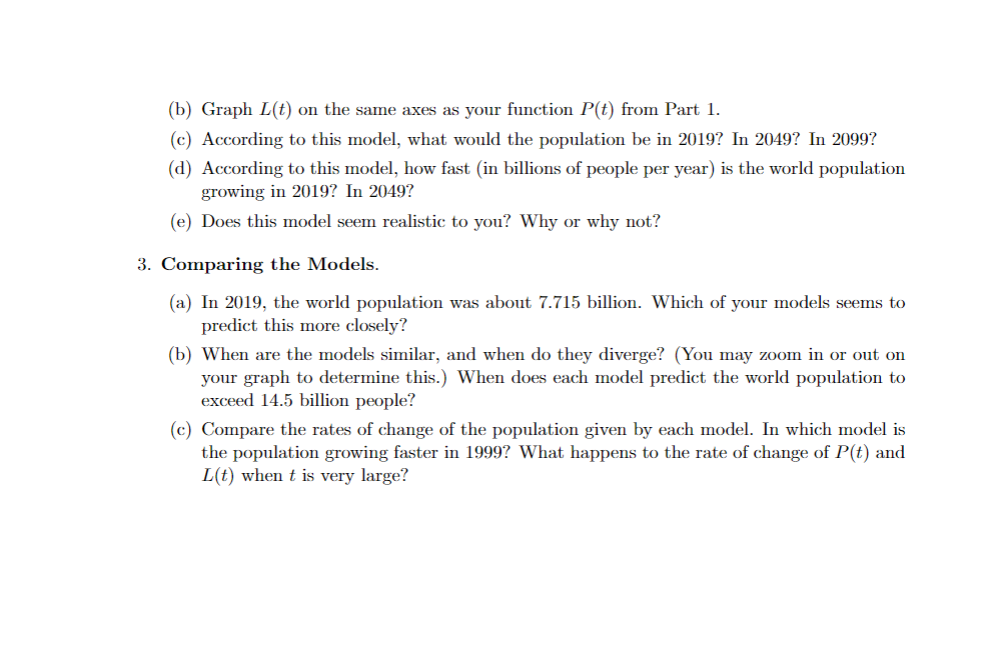
Week 10A Population Curves The world population in 1999 was approximately Po = 6.067 billion people, and in 2000, it was approximately P1 = 6.145 billion people.! In this activity, we'll compare different mathematical ways of modeling the world population (and, along the way, we'll practice the chain rule). 1. Exponential Growth Model. Let's assume that the world population is growing exponen- tially. To do this, we will let P(t) denote the world population (in billions of people) in year t, where t = 0 represents the year 1999. An exponential growth model would say P(t) = Poerot, where Po is the number defined above and ro is some number yet to be determined. (a) Use the information given above to determine To, and use that to write P(t) explicitly. (b) Using a computer graphing program (or graphing calculator), graph P(t) for 0
Step by Step Solution
There are 3 Steps involved in it

Get step-by-step solutions from verified subject matter experts
 Study Help