







Question: Calculus theorem proof In class we showed that you cannot use the fundamental theorem of calculus to evaluate the integral , Edx because the integrand
Calculus theorem proof
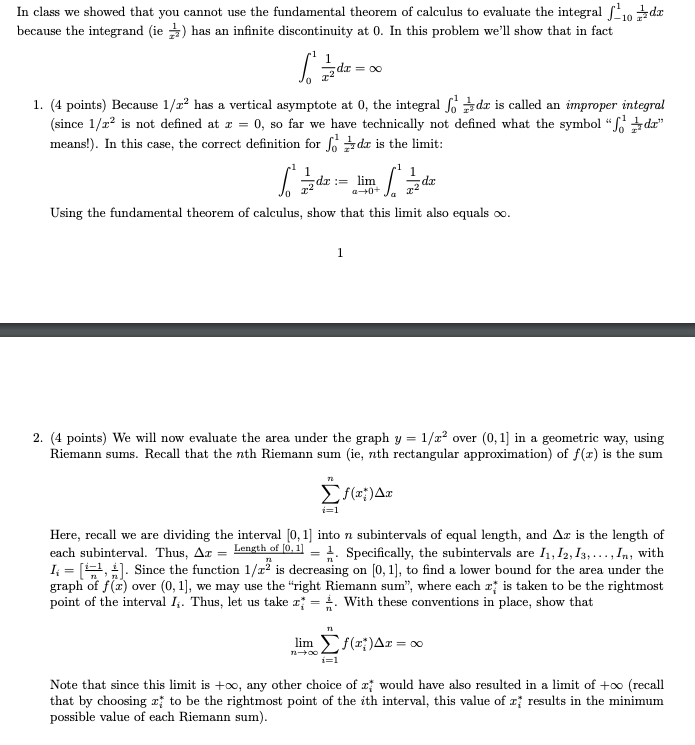
In class we showed that you cannot use the fundamental theorem of calculus to evaluate the integral , Edx because the integrand (ie ) has an infinite discontinuity at 0. In this problem we'll show that in fact 1. (4 points) Because 1/r has a vertical asymptote at 0, the integral So adr is called an improper integral (since 1/r is not defined at r = 0, so far we have technically not defined what the symbol "f Ada" means!). In this case, the correct definition for Jo Edx is the limit: Using the fundamental theorem of calculus, show that this limit also equals oo. 2. (4 points) We will now evaluate the area under the graph y = 1/c' over (0, 1] in a geometric way, using Riemann sums. Recall that the nth Riemann sum (ie, nth rectangular approximation) of f(x) is the sum Here, recall we are dividing the interval [0, 1] into n subintervals of equal length, and Ac is the length of each subinterval. Thus, Ar = Length of 10.1 = 1. Specifically, the subintervals are /1, 12, Is, ..., In, with I = [ , ]. Since the function 1/12 is decreasing on [0, 1], to find a lower bound for the area under the graph of f(x) over (0, 1], we may use the "right Riemann sum", where each r: is taken to be the rightmost point of the interval ;. Thus, let us take z, = 2. With these conventions in place, show that lim 1-+00 1= 1 Note that since this limit is too, any other choice of z/ would have also resulted in a limit of too (recall that by choosing z/ to be the rightmost point of the ith interval, this value of z; results in the minimum possible value of each Riemann sum)
Step by Step Solution
There are 3 Steps involved in it

Get step-by-step solutions from verified subject matter experts
 Study Help