







Question: Callo = SN(d) - Ee-RTN(dz) = where ( ()+(r+(22) |-3-) R+ di = 0 NT d2 = d; -OVT a You have just taken a
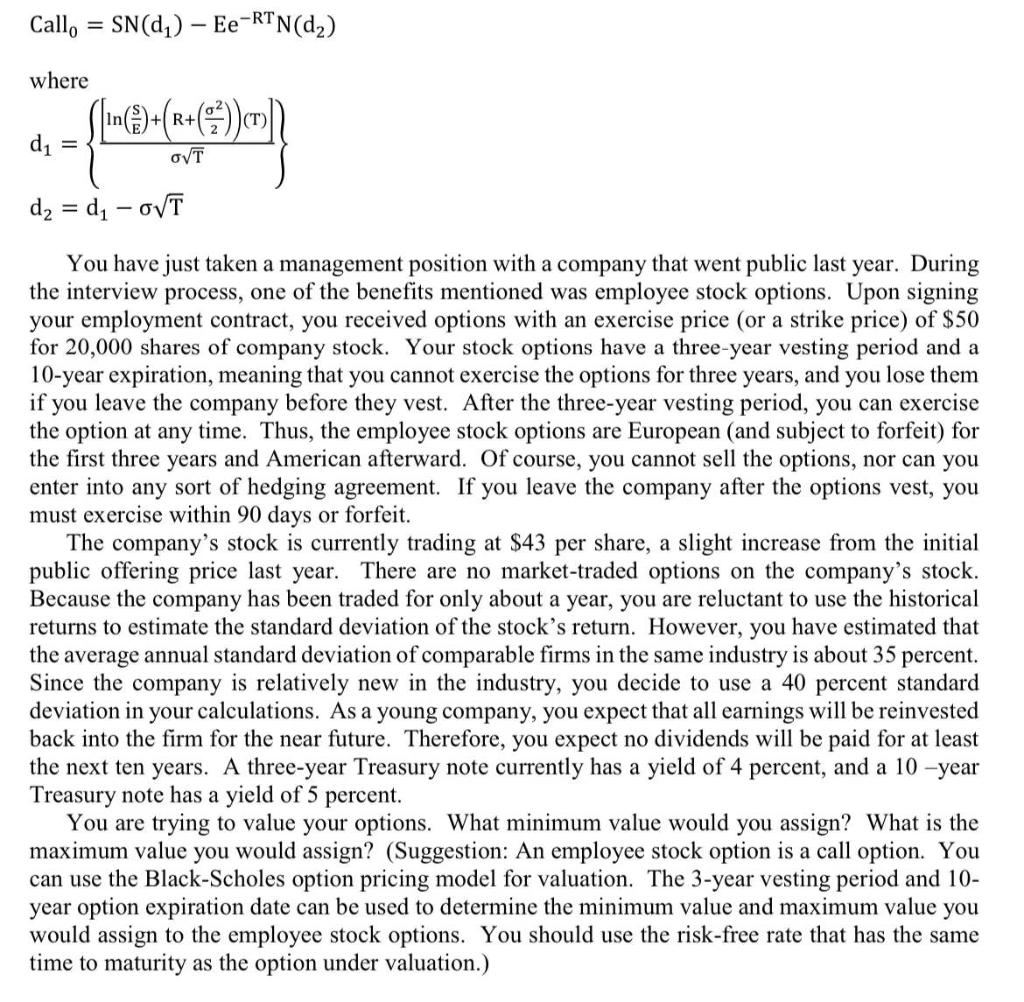
Callo = SN(d) - Ee-RTN(dz) = where ( ()+(r+(22) |-3-) R+ di = 0 NT d2 = d; -OVT a You have just taken a management position with a company that went public last year. During the interview process, one of the benefits mentioned was employee stock options. Upon signing your employment contract, you received options with an exercise price (or a strike price) of $50 for 20,000 shares of company stock. Your stock options have a three-year vesting period and a 10-year expiration, meaning that you cannot exercise the options for three years, and you lose them if you leave the company before they vest. After the three-year vesting period, you can exercise the option at any time. Thus, the employee stock options are European (and subject to forfeit) for the first three years and American afterward. Of course, you cannot sell the options, nor can you enter into any sort of hedging agreement. If you leave the company after the options vest, you must exercise within 90 days or forfeit. The company's stock is currently trading at $43 per share, a slight increase from the initial public offering price last year. There are no market-traded options on the company's stock. Because the company has been traded for only about a year, you are reluctant to use the historical returns to estimate the standard deviation of the stock's return. However, you have estimated that the average annual standard deviation of comparable firms in the same industry is about 35 percent. Since the company is relatively new in the industry, you decide to use a 40 percent standard deviation in your calculations. As a young company, you expect that all earnings will be reinvested back into the firm for the near future. Therefore, you expect no dividends will be paid for at least the next ten years. A three-year Treasury note currently has a yield of 4 percent, and a 10-year Treasury note has a yield of 5 percent. You are trying to value your options. What minimum value would you assign? What is the maximum value you would assign? (Suggestion: An employee stock option is a call option. You can use the Black-Scholes option pricing model for valuation. The 3-year vesting period and 10- year option expiration date can be used to determine the minimum value and maximum value you would assign to the employee stock options. You should use the risk-free rate that has the same time to maturity as the option under valuation.)
Step by Step Solution
There are 3 Steps involved in it

Get step-by-step solutions from verified subject matter experts
 Study Help