







Question: Can any tutor help me resolve those issues There are two countries, Canada (country A) and the US (country B). Each country can produce two
Can any tutor help me resolve those issues
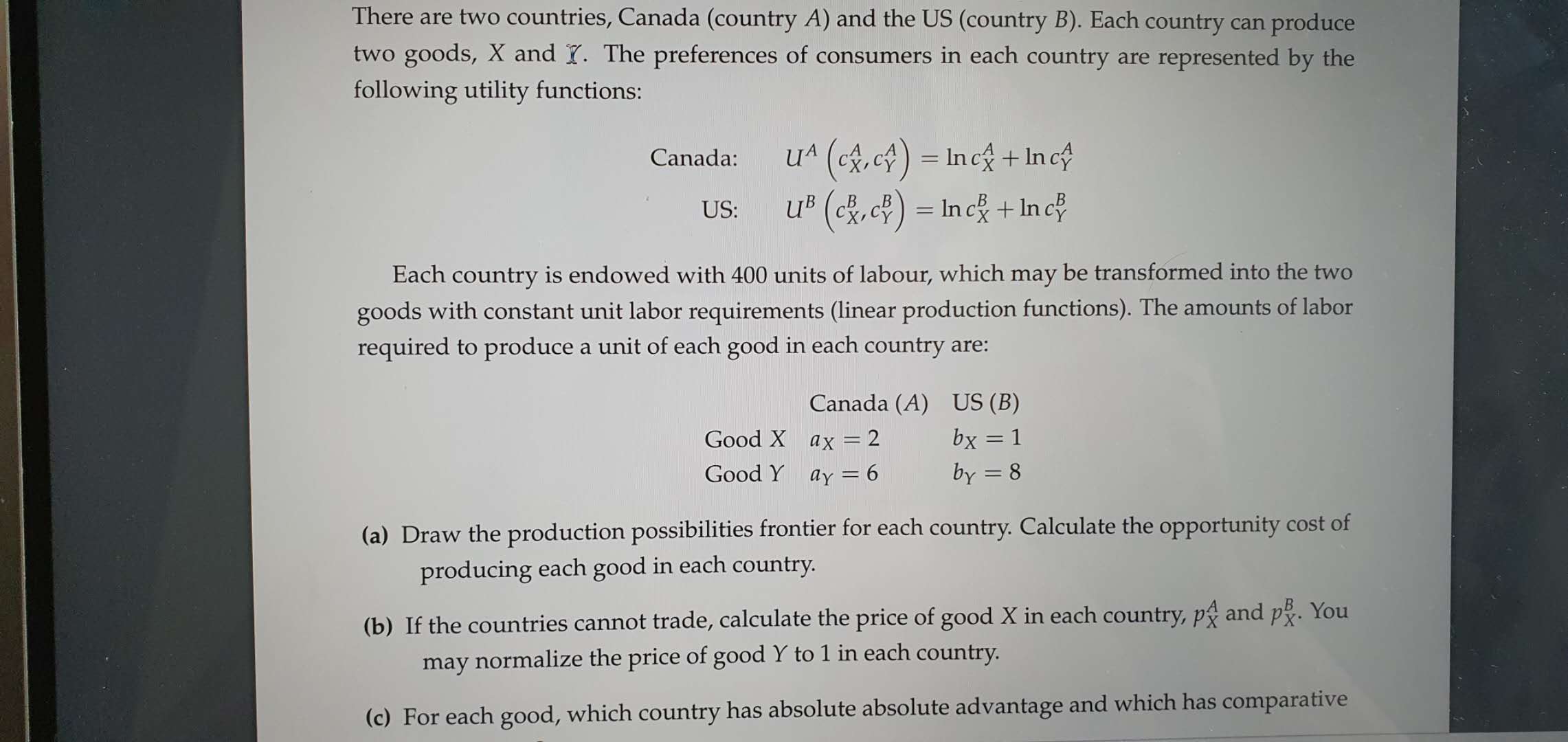

There are two countries, Canada (country A) and the US (country B). Each country can produce two goods, X and Y. The preferences of consumers in each country are represented by the following utility functions: Canada: UA (ck, cy ) = Inck + Incf US: UB (CR, CP) = Inck + Inc Each country is endowed with 400 units of labour, which may be transformed into the two goods with constant unit labor requirements (linear production functions). The amounts of labor required to produce a unit of each good in each country are: Canada (A) US (B) Good X ax = 2 bx = 1 Good Y ay = 6 by = 8 (a) Draw the production possibilities frontier for each country. Calculate the opportunity cost of producing each good in each country. (b) If the countries cannot trade, calculate the price of good X in each country, po and px. You may normalize the price of good Y to 1 in each country. (c) For each good, which country has absolute absolute advantage and which has comparative(c) For each good, which country has absolute absolute advantage and which has comparative advantage? (d) In an equilibrium with free trade, what is the world price of good X if country A produces both goods X and Y? (e) In an equilibrium with free trade, what is the world price of good X if country B produces both goods X and Y? (f) In an equilibrium with free trade and complete specialization, in what interval must the price of good X lie if country A produces only good Y and country B produces only good X? (g) Draw a world production possibilities frontier indicating the areas of the curve that corre- spond with the production possibilities described in (d), (e), (f)
Step by Step Solution
There are 3 Steps involved in it

Get step-by-step solutions from verified subject matter experts
 Study Help