







Question: Can anyone explain the solution vigorously for 10.8 ? 10.2 Characterization of random processes 389 When regarded as a function of the times , and
Can anyone explain the solution vigorously for 10.8 ?
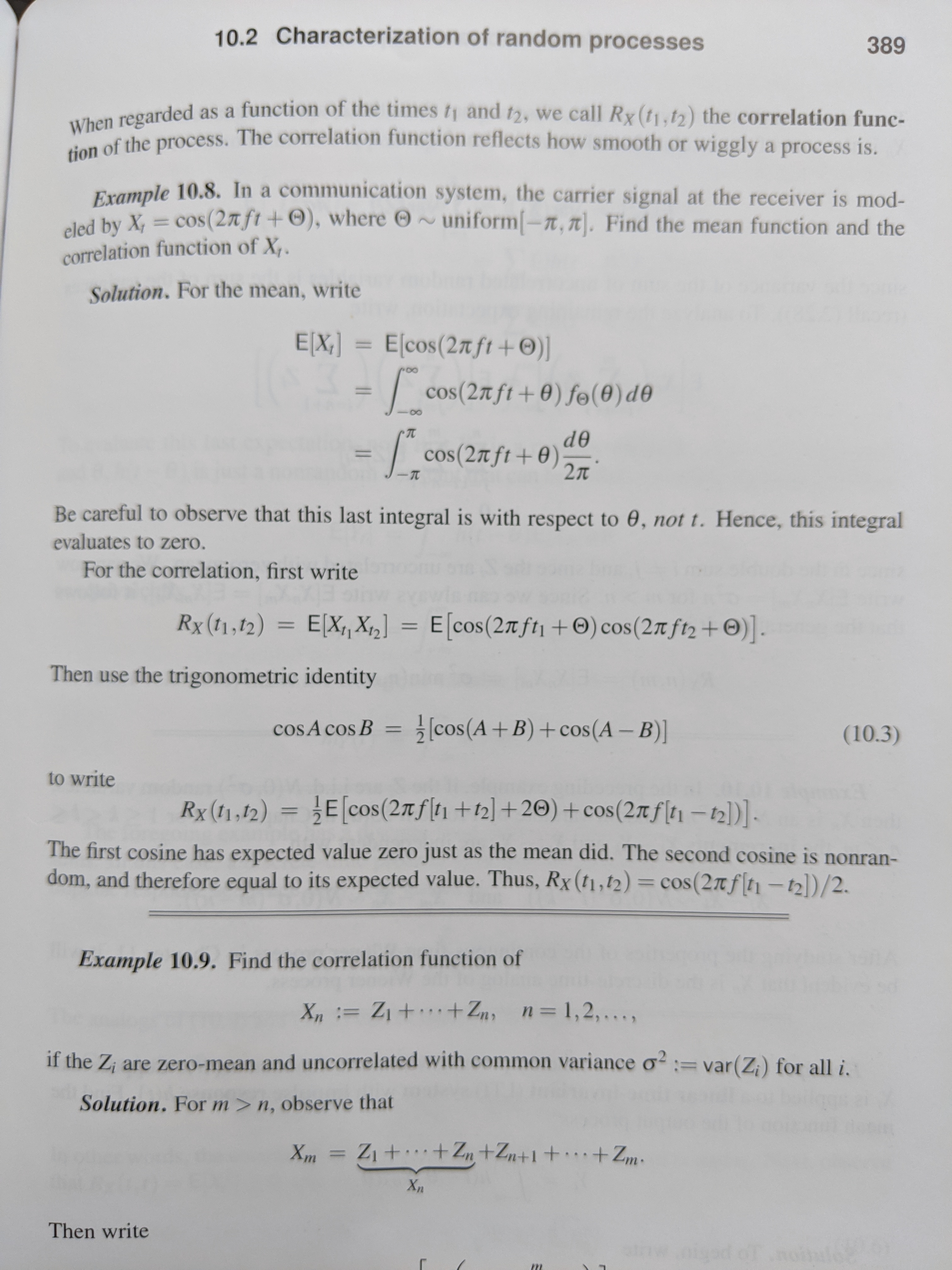
10.2 Characterization of random processes 389 When regarded as a function of the times , and t2, we call Rx (1, t2) the correlation func- tion of the process. The correlation function reflects how smooth or wiggly a process is. Example 10.8. In a communication system, the carrier signal at the receiver is mod- eled by X, = cos(27 ft + @), where @ ~ uniform[-it, it]. Find the mean function and the correlation function of X. Solution. For the mean, write E[X,] = Elcos(27 ft + 0)] = cos ( 2 7: f t + @ ) fo ( 0 ) do = cos ( 2 mift + 0 ) do Be careful to observe that this last integral is with respect to 0, not t. Hence, this integral evaluates to zero. For the correlation, first write Rx (1 1 , 12 ) = E[X,, X/2] = E[cos( 2n ft1 + @) cos(2n ft2 + 0)]. Then use the trigonometric identity COSA COS B = 2 [cos(A + B) + cos(A - B)] (10.3) to write Rx (1 1, 12 ) = E [cos ( 2 7t f [t1 + 12] + 20) + cos(2n f [1 - 12])]. The first cosine has expected value zero just as the mean did. The second cosine is nonran- dom, and therefore equal to its expected value. Thus, Rx (t1, t2) = cos(2n f [t1 - t2]) /2. Example 10.9. Find the correlation function of Xn := Z1+.".+ Zn, n=1,2,.... if the Zi are zero-mean and uncorrelated with common variance o' := var(Zi) for all i. Solution. For m > n, observe that Xm = ZI+ + Zn+ Zen+1 + ... +Zm. Xn Then write
Step by Step Solution
There are 3 Steps involved in it

Get step-by-step solutions from verified subject matter experts
 Study Help