







Question: Can anyone help? For the section 1 is true or false and section 2? Thanks before 1. The machine language target program produced by a
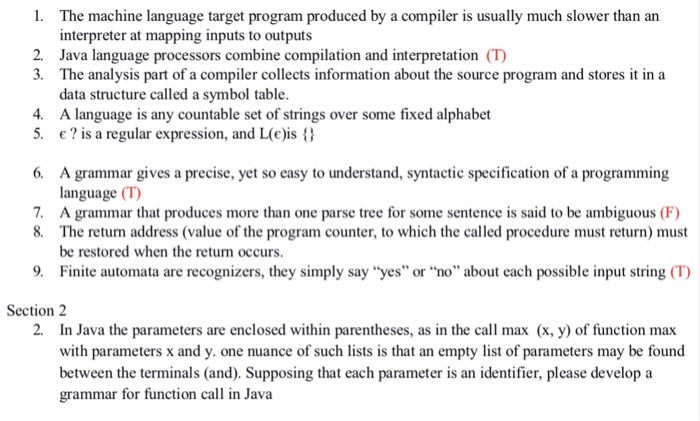
1. The machine language target program produced by a compiler is usually much slower than an interpreter at mapping inputs to outputs 2. Java language processors combine compilation and interpretation (T) 3. The analysis part of a compiler collects information about the source program and stores it in a data structure called a symbol table 4. A language is any countable set of strings over some fixed alphabet 5. e? is a regular expression, and L(e)is 6. A grammar gives a precise, yet so easy to understand, syntactic specification of a programming language (T) 7. A grammar that produces more than one parse tree for some sentence is said to be ambiguous (F) 8. The return address (value of the program counter, to which the called procedure must return) must be restored when the return occurs. Finite automata are recognizers, they simply say "yes" or "no" about each possible input string (T) 9. Section2 2. In Java the parameters are enclosed within parentheses, as in the call max (x, y) of function max with parameters x and y. one nuance of such lists is that an empty list of parameters may be found between the terminals (and). Supposing that each parameter is an identifier, please develop a grammar for function call in Java
Step by Step Solution
There are 3 Steps involved in it

Get step-by-step solutions from verified subject matter experts
 Study Help