







Question: can anyone help me write a assembly code about convolution, i really need the code for reviewing, thanks For this problem, you will implement a
can anyone help me write a assembly code about convolution, i really need the code for reviewing, thanks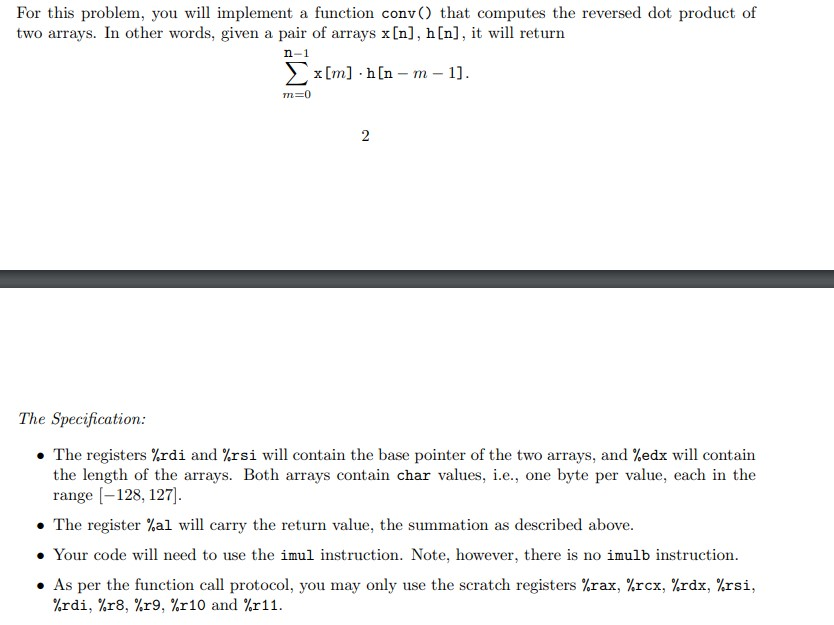
For this problem, you will implement a function conv) that computes the reversed dot product of two arrays. In other words, given a pair of arrays x[n], h[n], it will return n-1 x [m] h [n - m- 1] The Specification . The registers %rdi and %rsi will contain the base pointer of the two arrays, and %eax will contain the length of the arrays. Both arrays contain char values, i.e., one byte per value, each in the range [-128, 127) Your code wil need to use the imul instruction. Note, however, there is no imulb instruction. Zrdi. %r8, %r9, %r10 and %r11 The register %al will carry the return value, the summation as described above As per the function call protocol, you may only use the scratch registers %rax, %rcx, %rax, %rsi, For this problem, you will implement a function conv) that computes the reversed dot product of two arrays. In other words, given a pair of arrays x[n], h[n], it will return n-1 x [m] h [n - m- 1] The Specification . The registers %rdi and %rsi will contain the base pointer of the two arrays, and %eax will contain the length of the arrays. Both arrays contain char values, i.e., one byte per value, each in the range [-128, 127) Your code wil need to use the imul instruction. Note, however, there is no imulb instruction. Zrdi. %r8, %r9, %r10 and %r11 The register %al will carry the return value, the summation as described above As per the function call protocol, you may only use the scratch registers %rax, %rcx, %rax, %rsi
Step by Step Solution
There are 3 Steps involved in it

Get step-by-step solutions from verified subject matter experts
 Study Help