







Question: Can anyone please an elaborated answer for the case studies questions ? I just want to double check if I made right answers. Thank you
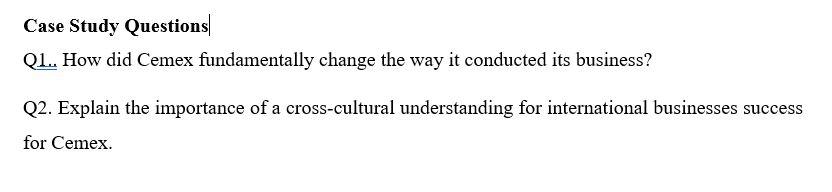
Can anyone please an elaborated answer for the case studies questions ? I just want to double check if I made right answers. Thank you in advance!
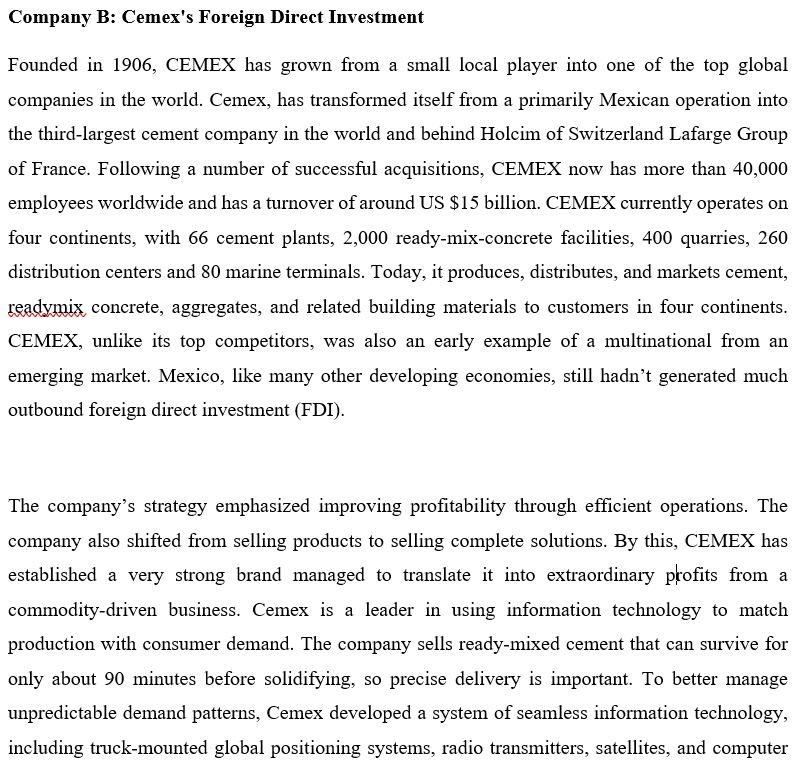
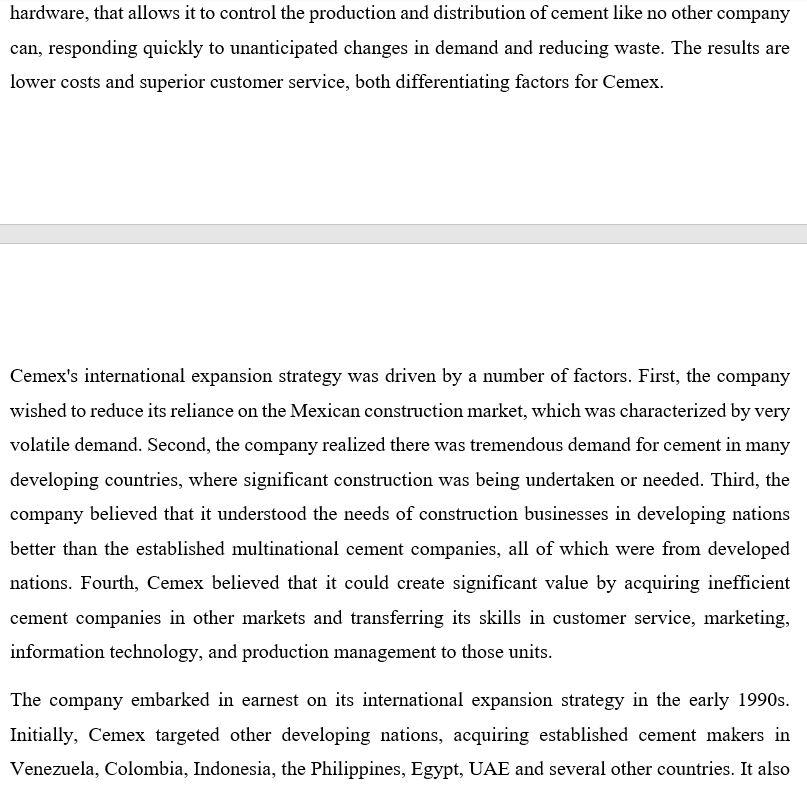
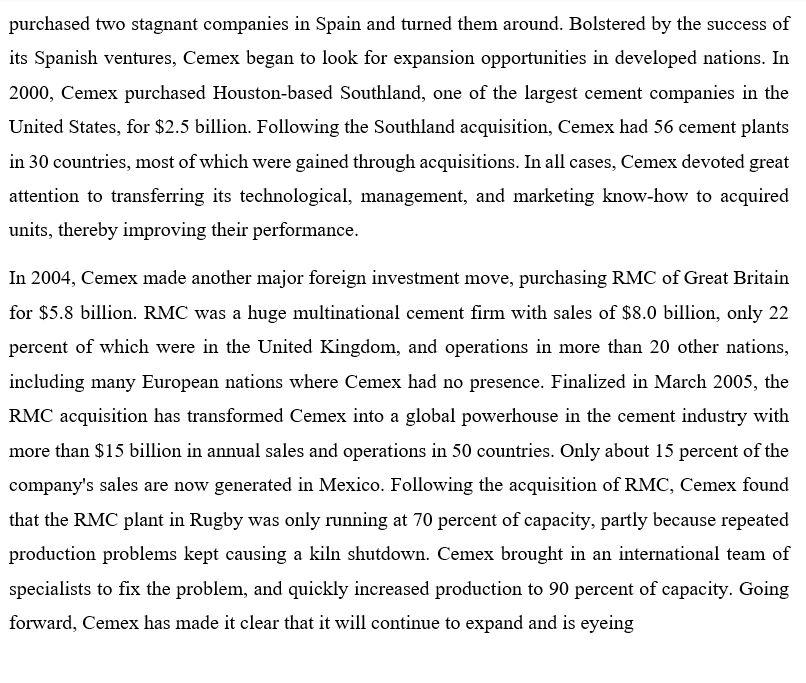
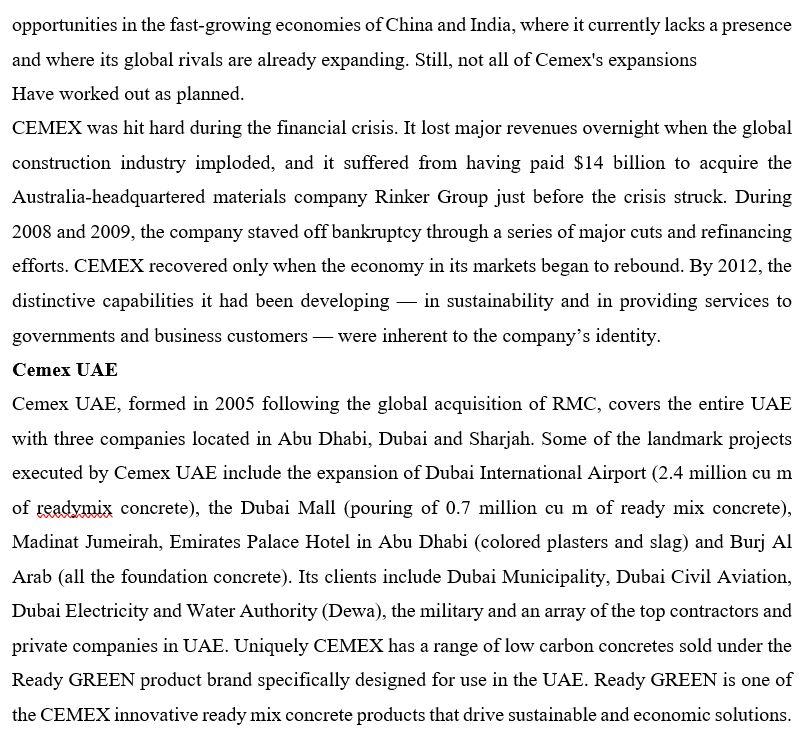
Company B: Cemex's Foreign Direct Investment Founded in 1906, CEMEX has grown from a small local player into one of the top global companies in the world. Cemex, has transformed itself from a primarily Mexican operation into the third-largest cement company in the world and behind Holcim of Switzerland Lafarge Group of France. Following a number of successful acquisitions, CEMEX now has more than 40,000 employees worldwide and has a turnover of around US $15 billion. CEMEX currently operates on four continents, with 66 cement plants, 2,000 ready-mix-concrete facilities, 400 quarries, 260 distribution centers and 80 marine terminals. Today, it produces, distributes, and markets cement, readymix concrete, aggregates, and related building materials to customers in four continents. CEMEX, unlike its top competitors, was also an early example of a multinational from an emerging market. Mexico, like many other developing economies, still hadn't generated much outbound foreign direct investment (FDI). The company's strategy emphasized improving profitability through efficient operations. The company also shifted from selling products to selling complete solutions. By this, CEMEX has established a very strong brand managed to translate it into extraordinary profits from a commodity-driven business. Cemex is a leader in using information technology to match production with consumer demand. The company sells ready-mixed cement that can survive for only about 90 minutes before solidifying, so precise delivery is important. To better manage unpredictable demand patterns, Cemex developed a system of seamless information technology, including truck-mounted global positioning systems, radio transmitters, satellites, and computer hardware, that allows it to control the production and distribution of cement like no other company can, responding quickly to unanticipated changes in demand and reducing waste. The results are lower costs and superior customer service, both differentiating factors for Cemex. Cemex's international expansion strategy was driven by a number of factors. First, the company wished to reduce its reliance on the Mexican construction market, which was characterized by very volatile demand. Second, the company realized there was tremendous demand for cement in many developing countries, where significant construction was being undertaken or needed. Third, the company believed that it understood the needs of construction businesses in developing nations better than the established multinational cement companies, all of which were from developed nations. Fourth, Cemex believed that it could create significant value by acquiring inefficient cement companies in other markets and transferring its skills in customer service, marketing, information technology, and production management to those units. The company embarked in earnest on its international expansion strategy in the early 1990s. Initially, Cemex targeted other developing nations, acquiring established cement makers in Venezuela, Colombia, Indonesia, the Philippines, Egypt, UAE and several other countries. It also purchased two stagnant companies in Spain and turned them around. Bolstered by the success of its Spanish ventures, Cemex began to look for expansion opportunities in developed nations. In 2000, Cemex purchased Houston-based Southland, one of the largest cement companies in the United States, for $2.5 billion. Following the Southland acquisition, Cemex had 56 cement plants in 30 countries, most of which were gained through acquisitions. In all cases, Cemex devoted great attention to transferring its technological, management, and marketing know-how to acquired units, thereby improving their performance. In 2004, Cemex made another major foreign investment move, purchasing RMC of Great Britain for $5.8 billion. RMC was a huge multinational cement firm with sales of $8.0 billion, only 22 percent of which were in the United Kingdom, and operations in more than 20 other nations, including many European nations where Cemex had no presence. Finalized in March 2005, the RMC acquisition has transformed Cemex into a global powerhouse in the cement industry with more than $15 billion in annual sales and operations in 50 countries. Only about 15 percent of the company's sales are now generated in Mexico. Following the acquisition of RMC, Cemex found that the RMC plant in Rugby was only running at 70 percent of capacity, partly because repeated production problems kept causing a kiln shutdown. Cemex brought in an international team of specialists to fix the problem, and quickly increased production to 90 percent of capacity. Going forward, Cemex has made it clear that it will continue to expand and is eyeing opportunities in the fast-growing economies of China and India, where it currently lacks a presence and where its global rivals are already expanding. Still, not all of Cemex's expansions Have worked out as planned. CEMEX was hit hard during the financial crisis. It lost major revenues overnight when the global construction industry imploded, and it suffered from having paid $14 billion to acquire the Australia-headquartered materials company Rinker Group just before the crisis struck. During 2008 and 2009, the company staved off bankruptcy through a series of major cuts and refinancing efforts. CEMEX recovered only when the economy in its markets began to rebound. By 2012, the distinctive capabilities it had been developing in sustainability and in providing services to governments and business customers were inherent to the company's identity. Cemex UAE Cemex UAE, formed in 2005 following the global acquisition of RMC, covers the entire UAE with three companies located in Abu Dhabi, Dubai and Sharjah. Some of the landmark projects executed by Cemex UAE include the expansion of Dubai International Airport (2.4 million cu m of readymix concrete), the Dubai Mall (pouring of 0.7 million cu m of ready mix concrete), Madinat Jumeirah, Emirates Palace Hotel in Abu Dhabi (colored plasters and slag) and Burj Al Arab (all the foundation concrete). Its clients include Dubai Municipality, Dubai Civil Aviation, Dubai Electricity and Water Authority (Dewa), the military and an array of the top contractors and private companies in UAE. Uniquely CEMEX has a range of low carbon concretes sold under the Ready GREEN product brand specifically designed for use in the UAE. Ready GREEN is one of the CEMEX innovative ready mix concrete products that drive sustainable and economic solutions. Case Study Questions Q1. How did Cemex fundamentally change the way it conducted its business? Q2. Explain the importance of a cross-cultural understanding for international businesses success for CemexStep by Step Solution
There are 3 Steps involved in it
1 Expert Approved Answer
Step: 1 Unlock

Question Has Been Solved by an Expert!
Get step-by-step solutions from verified subject matter experts
Step: 2 Unlock
Step: 3 Unlock
 Study Help