







Question: Can expert help me to write (python code) in the following question. if you think this is too long in one question, I can divide
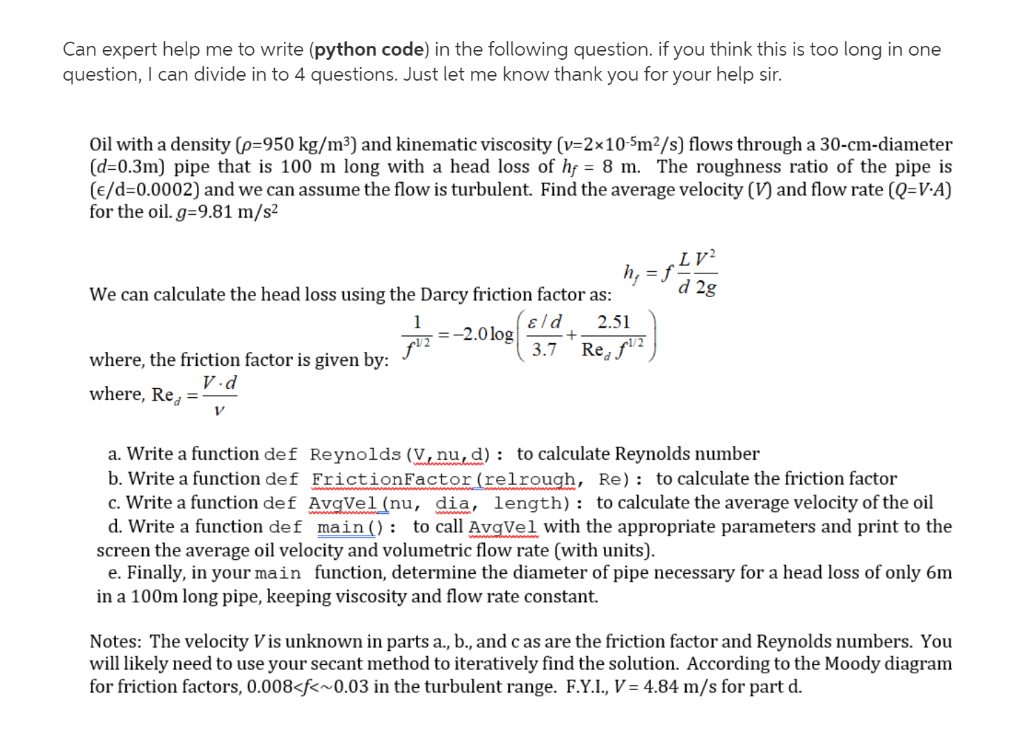
Can expert help me to write (python code) in the following question. if you think this is too long in one question, I can divide in to 4 questions. Just let me know thank you for your help sir. Oil with a density (p=950 kg/m3) and kinematic viscosity (v=2x10⁻⁵m2/s) flows through a 30-cm-diameter (d=0.3m) pipe that is 100 m long with a head loss of hf = 8 m. The roughness ratio of the pipe is (/d=0.0002) and we can assume the flow is turbulent. Find the average velocity (V) and flow rate (Q=V-A) for the oil. g=9.81 m/s2 d 2g .LV hy = f We can calculate the head loss using the Darcy friction factor as: 1 Eld 2.51 = -2.0 log + where, the friction factor is given by: 3.7 Reg fl2 Vid where, Rea = V a. Write a function def Reynolds (V, nu,d): to calculate Reynolds number b. Write a function def FrictionFactor (relrough, Re): to calculate the friction factor c. Write a function def AvgVel (nu, dia, length): to calculate the average velocity of the oil d. Write a function def main(): to call AvgVel with the appropriate parameters and print to the screen the average oil velocity and volumetric flow rate (with units). e. Finally, in your main function, determine the diameter of pipe necessary for a head loss of only 6m in a 100m long pipe, keeping viscosity and flow rate constant. Notes: The velocity Vis unknown in parts a., b., and cas are the friction factor and Reynolds numbers. You will likely need to use your secant method to iteratively find the solution. According to the Moody diagram for friction factors, 0.008
Step by Step Solution
There are 3 Steps involved in it

Get step-by-step solutions from verified subject matter experts
 Study Help