







Question: Can I get the solution for this Quantum Mechanics problem 2.11 from Griffith textbook? Textbook: Introduction to Quantum Mechanics, 2nd edition, by David J. Griffiths
Can I get the solution for this Quantum Mechanics problem 2.11 from Griffith textbook?
Textbook: Introduction to Quantum Mechanics, 2nd edition, by David J. Griffiths (Pearson Prentice Hall, Upper Saddle River, NJ, 2005).
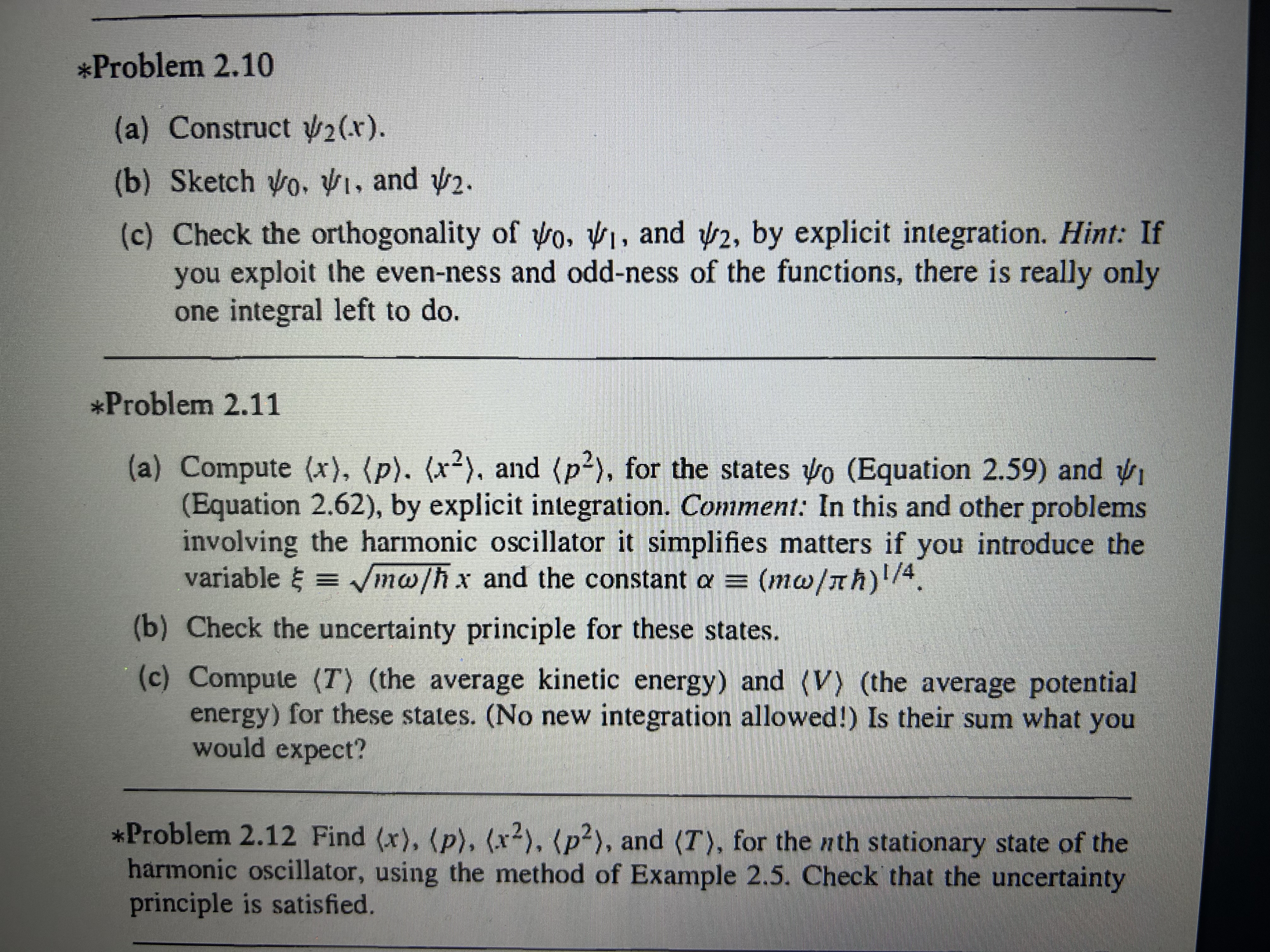
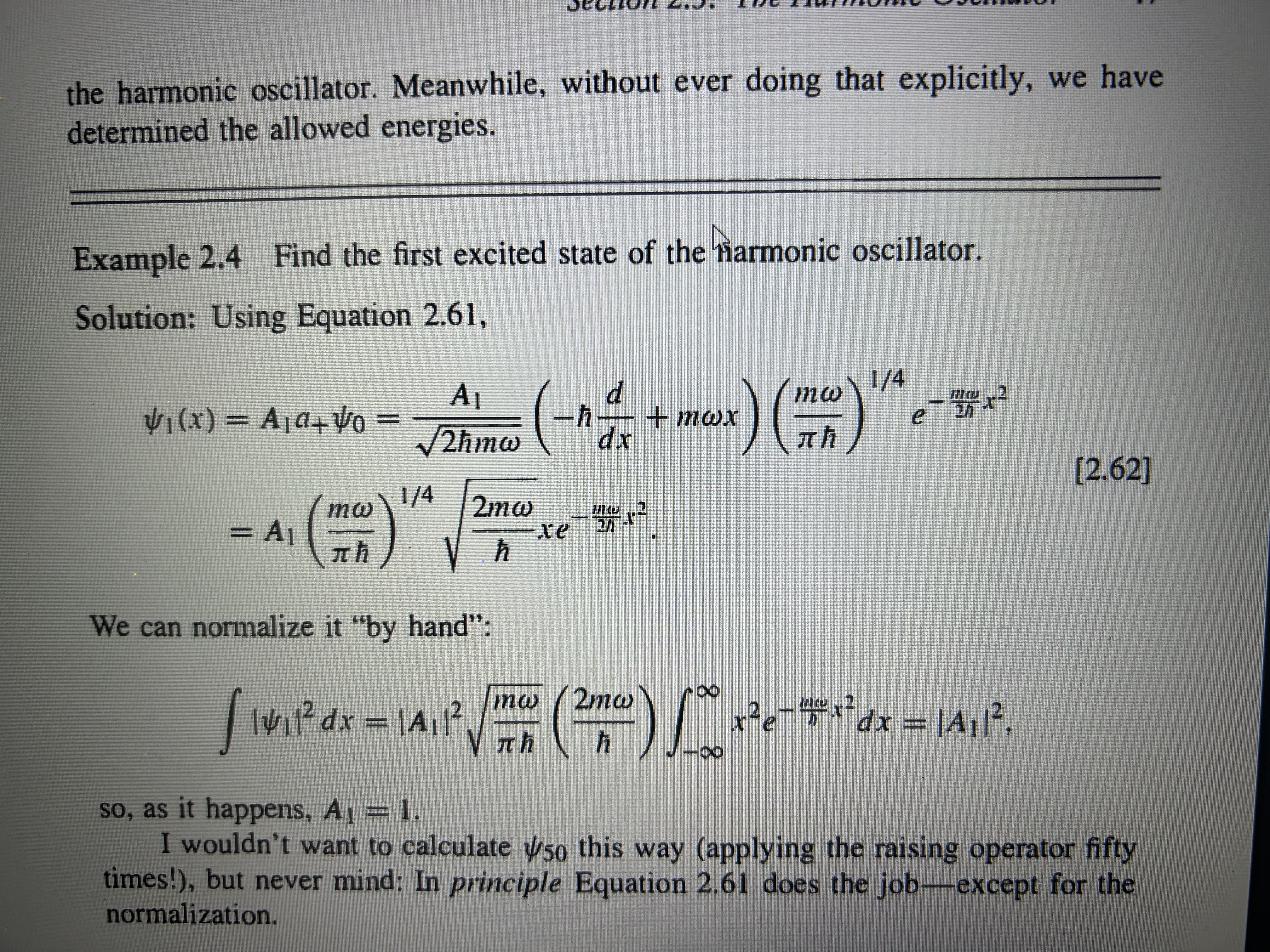
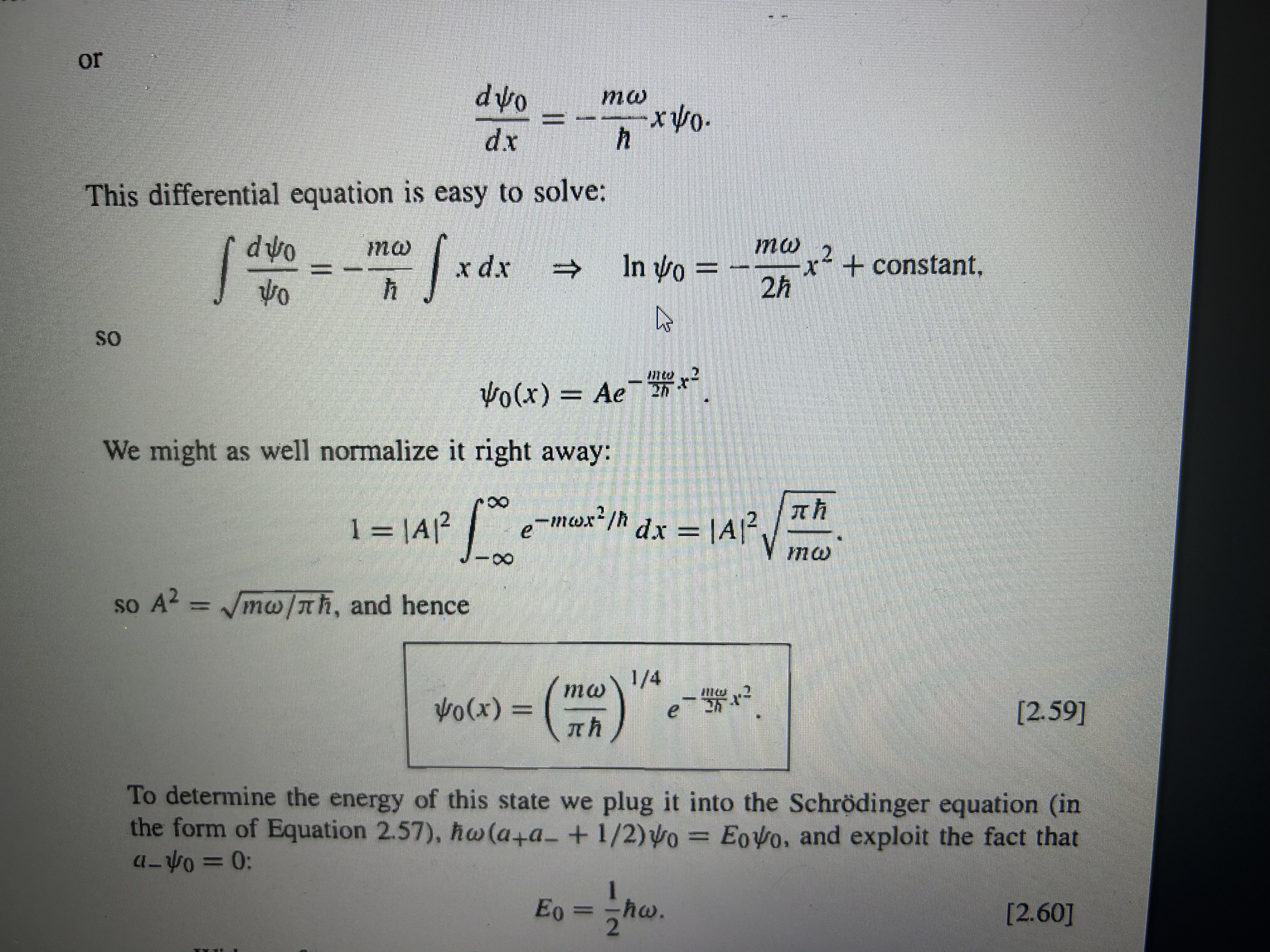
*Problem 2.10 (a) Construct 12(.x). (b) Sketch vo. VI, and v2. (c) Check the orthogonality of vo, vi, and v2, by explicit integration. Hint: If you exploit the even-ness and odd-ness of the functions, there is really only one integral left to do. *Problem 2.11 (a) Compute (x), (p). (x2), and (p=). for the states wo (Equation 2.59) and w1 (Equation 2.62), by explicit integration. Comment: In this and other problems involving the harmonic oscillator it simplifies matters if you introduce the variable & = vmw/h x and the constant a = (mw/ith) 1/4. (b) Check the uncertainty principle for these states. (c) Compute (7) (the average kinetic energy) and (V) (the average potential energy) for these states. (No new integration allowed!) Is their sum what you would expect? *Problem 2.12 Find (x), (p), (x2). (p?), and (T), for the ath stationary state of the harmonic oscillator, using the method of Example 2.5. Check that the uncertainty principle is satisfied.the harmonic oscillator. Meanwhile, without ever doing that explicitly, we have determined the allowed energies. Example 2.4 Find the first excited state of the harmonic oscillator. Solution: Using Equation 2.61, d ma 1/4 VI(x) = Ald+Vo = + max - 2hiw dx It h [2.62] ma\\ 1/4 2m.w = Al We can normalize it "by hand": Inw 2ma I h xen" dx = |All. DO so, as it happens, Al = 1. I wouldn't want to calculate vso this way (applying the raising operator fifty times!), but never mind: In principle Equation 2.61 does the job-except for the normalization.or dwo ma -XVO d.x h This differential equation is easy to solve: duo _ma xdx = In vo = ma 2 -x *+ constant. 2h SO vo(x) = Ae Zhi We might as well normalize it right away: 1 = 1AR e- max / dx = 1Al so As = Vmw/7h, and hence ma 1/4 yo(x) = e - [2.59] To determine the energy of this state we plug it into the Schrodinger equation (in the form of Equation 2.57), hw(a+a_ + 1/2) vo = Eovo, and exploit the fact that a_yo = 0: Eo = -hw. 2 [2.60]
Step by Step Solution
There are 3 Steps involved in it

Get step-by-step solutions from verified subject matter experts
 Study Help