







Question: lab question lab instuction which image because first you said more information and now that the information is provided you said kmavs is not clear.
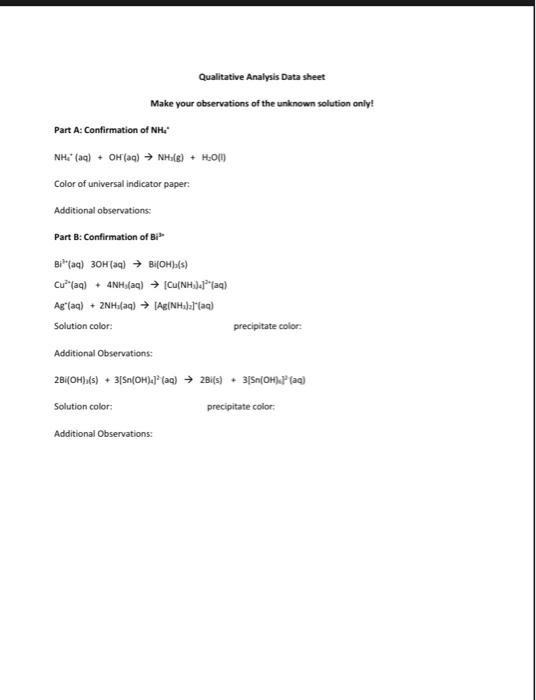
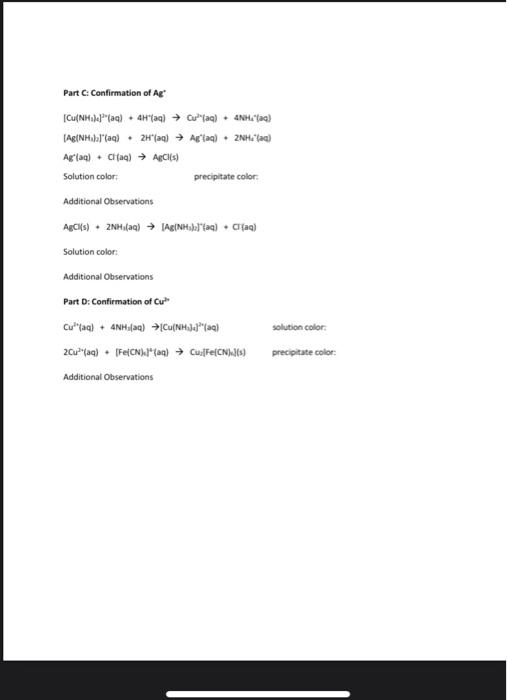
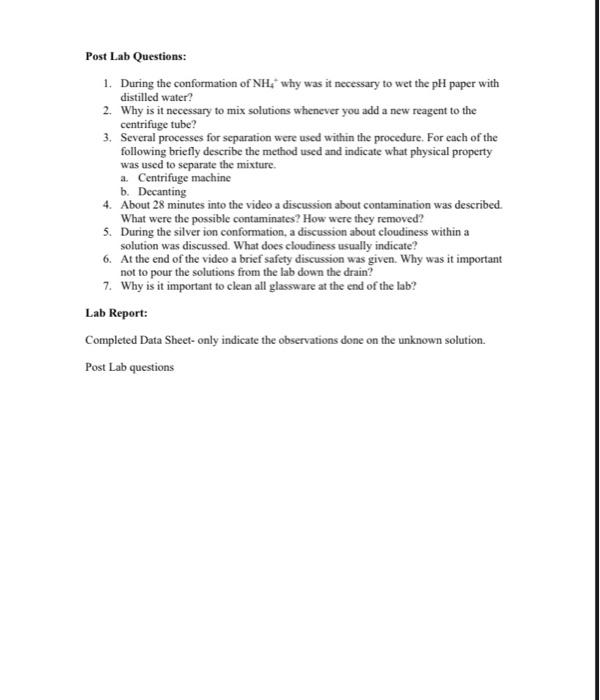
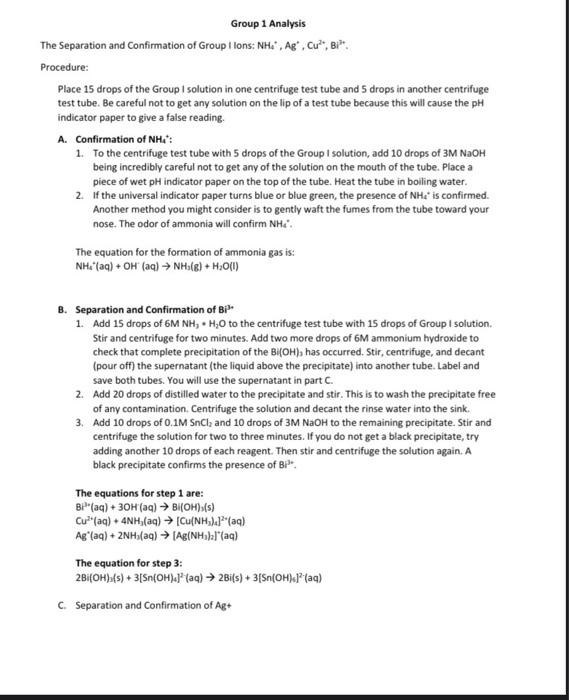
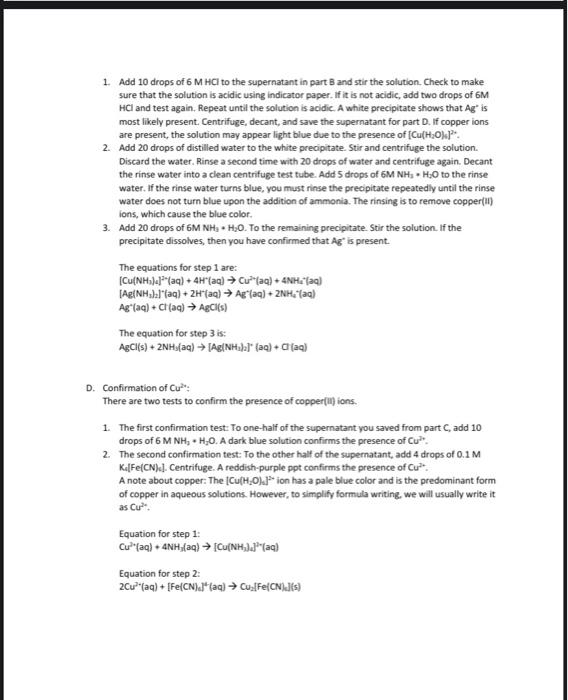
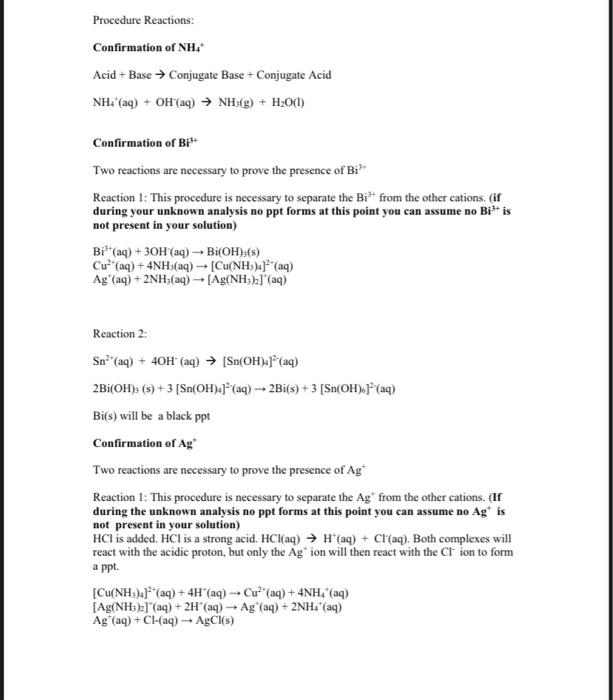
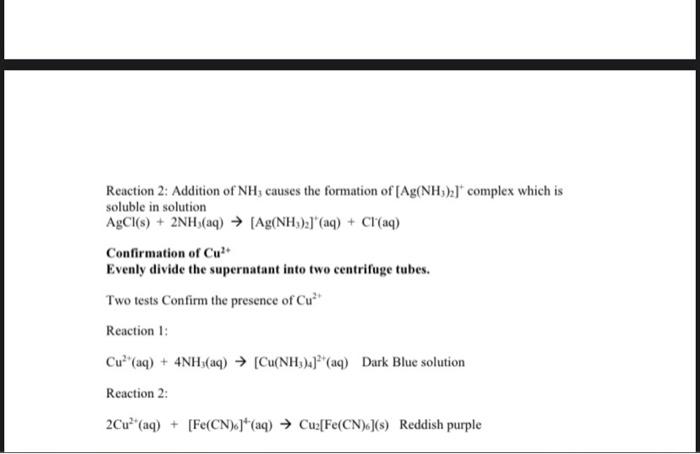
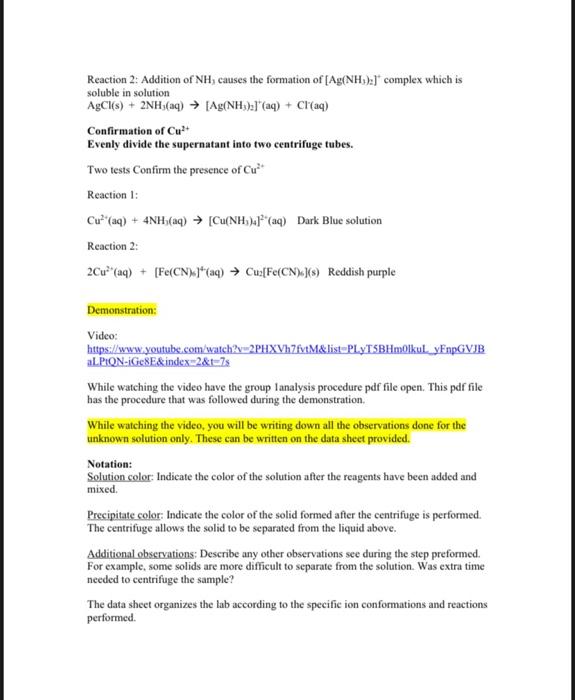
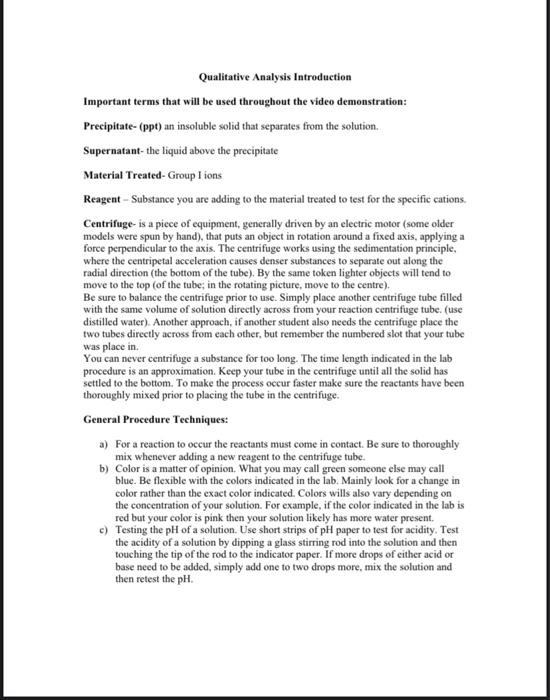
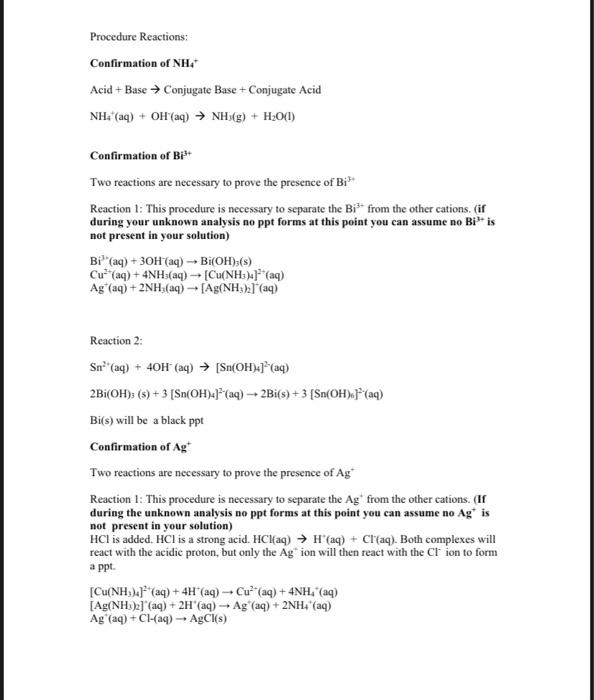
Qualitative Analysis Data sheet Make your observations of the unknown solution only! Part A: Confirmation of NH. NH." (aq) + OH (aq) + NH4(g) + H2O Color of universal indicator paper. Additional observations Part B: Confirmation of Bi Bifaq) 30H(aq) Bi[OH)>(s) c"(aq) + 4NH (aq) + [Cu(NH 3.1(aq) Ag(aq) + 2NH4(aq) + IA (NH)- tag) Solution color: precipitate color: Additional Observations: 2BI(OH)(s) + 3[Sn(OH)? (aq) Bi[s) 3[Sn(OH)2+(aq) Solution color: precipitate color Additional Observations: Part C. Confirmation of All [Cu(NHA) l"(aq) + 4H'(aq) + C" as) NH "tag) [AgNH.ballag) . 2H"faq) Alta). 2NHulaa) Ag'laq) + Cl faq) Agils) Solution color precipitate color Additional Observations AgCl) + 2NH(aq) AINH.l:ltaa) . Cae) Solution color: Additional Observations Part D: Confirmation of Cu Cu"laq) + 4NH(aq) + Cu(Haaa) 20v?"aa) [FeCN)/(aq) Cus[Fe(CN):38) Additional Observations solution color precipitate color: Post Lab Questions: 1. During the conformation of NH," why was it necessary to wet the pH paper with distilled water? 2. Why is it necessary to mix solutions whenever you add a new reagent to the centrifuge tube? 3. Several processes for separation were used within the procedure. For each of the following briefly describe the method used and indicate what physical property was used to separate the mixture a. Centrifuge machine b. Decanting 4. About 28 minutes into the video a discussion about contamination was described. What were the possible contaminates? How were they removed? 5. During the silver ion conformation, a discussion about cloudiness within a solution was discussed. What does cloudiness usually indicate? 6. At the end of the video a brief safety discussion was given. Why was it important not to pour the solutions from the lab down the drain? 7. Why is it important to clean all glassware at the end of the lab? Lab Report: Completed Data Sheet-only indicate the observations done on the unknown solution. Post Lab questions Group 1 Analysis The Separation and Confirmation of Group Ilons: NHA, Ag, Cu?, Procedure: Place 15 drops of the Group 1 solution in one centrifuge test tube and 5 drops in another centrifuge test tube. Be careful not to get any solution on the lip of a test tube because this will cause the pH indicator paper to give a false reading, A. Confirmation of NHA: 1. To the centrifuge test tube with 5 drops of the Group I solution, add 10 drops of 3M NaOH being incredibly careful not to get any of the solution on the mouth of the tube. Place a piece of wet pH indicator paper on the top of the tube. Heat the tube in boiling water. 2. If the universal indicator paper turns blue or blue green, the presence of NHa* is confirmed. Another method you might consider is to gently waft the fumes from the tube toward your nose. The odor of ammonia will confirm NH.. The equation for the formation of ammonia gas is: NHA" (aq) + OH(aq) NH3(g) + H2O(l) 8. Separation and Confirmation of Bi 1. Add 15 drops of 6M NH, H,0 to the centrifuge test tube with 15 drops of Group solution. Stir and centrifuge for two minutes. Add two more drops of 6M ammonium hydroxide to check that complete precipitation of the Bi(OH), has occurred. Stir, centrifuge, and decant (pour off) the supernatant (the liquid above the precipitate) into another tube. Label and save both tubes. You will use the supernatant in part C. 2. Add 20 drops of distilled water to the precipitate and stir. This is to wash the precipitate free of any contamination Centrifuge the solution and decant the rinse water into the sink. 3. Add 10 drops of 0.1M SnCl2 and 10 drops of 3M NaOH to the remaining precipitate. Stir and centrifuge the solution for two to three minutes. If you do not get a black precipitate, try adding another 10 drops of each reagent. Then stir and centrifuge the solution again. A black precipitate confirms the presence of Bp. The equations for step 1 are: BP"(aq) + 3OH(aq) BI(OH),(s) Cu?"(aq) + 4NH, (aq) [Cu(N.) Jaq) Ag"(aq) + 2NH3(aq) [Ag(NH)al"(aq) The equation for step 3: 28.[OH)(s) + 3[Sn(OH) 1" (aq) Bils) + 3Sn(OH)2 (aq) C Separation and Confirmation of Ag+ 1. Add 10 drops of 6 M HCl to the supernatant in part 3 and stir the solution. Check to make sure that the solution is acidic using indicator paper. If it is not acidic, add two drops of 6M HCl and test again, Repeat until the solution is acidic. A white precipitate shows that Ag" is most likely present. Centrifuge, decant, and save the supernatant for part D. If copper ions are present, the solution may appear light blue due to the presence of [Cu(H.01.1. 2. Add 20 drops of distilled water to the white precipitate. Stir and centrifuge the solution. Discard the water. Rinse a second time with 20 drops of water and centrifuge again. Decant the rinse water into a clean centrifuge test tube. Add 5 drops of 6M NHH0 to the tinse water. If the rinse water turns blue, you must rinse the precipitate repeatedly until the rinse water does not turn blue upon the addition of ammonia. The rinsing is to remove copper(11 ions, which cause the blue color. 3. Add 20 drops of 6M NH, H20. To the remaining precipitate. Stir the solution. If the precipitate dissolves, then you have confirmed that Ag" is present. The equations for step 1 are: [Cu(NH3)](aq) + 4H"(aq) Cu?"(aq) + 4He" (aa) [AgNH.))"faq) + 2H(aq) Ag'laq) + 2NH. (24) Ag"(aq) + Cl(aq) AgCl(s) The equation for step 3 is: AgCl(s) + 2NHs(aq) [AgNH.) 14 (20) + (20) D. Confirmation of Cu? There are two tests to confirm the presence of copperu) ions. 1. The first confirmation test: To one-half of the supernatant you saved from partCadd 10 drops of 6M NH, H,0. A dark blue solution confirms the presence of Cuba 2. The second confirmation test: To the other half of the supernatant, add 4 drops of 0.1 M Ke[Fe(CN)]. Centrifuge. A reddish-purple ppt confirms the presence of Cu? A note about copper: The Cu(H.O.Pion has a pale blue color and is the predominant form of copper in aqueous solutions. However, to simplify formula writing, we will usually write it as Cu? Equation for step 1: Cu?"faq) + 4NH, faq) [Cu(NH)"faq) Equation for step 2: 2Cu"(aq) + [Fe(CN)]" (aq) Cus[Fe(CN Jis) Procedure Reactions: Confirmation of NH. Acid + Base Conjugate Base + Conjugate Acid NH:"(aq) + OH(aq) NH3(g) + H:0() Confirmation of Bi- Two reactions are necessary to prove the presence of Bi- Reaction 1: This procedure is necessary to separate the Bit from the other cations. (if during your unknown analysis no ppt forms at this point you can assume no Bip is not present in your solution) Bi" (aq) +30H"(aq) - Bi(OH)3(s) Cu(aq) + 4NH(aq) - [Cu(NH3)(aq) Ag (aq) + 2NH3(aq) - [Ag(NH3)*(aq) Reaction 2: Sn"(aq) + 4OH(aq) [Sn(OH)} (aq) 2Bi(OH): (s) + 3 [Sn(OH)}"(aq) -- 2Bi(s) + 3 [Sn(OH). (aq) Bi(s) will be a black ppt Confirmation of Agt Two reactions are necessary to prove the presence of Ag Reaction 1: This procedure is necessary to separate the Ag from the other cations. (Ir during the unknown analysis no ppt forms at this point you can assume no Agt is not present in your solution) HCI is added. HCI is a strong acid. HCl(aq) H(aq) + Cl(aq). Both complexes will react with the acidic proton, but only the Agion will then react with the Cr ion to form a ppt. [Cu(NH3).F"(aq) + 4H"(aq) - Cu?" (aq) + 4NH. (aq) [Ag(NH: ))" (aq) + 2H+ (aq) - Ag (aq) + 2NH:"(aq) Ag (aq) + CH-(aq) AgCl(s) Reaction 2: Addition of NH; causes the formation of [Ag(NH3)2] complex which is soluble in solution AgCl(s) + 2NH3(aq) (Ag(NH3)2)"(aq) + Cl'(aq) Confirmation of Cult Evenly divide the supernatant into two centrifuge tubes. Two tests Confirm the presence of Cu?" Reaction 1: Cu?"(aq) + 4NH3(aq) [Cu(NH3).]"(aq) Dark Blue solution Reaction 2: 2Cu?"(aq) + [Fe(CN).]*(aq) Cu2[Fe(CN)]() Reddish purple Reaction 2: Addition of NH, causes the formation of [Ag(NH) complex which is soluble in solution AgCl(s) + 2NH3(aq) Ag(NH)" (aq) + Cl(aq) Confirmation of Cu? Evenly divide the supernatant into two centrifuge tubes. Two tests Confirm the presence of Cr* Reaction : Cu?"(aq) + 4NH (aq) [Cu(NH).1(aq) Dark Blue solution Reaction 2: 2Cu" (aq) + [Fe(CN).]" (aq) Cuz[Fe(CN).JS) Reddish purple Demonstration: Video: https://www.youtube.com/watch?v=2PHXVh7fvtM&list=PLyT5BHmOlkulyFnpGVJB aLPON-Gc8E&index=2&t=7s While watching the video have the group lanalysis procedure pdf file open. This pdf file has the procedure that was followed during the demonstration, While watching the video, you will be writing down all the observations done for the unknown solution only. These can be written on the data sheet provided. Notation: Solution color: Indicate the color of the solution after the reagents have been added and mixed. Precipitate color: Indicate the color of the solid formed after the centrifuge is performed. The centrifuge allows the solid to be separated from the liquid above. Additional observations: Describe any other observations see during the step preformed. For example, some solids are more difficult to separate from the solution. Was extra time needed to centrifuge the sample? The data sheet organizes the lab according to the specific ion conformations and reactions performed Qualitative Analysis Introduction Important terms that will be used throughout the video demonstration: Precipitate- (ppt) an insoluble solid that separates from the solution, Supernatant- the liquid above the precipitate Material Treated-Group lions Reagent - Substance you are adding to the material treated to test for the specific cations. Centrifuge- is a piece of equipment, generally driven by an electric motor (some older models were spun by hand), that puts an object in rotation around a fixed axis, applying a force perpendicular to the axis. The centrifuge works using the sedimentation principle, where the centripetal acceleration causes denser substances to separate out along the radial direction (the bottom of the tube). By the same token lighter objects will tend to move to the top of the tube in the rotating picture, move to the centre). Be sure to balance the centrifuge prior to use. Simply place another centrifuge tube filled with the same volume of solution directly across from your reaction centrifuge tube. (use distilled water). Another approach, if another student also needs the centrifuge place the two tubes directly across from each other, but remember the numbered slot that your tube was place in You can never centrifuge a substance for too long. The time length indicated in the lab procedure is an approximation. Keep your tube in the centrifuge until all the solid has settled to the bottom. To make the process occur faster make sure the reactants have been thoroughly mixed prior to placing the tube in the centrifuge General Procedure Techniques: a) For a reaction to occur the reactants must come in contact. Be sure to thoroughly mix whenever adding a new reagent to the centrifuge tube b) Color is a matter of opinion. What you may call green someone else may call blue. Be flexible with the colors indicated in the lab. Mainly look for a change in color rather than the exact color indicated. Colors will also vary depending on the concentration of your solution. For example, if the color indicated in the lab is red but your color is pink then your solution likely has more water present. c) Testing the pH of a solution. Use short strips of pH paper to test for acidity. Test the acidity of a solution by dipping a glass stirring rod into the solution and then touching the tip of the rod to the indicator paper. If more drops of either acid or base need to be added, simply add one to two drops more, mix the solution and then retest the pH Procedure Reactions: Confirmation of NHA Acid + Base Conjugate Base + Conjugate Acid NH:"(aq) + OH"(aq) NH3(g) + H2O(1) Confirmation of Bi- Two reactions are necessary to prove the presence of Bi Reaction 1: This procedure is necessary to separate the Bit from the other cations. (if during your unknown analysis no ppt forms at this point you can assume no Bit is not present in your solution) Bi(aq) + 3OH(aq) - Bi(OH)() Cu" (aq) + 4NH3(aq) -- [Cu(NH)F"(aq) Ag (aq) + 2NH3(aq) + [Ag(NH3)2(aq) Reaction 2: Sn" (aq) + 4OH" (aq) [Sn(OH)4]+" (aq) 2Bi(OH); (s) +3 (Sn(OH)4](aq) +2Bi(s) +3 (Sn(OH)} (aq) Bi(s) will be a black ppt Confirmation of Ag Two reactions are necessary to prove the presence of Ag* Reaction 1: This procedure is necessary to separate the Ag from the other cations. (If during the unknown analysis no ppt forms at this point you can assume no Agt is not present in your solution) HC is added. HCI is a strong acid. HCl(aq) H(aq) + Cl(aq). Both complexes will react with the acidic proton, but only the Ag ion will then react with the ction to form a ppt. [Cu(NH3)-f(aq) + 4H*(aq) - Cu" (aq) + 4NH." (aq) [Ag(NH)2]" (aq) + 2H" (aq) - Ag (aq) + 2NH:"(aq) Ag" (aq) + CH-(aq) -- AgCl(s) Qualitative Analysis Data sheet Make your observations of the unknown solution only! Part A: Confirmation of NH. NH." (aq) + OH (aq) + NH4(g) + H2O Color of universal indicator paper. Additional observations Part B: Confirmation of Bi Bifaq) 30H(aq) Bi[OH)>(s) c"(aq) + 4NH (aq) + [Cu(NH 3.1(aq) Ag(aq) + 2NH4(aq) + IA (NH)- tag) Solution color: precipitate color: Additional Observations: 2BI(OH)(s) + 3[Sn(OH)? (aq) Bi[s) 3[Sn(OH)2+(aq) Solution color: precipitate color Additional Observations: Part C. Confirmation of All [Cu(NHA) l"(aq) + 4H'(aq) + C" as) NH "tag) [AgNH.ballag) . 2H"faq) Alta). 2NHulaa) Ag'laq) + Cl faq) Agils) Solution color precipitate color Additional Observations AgCl) + 2NH(aq) AINH.l:ltaa) . Cae) Solution color: Additional Observations Part D: Confirmation of Cu Cu"laq) + 4NH(aq) + Cu(Haaa) 20v?"aa) [FeCN)/(aq) Cus[Fe(CN):38) Additional Observations solution color precipitate color: Post Lab Questions: 1. During the conformation of NH," why was it necessary to wet the pH paper with distilled water? 2. Why is it necessary to mix solutions whenever you add a new reagent to the centrifuge tube? 3. Several processes for separation were used within the procedure. For each of the following briefly describe the method used and indicate what physical property was used to separate the mixture a. Centrifuge machine b. Decanting 4. About 28 minutes into the video a discussion about contamination was described. What were the possible contaminates? How were they removed? 5. During the silver ion conformation, a discussion about cloudiness within a solution was discussed. What does cloudiness usually indicate? 6. At the end of the video a brief safety discussion was given. Why was it important not to pour the solutions from the lab down the drain? 7. Why is it important to clean all glassware at the end of the lab? Lab Report: Completed Data Sheet-only indicate the observations done on the unknown solution. Post Lab questions Group 1 Analysis The Separation and Confirmation of Group Ilons: NHA, Ag, Cu?, Procedure: Place 15 drops of the Group 1 solution in one centrifuge test tube and 5 drops in another centrifuge test tube. Be careful not to get any solution on the lip of a test tube because this will cause the pH indicator paper to give a false reading, A. Confirmation of NHA: 1. To the centrifuge test tube with 5 drops of the Group I solution, add 10 drops of 3M NaOH being incredibly careful not to get any of the solution on the mouth of the tube. Place a piece of wet pH indicator paper on the top of the tube. Heat the tube in boiling water. 2. If the universal indicator paper turns blue or blue green, the presence of NHa* is confirmed. Another method you might consider is to gently waft the fumes from the tube toward your nose. The odor of ammonia will confirm NH.. The equation for the formation of ammonia gas is: NHA" (aq) + OH(aq) NH3(g) + H2O(l) 8. Separation and Confirmation of Bi 1. Add 15 drops of 6M NH, H,0 to the centrifuge test tube with 15 drops of Group solution. Stir and centrifuge for two minutes. Add two more drops of 6M ammonium hydroxide to check that complete precipitation of the Bi(OH), has occurred. Stir, centrifuge, and decant (pour off) the supernatant (the liquid above the precipitate) into another tube. Label and save both tubes. You will use the supernatant in part C. 2. Add 20 drops of distilled water to the precipitate and stir. This is to wash the precipitate free of any contamination Centrifuge the solution and decant the rinse water into the sink. 3. Add 10 drops of 0.1M SnCl2 and 10 drops of 3M NaOH to the remaining precipitate. Stir and centrifuge the solution for two to three minutes. If you do not get a black precipitate, try adding another 10 drops of each reagent. Then stir and centrifuge the solution again. A black precipitate confirms the presence of Bp. The equations for step 1 are: BP"(aq) + 3OH(aq) BI(OH),(s) Cu?"(aq) + 4NH, (aq) [Cu(N.) Jaq) Ag"(aq) + 2NH3(aq) [Ag(NH)al"(aq) The equation for step 3: 28.[OH)(s) + 3[Sn(OH) 1" (aq) Bils) + 3Sn(OH)2 (aq) C Separation and Confirmation of Ag+ 1. Add 10 drops of 6 M HCl to the supernatant in part 3 and stir the solution. Check to make sure that the solution is acidic using indicator paper. If it is not acidic, add two drops of 6M HCl and test again, Repeat until the solution is acidic. A white precipitate shows that Ag" is most likely present. Centrifuge, decant, and save the supernatant for part D. If copper ions are present, the solution may appear light blue due to the presence of [Cu(H.01.1. 2. Add 20 drops of distilled water to the white precipitate. Stir and centrifuge the solution. Discard the water. Rinse a second time with 20 drops of water and centrifuge again. Decant the rinse water into a clean centrifuge test tube. Add 5 drops of 6M NHH0 to the tinse water. If the rinse water turns blue, you must rinse the precipitate repeatedly until the rinse water does not turn blue upon the addition of ammonia. The rinsing is to remove copper(11 ions, which cause the blue color. 3. Add 20 drops of 6M NH, H20. To the remaining precipitate. Stir the solution. If the precipitate dissolves, then you have confirmed that Ag" is present. The equations for step 1 are: [Cu(NH3)](aq) + 4H"(aq) Cu?"(aq) + 4He" (aa) [AgNH.))"faq) + 2H(aq) Ag'laq) + 2NH. (24) Ag"(aq) + Cl(aq) AgCl(s) The equation for step 3 is: AgCl(s) + 2NHs(aq) [AgNH.) 14 (20) + (20) D. Confirmation of Cu? There are two tests to confirm the presence of copperu) ions. 1. The first confirmation test: To one-half of the supernatant you saved from partCadd 10 drops of 6M NH, H,0. A dark blue solution confirms the presence of Cuba 2. The second confirmation test: To the other half of the supernatant, add 4 drops of 0.1 M Ke[Fe(CN)]. Centrifuge. A reddish-purple ppt confirms the presence of Cu? A note about copper: The Cu(H.O.Pion has a pale blue color and is the predominant form of copper in aqueous solutions. However, to simplify formula writing, we will usually write it as Cu? Equation for step 1: Cu?"faq) + 4NH, faq) [Cu(NH)"faq) Equation for step 2: 2Cu"(aq) + [Fe(CN)]" (aq) Cus[Fe(CN Jis) Procedure Reactions: Confirmation of NH. Acid + Base Conjugate Base + Conjugate Acid NH:"(aq) + OH(aq) NH3(g) + H:0() Confirmation of Bi- Two reactions are necessary to prove the presence of Bi- Reaction 1: This procedure is necessary to separate the Bit from the other cations. (if during your unknown analysis no ppt forms at this point you can assume no Bip is not present in your solution) Bi" (aq) +30H"(aq) - Bi(OH)3(s) Cu(aq) + 4NH(aq) - [Cu(NH3)(aq) Ag (aq) + 2NH3(aq) - [Ag(NH3)*(aq) Reaction 2: Sn"(aq) + 4OH(aq) [Sn(OH)} (aq) 2Bi(OH): (s) + 3 [Sn(OH)}"(aq) -- 2Bi(s) + 3 [Sn(OH). (aq) Bi(s) will be a black ppt Confirmation of Agt Two reactions are necessary to prove the presence of Ag Reaction 1: This procedure is necessary to separate the Ag from the other cations. (Ir during the unknown analysis no ppt forms at this point you can assume no Agt is not present in your solution) HCI is added. HCI is a strong acid. HCl(aq) H(aq) + Cl(aq). Both complexes will react with the acidic proton, but only the Agion will then react with the Cr ion to form a ppt. [Cu(NH3).F"(aq) + 4H"(aq) - Cu?" (aq) + 4NH. (aq) [Ag(NH: ))" (aq) + 2H+ (aq) - Ag (aq) + 2NH:"(aq) Ag (aq) + CH-(aq) AgCl(s) Reaction 2: Addition of NH; causes the formation of [Ag(NH3)2] complex which is soluble in solution AgCl(s) + 2NH3(aq) (Ag(NH3)2)"(aq) + Cl'(aq) Confirmation of Cult Evenly divide the supernatant into two centrifuge tubes. Two tests Confirm the presence of Cu?" Reaction 1: Cu?"(aq) + 4NH3(aq) [Cu(NH3).]"(aq) Dark Blue solution Reaction 2: 2Cu?"(aq) + [Fe(CN).]*(aq) Cu2[Fe(CN)]() Reddish purple Reaction 2: Addition of NH, causes the formation of [Ag(NH) complex which is soluble in solution AgCl(s) + 2NH3(aq) Ag(NH)" (aq) + Cl(aq) Confirmation of Cu? Evenly divide the supernatant into two centrifuge tubes. Two tests Confirm the presence of Cr* Reaction : Cu?"(aq) + 4NH (aq) [Cu(NH).1(aq) Dark Blue solution Reaction 2: 2Cu" (aq) + [Fe(CN).]" (aq) Cuz[Fe(CN).JS) Reddish purple Demonstration: Video: https://www.youtube.com/watch?v=2PHXVh7fvtM&list=PLyT5BHmOlkulyFnpGVJB aLPON-Gc8E&index=2&t=7s While watching the video have the group lanalysis procedure pdf file open. This pdf file has the procedure that was followed during the demonstration, While watching the video, you will be writing down all the observations done for the unknown solution only. These can be written on the data sheet provided. Notation: Solution color: Indicate the color of the solution after the reagents have been added and mixed. Precipitate color: Indicate the color of the solid formed after the centrifuge is performed. The centrifuge allows the solid to be separated from the liquid above. Additional observations: Describe any other observations see during the step preformed. For example, some solids are more difficult to separate from the solution. Was extra time needed to centrifuge the sample? The data sheet organizes the lab according to the specific ion conformations and reactions performed Qualitative Analysis Introduction Important terms that will be used throughout the video demonstration: Precipitate- (ppt) an insoluble solid that separates from the solution, Supernatant- the liquid above the precipitate Material Treated-Group lions Reagent - Substance you are adding to the material treated to test for the specific cations. Centrifuge- is a piece of equipment, generally driven by an electric motor (some older models were spun by hand), that puts an object in rotation around a fixed axis, applying a force perpendicular to the axis. The centrifuge works using the sedimentation principle, where the centripetal acceleration causes denser substances to separate out along the radial direction (the bottom of the tube). By the same token lighter objects will tend to move to the top of the tube in the rotating picture, move to the centre). Be sure to balance the centrifuge prior to use. Simply place another centrifuge tube filled with the same volume of solution directly across from your reaction centrifuge tube. (use distilled water). Another approach, if another student also needs the centrifuge place the two tubes directly across from each other, but remember the numbered slot that your tube was place in You can never centrifuge a substance for too long. The time length indicated in the lab procedure is an approximation. Keep your tube in the centrifuge until all the solid has settled to the bottom. To make the process occur faster make sure the reactants have been thoroughly mixed prior to placing the tube in the centrifuge General Procedure Techniques: a) For a reaction to occur the reactants must come in contact. Be sure to thoroughly mix whenever adding a new reagent to the centrifuge tube b) Color is a matter of opinion. What you may call green someone else may call blue. Be flexible with the colors indicated in the lab. Mainly look for a change in color rather than the exact color indicated. Colors will also vary depending on the concentration of your solution. For example, if the color indicated in the lab is red but your color is pink then your solution likely has more water present. c) Testing the pH of a solution. Use short strips of pH paper to test for acidity. Test the acidity of a solution by dipping a glass stirring rod into the solution and then touching the tip of the rod to the indicator paper. If more drops of either acid or base need to be added, simply add one to two drops more, mix the solution and then retest the pH Procedure Reactions: Confirmation of NHA Acid + Base Conjugate Base + Conjugate Acid NH:"(aq) + OH"(aq) NH3(g) + H2O(1) Confirmation of Bi- Two reactions are necessary to prove the presence of Bi Reaction 1: This procedure is necessary to separate the Bit from the other cations. (if during your unknown analysis no ppt forms at this point you can assume no Bit is not present in your solution) Bi(aq) + 3OH(aq) - Bi(OH)() Cu" (aq) + 4NH3(aq) -- [Cu(NH)F"(aq) Ag (aq) + 2NH3(aq) + [Ag(NH3)2(aq) Reaction 2: Sn" (aq) + 4OH" (aq) [Sn(OH)4]+" (aq) 2Bi(OH); (s) +3 (Sn(OH)4](aq) +2Bi(s) +3 (Sn(OH)} (aq) Bi(s) will be a black ppt Confirmation of Ag Two reactions are necessary to prove the presence of Ag* Reaction 1: This procedure is necessary to separate the Ag from the other cations. (If during the unknown analysis no ppt forms at this point you can assume no Agt is not present in your solution) HC is added. HCI is a strong acid. HCl(aq) H(aq) + Cl(aq). Both complexes will react with the acidic proton, but only the Ag ion will then react with the ction to form a ppt. [Cu(NH3)-f(aq) + 4H*(aq) - Cu" (aq) + 4NH." (aq) [Ag(NH)2]" (aq) + 2H" (aq) - Ag (aq) + 2NH:"(aq) Ag" (aq) + CH-(aq) -- AgCl(s)
Step by Step Solution
There are 3 Steps involved in it

Get step-by-step solutions from verified subject matter experts
 Study Help