







Question: can i please get help with question 4 Case 6 Ten percent of the customers would take advantage of the 1 percent discount by paying
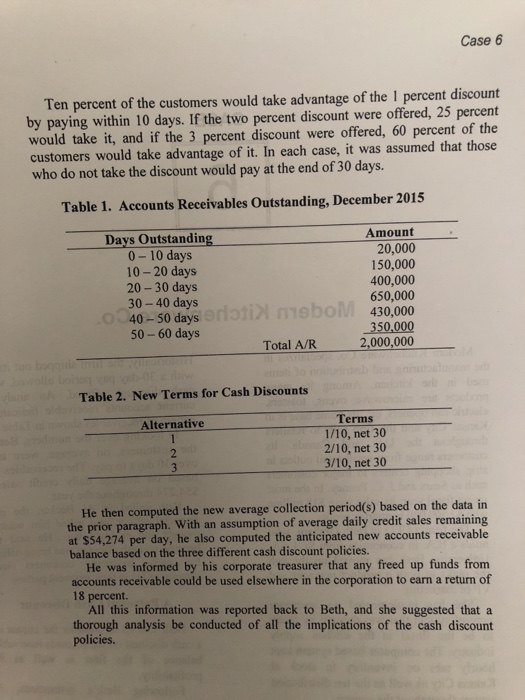
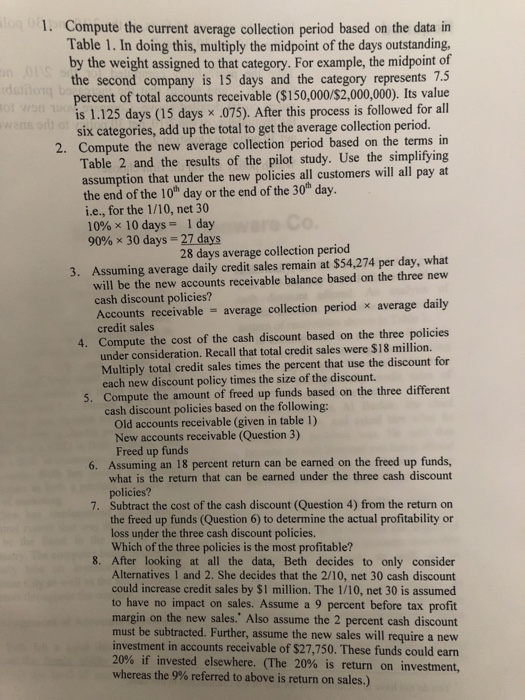
Case 6 Ten percent of the customers would take advantage of the 1 percent discount by paying within 10 days. If the two percent discount were offered, 25 percent would take it, and if the 3 percent discount were offered, 60 percent of the customers would take advantage of it. In each case, it was assumed that those who do not take the discount would pay at the end of 30 days. Table 1. Accounts Receivables Outstanding, December 2015 Days Outstanding 0-10 days 10-20 days 20-30 days 30-40 days 40-50 days 50- 60 days Amount 20,000 150,000 400,000 650,000 430,000 350,000 2,000,000 Total A/R Table 2. New Terms for Cash Discounts Terms 1/10, net 30 2/10, net 30 3/10, net 30 Alternative He then computed the new average collection period(s) based on the data in the prior paragraph. With an assumption of average daily credit sales remaining at $54,274 per day, he also computed the anticipated new accounts receivable balance based on the three different cash discount policies. He was informed by his corporate treasurer that any freed up funds from accounts receivable could be used elsewhere in the corporation to earn a return of 18 percent. All this information was reported back to Beth, and she suggested that a thorough analysis be conducted of all the implications of the cash discount policies. Compute the current average collection period based on the data in Table 1. In doing this, multiply the midpoint of the days outstanding, by the weight assigned to that category. For example, the midpoint of the second company is 15 days and the category represents 7.5 percent of total accounts receivable ($150,000/$2,000,000). Its value is 1.125 days (15 days x .075). After this process is followed for all ds six categories, add up the total to get the average collection period. 2. Compute the new average collection period based on the terms in Table 2 and the results of the pilot study. Use the simplifying assumption that under the new policies all customers will all pay at the end of the 10h day or the end of the 30h day. i.e., for the 1/10, net 30 10% x 10 days- 1 day 90% x 30 days 27 days 28 days average collection period Assuming average daily credit sales remain at $54,274 per day, what 3. will be the new accounts receivable balance based on the three nevw Accounts receivable average collection period average daily 4. Compute the cost of the cash discount based on the three policies Multiply total credit sales times the percent that use the discount for 5. Compute the amount of freed up funds based on the three different cash discount policies? credit sales under consideration. Recall that total credit sales were $18 million. each new discount policy times the size of the discount. cash discount policies based on the following: Old accounts receivable (given in table 1) New accounts receivable (Question 3) Freed up funds 6. Assuming an 18 percent return can be earned on the freed up funds what is the return that can be earned under the three cash discount policies? 7. Subtract the cost of the cash discount (Question 4) from the return on the freed up funds (Question 6) to determine the actual profitability or loss under the three cash discount policies. Which of the three policies is the most profitable? 8. After looking at all the data, Beth decides to only consider Alternatives 1 and 2. She decides that the 2/10, net 30 cash discount to have no impact on sales. Assume a 9 percent before tax profit margin on the new sales. Also assume the 2 percent cash discount must be subtracted. Further, assume the new sales will require a new investment in accounts receivable of $27,750. These funds could earn 20% if invested elsewhere. (The 20% is return on investment, whereas the 9% referred to above is return on sales.)
Step by Step Solution
There are 3 Steps involved in it

Get step-by-step solutions from verified subject matter experts
 Study Help