







Question: can some one help do this i have 30 mins to take this. i cant seem to get the answers right. posted at 10:26pm. View
can some one help do this i have 30 mins to take this. i cant seem to get the answers right. posted at 10:26pm.
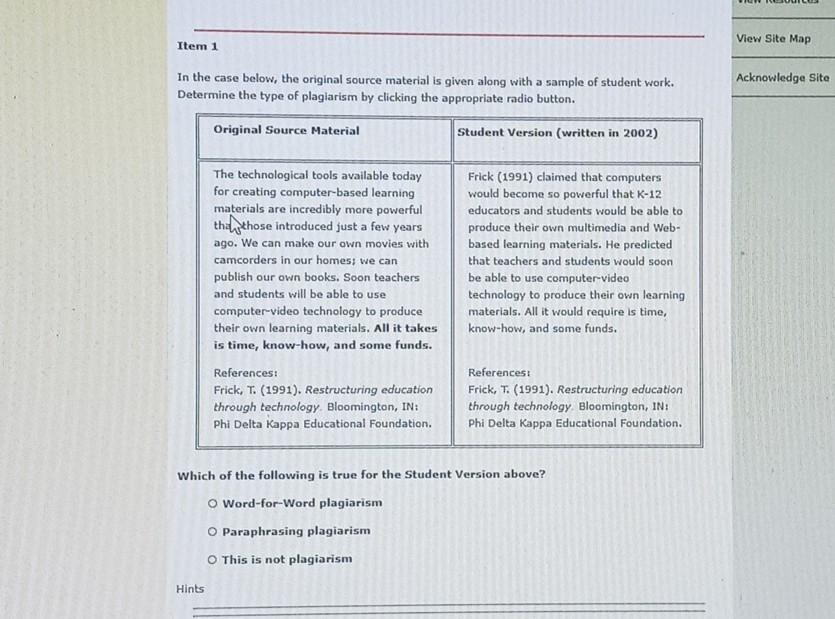
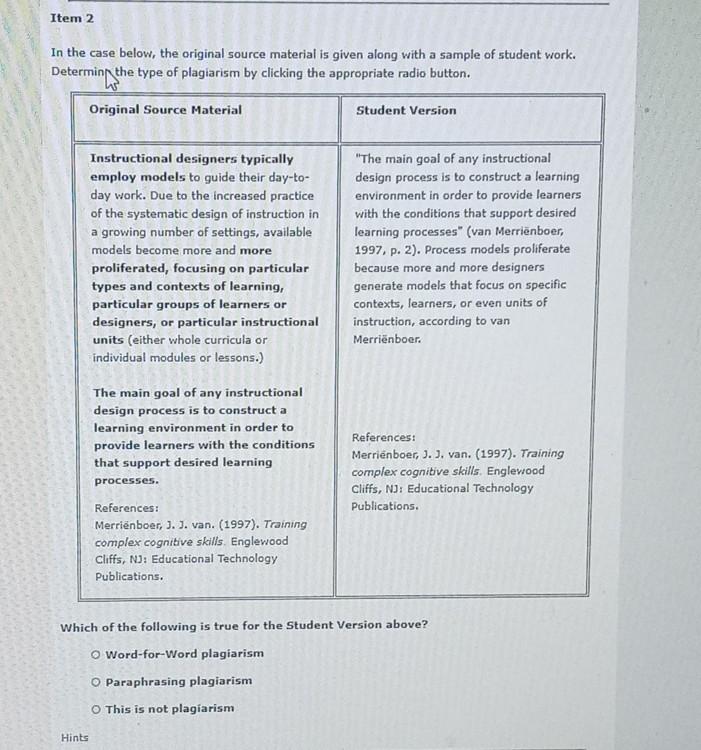
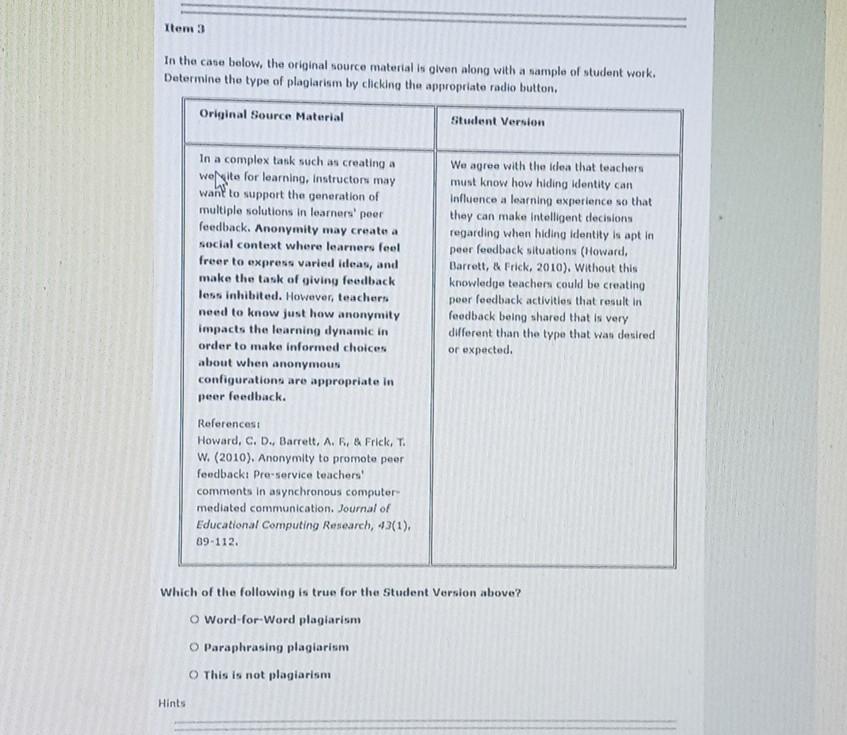
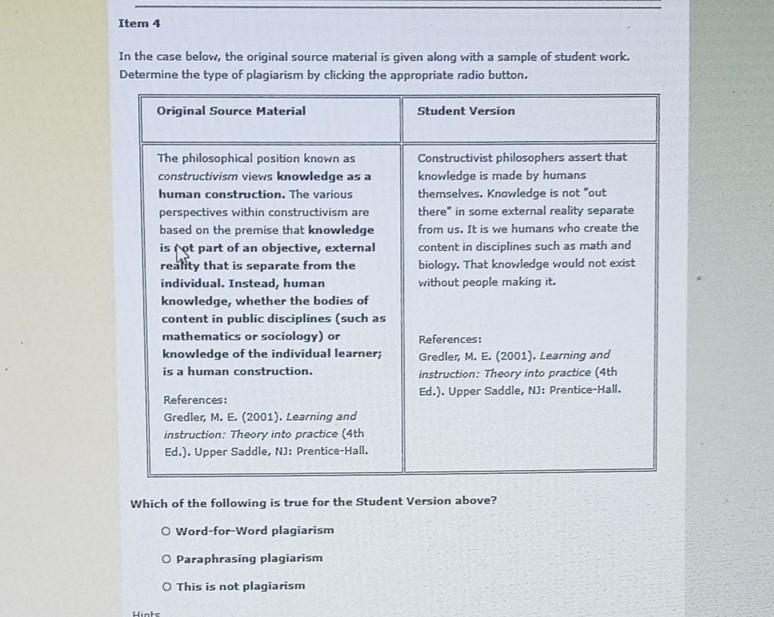
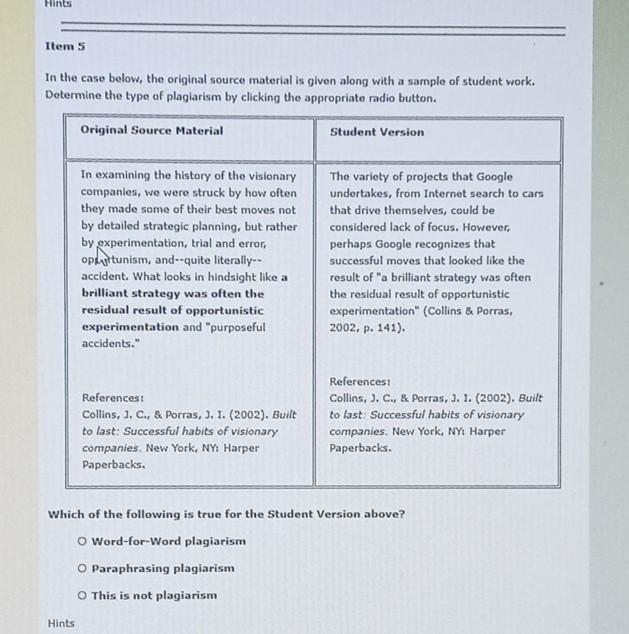
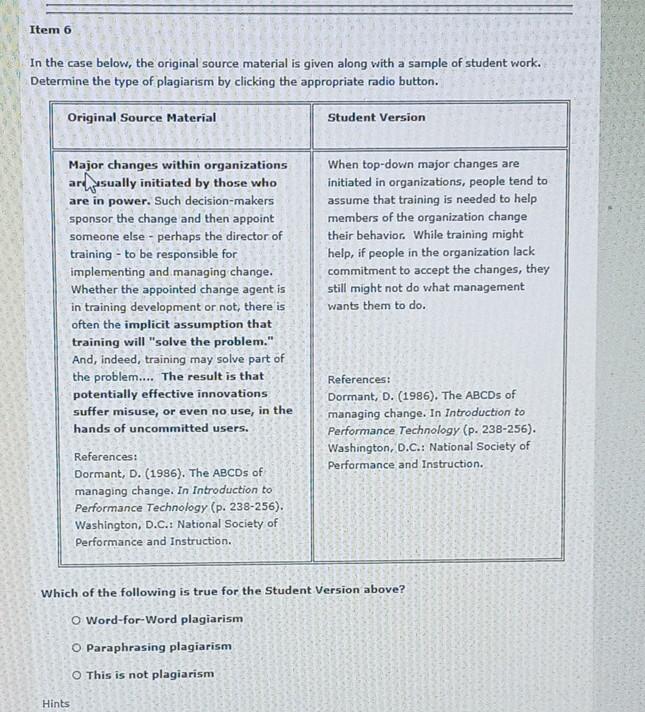
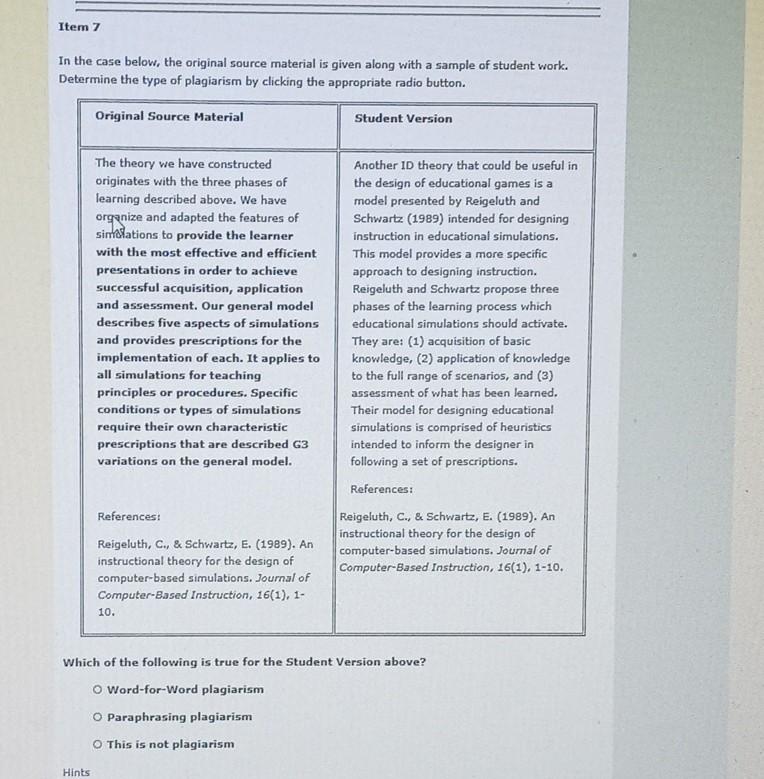
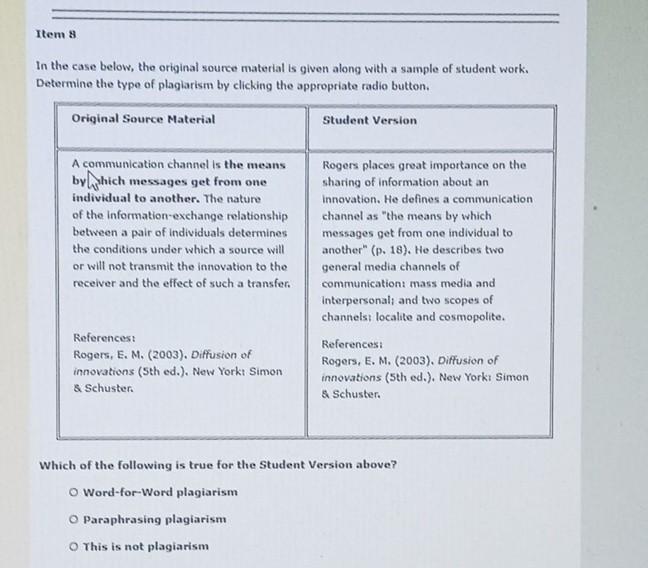
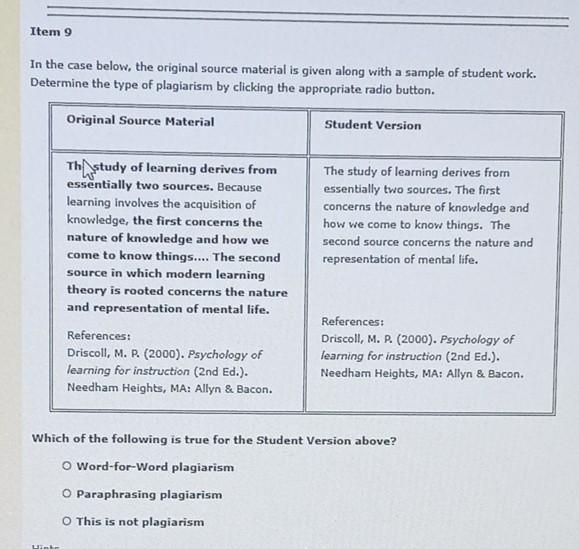
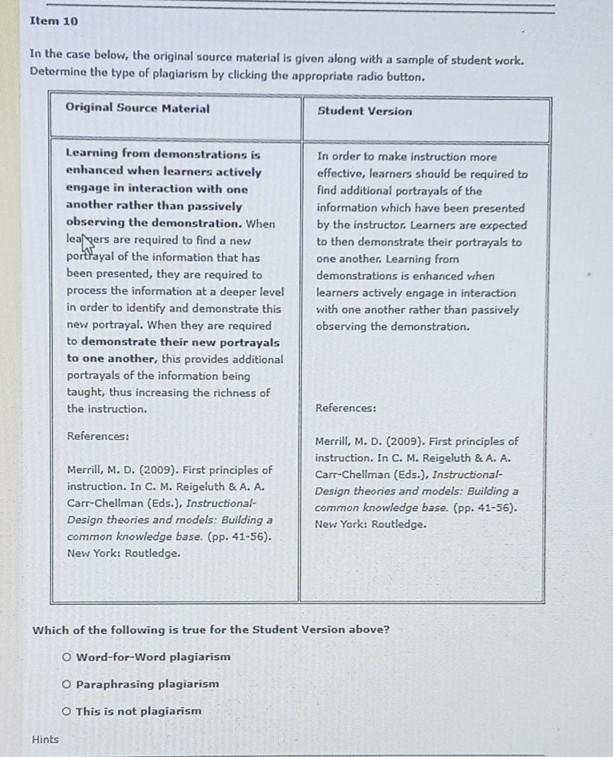
View Site Map Item 1 In the case below, the original source material is given along with a sample of student work. Determine the type of plagiarism by clicking the appropriate radio button. Acknowledge Site Original Source Material Student Version (written in 2002) The technological tools available today for creating computer-based learning materials are incredibly more powerful that those introduced just a few years ago. We can make our own movies with camcorders in our homes, we can publish our own books. Soon teachers and students will be able to use computer-video technology to produce their own learning materials. All it takes is time, know-how, and some funds. References: Frick, T. (1991). Restructuring education through technology Bloomington, IN: Phi Delta Kappa Educational Foundation. Frick (1991) claimed that computers would become so powerful that K-12 educators and students would be able to produce their own multimedia and Web- based learning materials. He predicted that teachers and students would soon be able to use computer-video technology to produce their own learning materials. All it would require is time, know-how, and some funds. References: Frick, T. (1991). Restructuring education through technology Bloomington, IN: Phi Delta Kappa Educational Foundation. which of the following is true for the Student Version above? O Word-for-Word plagiarism O Paraphrasing plagiarism This is not plagiarism Hints Item 2 In the case below, the original source material is given along with a sample of student work. Determin the type of plagiarism by clicking the appropriate radio button. Original Source Material Student Version Instructional designers typically employ models to guide their day-to- day work. Due to the increased practice of the systematic design of instruction in a growing number of settings, available models become more and more proliferated, focusing on particular types and contexts of learning, particular groups of learners or designers, or particular instructional units (either whole curricula or individual modules or lessons.) "The main goal of any instructional design process is to construct a learning environment in order to provide learners with the conditions that support desired learning processes" (van Merrienboer, 1997, p. 2). Process models proliferate because more and more designers generate models that focus on specific contexts, learners, or even units of instruction, according to van Merrinboer. The main goal of any instructional design process is to construct a learning environment in order to provide learners with the conditions that support desired learning processes. References: Merrienboer, J. J. van. (1997). Training complex cognitive skills. Englewood Cliffs, NJ: Educational Technology Publications. References: Merrienboer, J. J. van. (1997). Training complex cognitive skills. Englewood Cliffs, NJ: Educational Technology Publications. Which of the following is true for the Student Version above? o Word-for-Word plagiarism Paraphrasing plagiarism This is not plagiarism Hints Item 3 In the case below, the original source material is given along with a sample of student work. Determine the type of plagiarism by clicking the appropriate radio button. Original Source Material Student Version In a complex tank such as creating a weite for learning, Instructors may want to support the generation of multiple solutions in learners' peer feedback. Anonymity may create a social context where learners feel freer to express varied ideas, and make the task of giving feedback less inhibited. However, teachers need to know just how anonymity impacts the learning dynamic in order to make informed choices about when anonymous configurations are appropriate in We agree with the idea that teachers must know how hiding Identity can Influence a learning experience so that they can make Intelligent decisions regarding when hiding identity is apt in peer feedback situations (Howard, Barrett, & Frick, 2010). Without this knowledge teachers could be creating peor feedback activities that result in feedback being shared that is very different than the type that was desired or expected. peer feedback References Howard, C. D., Barrett. A. , & Frick, T. W. (2010). Anonymity to promote peer feedback Pre-service teachers! comments in asynchronous computer mediated communication. Journal of Educational Computing Research, 13(1), 89-112. Which of the following is true for the Student Version above? O Word-for-Word plagiarism O Paraphrasing plagiarism This is not plagiarism Hints Item 4 In the case below, the original source material is given along with a sample of student work. Determine the type of plagiarism by clicking the appropriate radio button. Original Source Material Student Version The philosophical position known as constructivism views knowledge as a human construction. The various perspectives within constructivism are based on the premise that knowledge ist part of an objective, external reality that is separate from the individual. Instead, human knowledge, whether the bodies of content in public disciplines (such as mathematics or sociology) or knowledge of the individual learner; is a human construction. Constructivist philosophers assert that knowledge is made by humans themselves. Knowledge is not "out there" in some external reality separate from us. It is we humans who create the content in disciplines such as math and biology. That knowledge would not exist without people making it. References: Gredler, M. E. (2001). Learning and instruction: Theory into practice (4th Ed.). Upper Saddle, NJ: Prentice-Hall. References: Gredler, M. E. (2001). Learning and instruction: Theory into practice (4th Ed.). Upper Saddle, NJ: Prentice-Hall. Which of the following is true for the Student Version above? O Word-for-Word plagiarism O Paraphrasing plagiarism This is not plagiarism Hints Hine Item 5 In the case below, the original source material is given along with a sample of student work. Determine the type of plagiarism by clicking the appropriate radio button. Original Source Material Student Version In examining the history of the visionary companies, we were struck by how often they made some of their best moves not by detailed strategic planning, but rather by experimentation, trial and error, opdyttunism, and--quite literally- accident. What looks in hindsight like a brilliant strategy was often the residual result of opportunistic experimentation and purposeful accidents." The variety of projects that Google undertakes, from Internet search to cars that drive themselves, could be considered lack of focus. However, perhaps Google recognizes that successful moves that looked like the result of "a brilliant strategy was often the residual result of opportunistic experimentation" (Collins & Porras, 2002. p. 141). References: Collins, 1. C., & Porras, J. 1. (2002). Built to last: Successful habits of visionary companies. New York, NY: Harper Paperbacks. References: Collins, J. C., & Porras, J. 1. (2002). Built to last: Successful habits of visionary companies. New York, NY: Harper Paperbacks. Which of the following is true for the Student Version above? O Word-for-Word plagiarism Paraphrasing plagiarism This is not plagiarism Hints Item 6 In the case below, the original source material is given along with a sample of student work. Determine the type of plagiarism by clicking the appropriate radio button. Original Source Material Student Version ar Major changes within organizations ard pesually initiated by those who are in power. Such decision-makers sponsor the change and then appoint someone else - perhaps the director of training - to be responsible for implementing and managing change. Whether the appointed change agent is in training development or not, there is often the implicit assumption that training will "solve the problem." And, indeed, training may solve part of the problem.... The result is that potentially effective innovations suffer misuse, or even no use, in the hands of uncommitted users. When top-down major changes are initiated in organizations, people tend to assume that training is needed to help members of the organization change their behavior. While training might help, if people in the organization lack commitment to accept the changes, they still might not do what management wants them to do. References: Dormant, D. (1986). The ABCDs of managing change. In Introduction to Performance Technology (p. 238-256). Washington, D.C.: National Society of Performance and Instruction. References: Dormant, D. (1996). The ABCDs of managing change. In Introduction to Performance Technology (p. 238-256). Washington, D.C.: National Society of Performance and Instruction. Which of the following is true for the Student Version above? O Word-for-Word plagiarism O Paraphrasing plagiarism This is not plagiarism Hints Item 7 In the case below, the original source material is given along with a sample of student work. Determine the type of plagiarism by clicking the appropriate radio button. Original Source Material Student Version The theory we have constructed originates with the three phases of learning described above. We have organize and adapted the features of similations to provide the learner with the most effective and efficient presentations in order to achieve successful acquisition, application and assessment. Our general model describes five aspects of simulations and provides prescriptions for the implementation of each. It applies to all simulations for teaching principles or procedures. Specific conditions or types of simulations require their own characteristic prescriptions that are described G3 variations on the general model. Another ID theory that could be useful in the design of educational games is a model presented by Reigeluth and Schwartz (1989) intended for designing instruction in educational simulations. This model provides a more specific approach to designing instruction. Reigeluth and Schwartz propose three phases of the learning process which educational simulations should activate. They are: (1) acquisition of basic knowledge, (2) application of knowledge to the full range of scenarios, and (3) assessment of what has been learned. Their model for designing educational simulations is comprised of heuristics intended to inform the designer in following a set prescriptions. References: Reigeluth, C., & Schwartz, E. (1989). An instructional theory for the design of computer-based simulations. Journal of Computer-Based Instruction, 16(1), 1-10. References: Reigeluth, C., & Schwartz, E. (1989). An instructional theory for the design of computer-based simulations. Journal of Computer-Based Instruction, 16(1), 1- 10. Which of the following is true for the Student Version above? O Word-for-Word plagiarism O Paraphrasing plagiarism O This is not plagiarism Hints Item 8 In the case below, the original source material is given along with a sample of student work. Determine the type of plagiarism by clicking the appropriate radio button. Original Source Material Student Version A communication channel is the means by Which messages get from one individual to another. The nature of the information exchange relationship between a pair of individuals determines the conditions under which a source will or will not transmit the innovation to the receiver and the effect of such a transfer Rogers places great importance on the sharing of information about an innovation. He defines a communication channel as "the means by which messages get from one individual to another" (p. 18). He describes two general media channels of communication mass media and Interpersonals and two scopes of channels localite and cosmopolite. References Rogers, E.M. (2003). Diffusion of innovations (5th ed.). New York: Simon & Schuster References: Rogers, E. M. (2003). Diffusion of innovations (Sth ed.). New York: Simon & Schuster Which of the following is true for the Student Version above? O Word-for-Word plagiarism O Paraphrasing plagiarism This is not plagiarism Item 9 In the case below, the original source material is given along with a sample of student work. Determine the type of plagiarism by clicking the appropriate radio button. Original Source Material Student Version The study of learning derives from essentially two sources. The first concerns the nature of knowledge and how we come to know things. The second source concerns the nature and representation of mental life. Thstudy of learning derives from essentially two sources. Because learning involves the acquisition of knowledge, the first concerns the nature of knowledge and how we come to know things.... The second source in which modern learning theory is rooted concerns the nature and representation of mental life. References: Driscoll, M. R. (2000). Psychology of learning for instruction (2nd Ed.). Needham Heights, MA: Allyn & Bacon. References: Driscoll, M. P. (2000). Psychology of learning for instruction (2nd Ed.). Needham Heights, MA: Allyn & Bacon. Which of the following is true for the Student Version above? O Word-for-Word plagiarism O Paraphrasing plagiarism O This is not plagiarism Item 10 In the case below, the original source material is given along with a sample of student work. Determine the type of plagiarism by clicking the appropriate radio button. Original Source Material Student Version Learning from demonstrations is enhanced when learners actively engage in interaction with one another rather than passively observing the demonstration. When leargers are required to find a new portrayal of the information that has been presented, they are required to process the information at a deeper level in order to identify and demonstrate this new portrayal. When they are required to demonstrate their new portrayals to one another, this provides additional portrayals of the information being taught, thus increasing the richness of the instruction. References: In order to make instruction more effective, learners should be required to find additional portrayals of the information which have been presented by the instructor. Learners are expected to then demonstrate their portrayals to one another. Learning from demonstrations is enhanced when learners actively engage in interaction with one another rather than passively observing the demonstration. References: Merrill, M. D. (2009). First principles of instruction. In C. M. Reigeluth & A. A. Carr-Chellman (Eds.), Instructional- Design theories and models: Building a common knowledge base. (pp. 41-56). New York: Routledge. Merrill, M. D. (2009). First principles of instruction. In C. M. Reigeluth & A. A. Carr-Chellman (Eds.), Instructional- Design theories and models: Building a common knowledge base. (pp. 41-56). New York: Routledge. Which of the following is true for the Student Version above? O Word-for-Word plagiarism O Paraphrasing plagiarism This is not plagiarism HintsStep by Step Solution
There are 3 Steps involved in it
1 Expert Approved Answer
Step: 1 Unlock

Question Has Been Solved by an Expert!
Get step-by-step solutions from verified subject matter experts
Step: 2 Unlock
Step: 3 Unlock
 Study Help