







Question: Can somebody please answer this question for me please? Recall the definitions of the asymptotic notations. We will say that f(x) has order of growth
Can somebody please answer this question for me please?
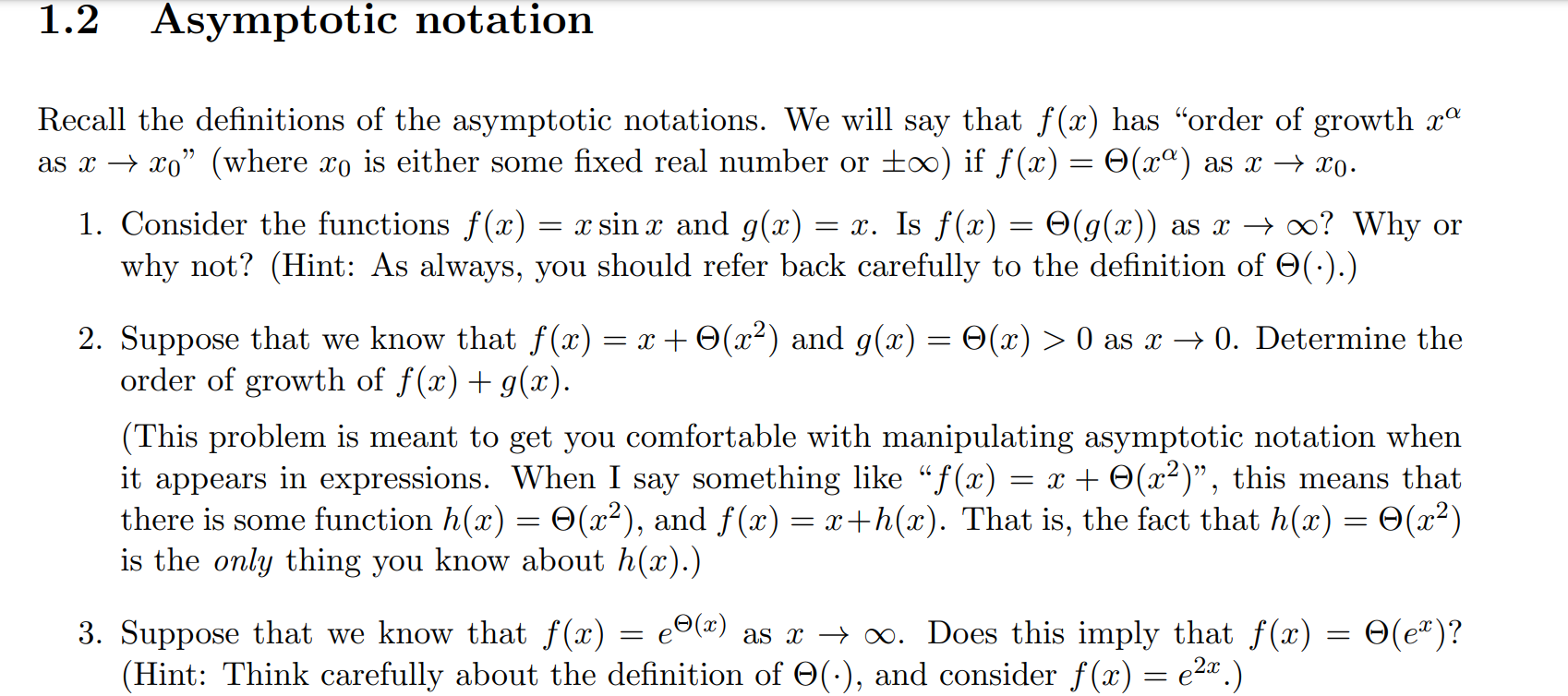
Recall the definitions of the asymptotic notations. We will say that f(x) has "order of growth x as xx0 " (where x0 is either some fixed real number or ) if f(x)=(x) as xx0. 1. Consider the functions f(x)=xsinx and g(x)=x. Is f(x)=(g(x)) as x ? Why or why not? (Hint: As always, you should refer back carefully to the definition of ().) 2. Suppose that we know that f(x)=x+(x2) and g(x)=(x)>0 as x0. Determine the order of growth of f(x)+g(x). (This problem is meant to get you comfortable with manipulating asymptotic notation when it appears in expressions. When I say something like " f(x)=x+(x2) ", this means that there is some function h(x)=(x2), and f(x)=x+h(x). That is, the fact that h(x)=(x2) is the only thing you know about h(x).) 3. Suppose that we know that f(x)=e(x) as x. Does this imply that f(x)=(ex) ? (Hint: Think carefully about the definition of (), and consider f(x)=e2x.)
Step by Step Solution
There are 3 Steps involved in it

Get step-by-step solutions from verified subject matter experts
 Study Help