



Question: Can someone do this for Acetone ? 1. Choose and chemical species which has both liquid and vapor phase coefficients. 2. Calculate and average value
Can someone do this for Acetone ?
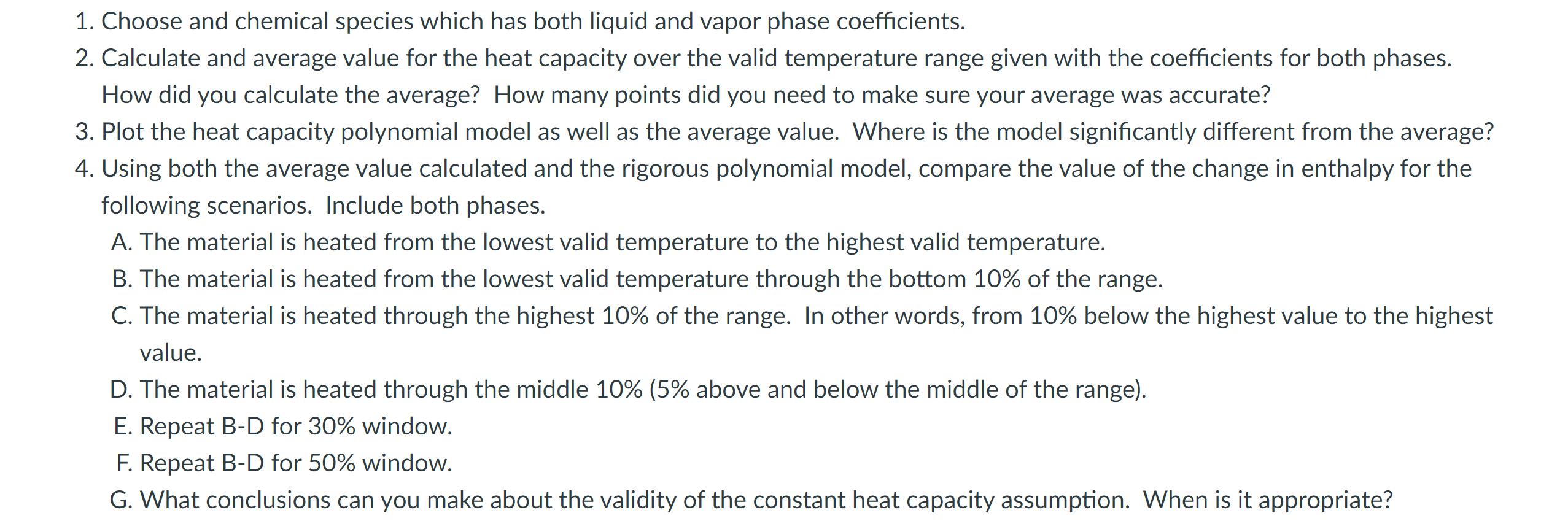
1. Choose and chemical species which has both liquid and vapor phase coefficients. 2. Calculate and average value for the heat capacity over the valid temperature range given with the coefficients for both phases. How did you calculate the average? How many points did you need to make sure your average was accurate? 3. Plot the heat capacity polynomial model as well as the average value. Where is the model significantly different from the average? 4. Using both the average value calculated and the rigorous polynomial model, compare the value of the change in enthalpy for the following scenarios. Include both phases. A. The material is heated from the lowest valid temperature to the highest valid temperature. B. The material is heated from the lowest valid temperature through the bottom 10% of the range. C. The material is heated through the highest 10% of the range. In other words, from 10% below the highest value to the highest value. D. The material is heated through the middle 10% (5% above and below the middle of the range). E. Repeat B-D for 30% window. F. Repeat B-D for 50% window. G. What conclusions can you make about the validity of the constant heat capacity assumption. When is it appropriate
Step by Step Solution
There are 3 Steps involved in it

Get step-by-step solutions from verified subject matter experts