







Question: Can someone help answer this Problem 4: (15 points) 1) Let X. denote an Erlang (n, A) random variable. Use the definition of the Erlang
Can someone help answer this
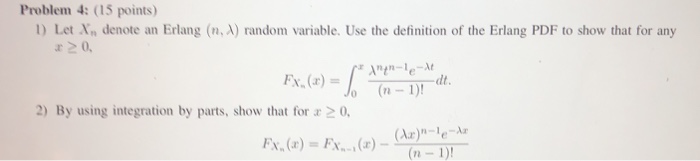
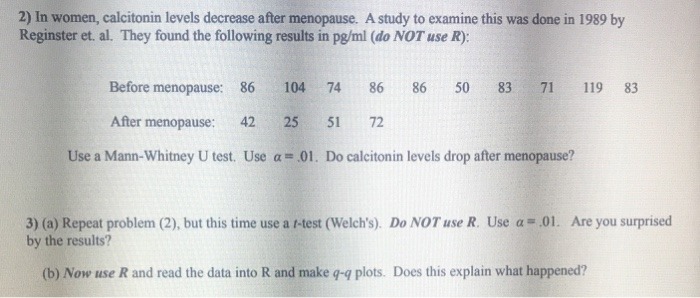
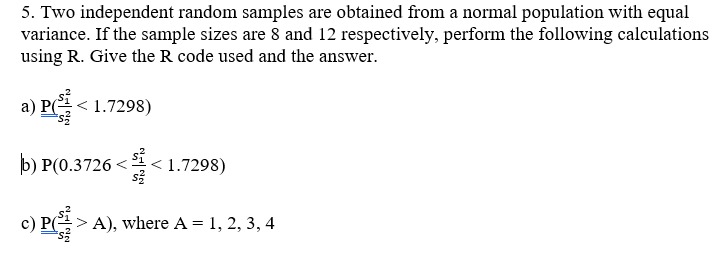
Problem 4: (15 points) 1) Let X. denote an Erlang (n, A) random variable. Use the definition of the Erlang PDF to show that for any x 20. Fx. (x) = (n - 1)! .dt. 2) By using integration by parts, show that for a 2 0. Fx. (x) = Fx., (x) - (Ap)-le-Ar (n - 1)!2) In women, calcitonin levels decrease after menopause. A study to examine this was done in 1989 by Reginster et. al. They found the following results in pg/ml (do NOT use R): Before menopause: 86 104 74 86 86 50 83 71 119 83 After menopause: 42 25 51 72 Use a Mann-Whitney U test. Use a = .01. Do calcitonin levels drop after menopause? 3) (a) Repeat problem (2), but this time use a t-test (Welch's). Do NOT use R. Use a = .01. Are you surprised by the results? (b) Now use R and read the data into R and make q-q plots. Does this explain what happened?5. Two independent random samples are obtained from a normal population with equal variance. If the sample sizes are 8 and 12 respectively, perform the following calculations using R. Give the R code used and the answer. a) A), where A = 1, 2, 3, 4 52
Step by Step Solution
There are 3 Steps involved in it

Get step-by-step solutions from verified subject matter experts
 Study Help