







Question: Can someone help me answer this, it's to identify the astronomical phenomena/model of the universe/behaviour of light that are being described in each of statement.
Can someone help me answer this, it's to identify the astronomical phenomena/model of the universe/behaviour of light that are being described in each of statement. Thank you!
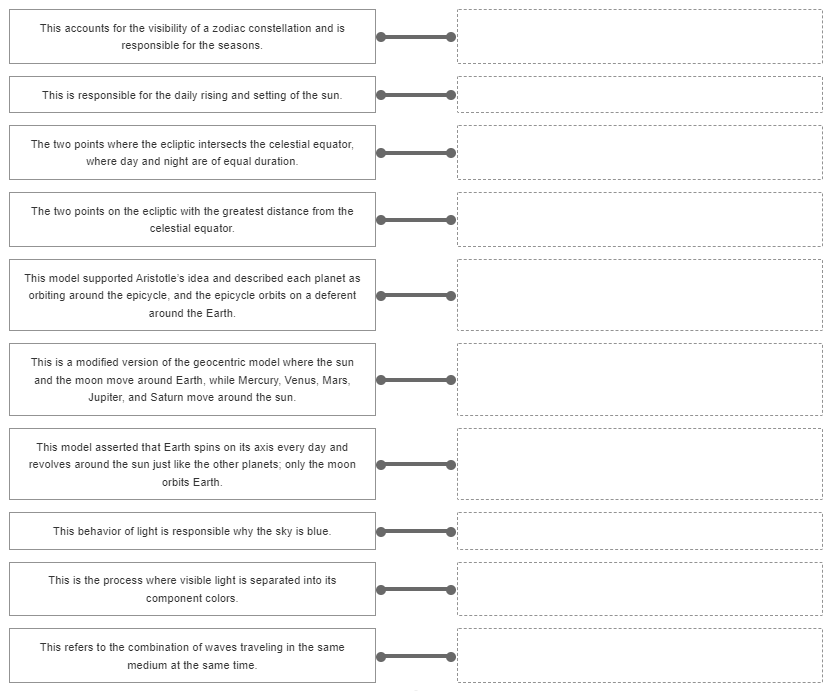

This accounts for the visibility of a zodiac constellation and is responsible for the seasons This is responsible for the daily rising and setting of the sun. The two points where the ecliptic intersects the celestial equator, where day and night are of equal duration. The two points on the ecliptic with the greatest distance from the celestial equator. This model supported Aristotle's idea and described each planet as orbiting around the epicycle, and the epicycle orbits on a deferent around the Earth. This is a modified version of the geocentric model where the sun and the moon move around Earth, while Mercury, Venus, Mars, Jupiter, and Saturn move around the sun. This model asserted that Earth spins on its axis every day and revolves around the sun just like the other planets; only the moon orbits Earth. This behavior of light is responsible why the sky is blue. This is the process where visible light is separated into its component colors. This refers to the combination of waves traveling in the same medium at the same time.#: Annual Motion #: Aristarchus' Model #: Aristotle's Model #: Copernican Model : Dispersion #: Diurnal Motion :: Equinoxes Interference " Lunar Eclipse : Polarization Ptolemaic Model #: Scattering 1: Solstices #: Tycho Brahe's Model
Step by Step Solution
There are 3 Steps involved in it

Get step-by-step solutions from verified subject matter experts
 Study Help