







Question: Can someone help solve the questions below using the link provided https://fred.stlouisfed.org/ QUESTION 1 Use nominal GDP (GDP) and real GDP (GDPC1) to construct a
Can someone help solve the questions below using the link provided
https://fred.stlouisfed.org/
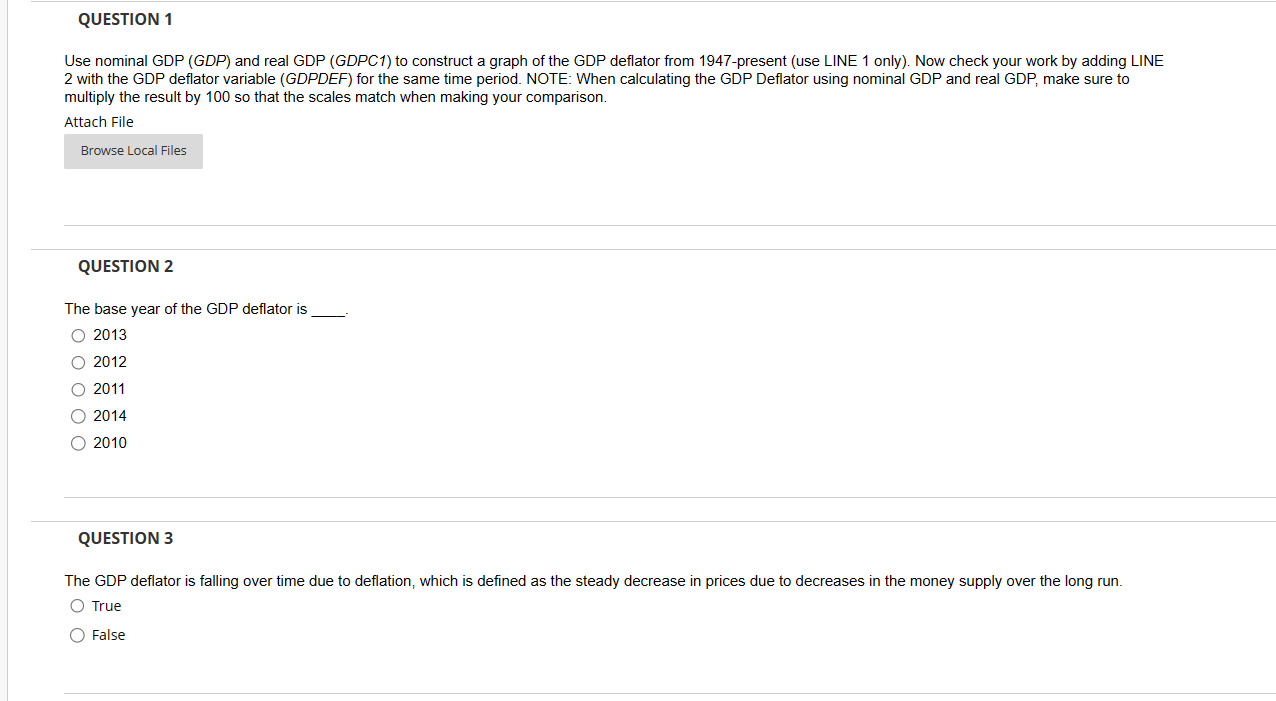
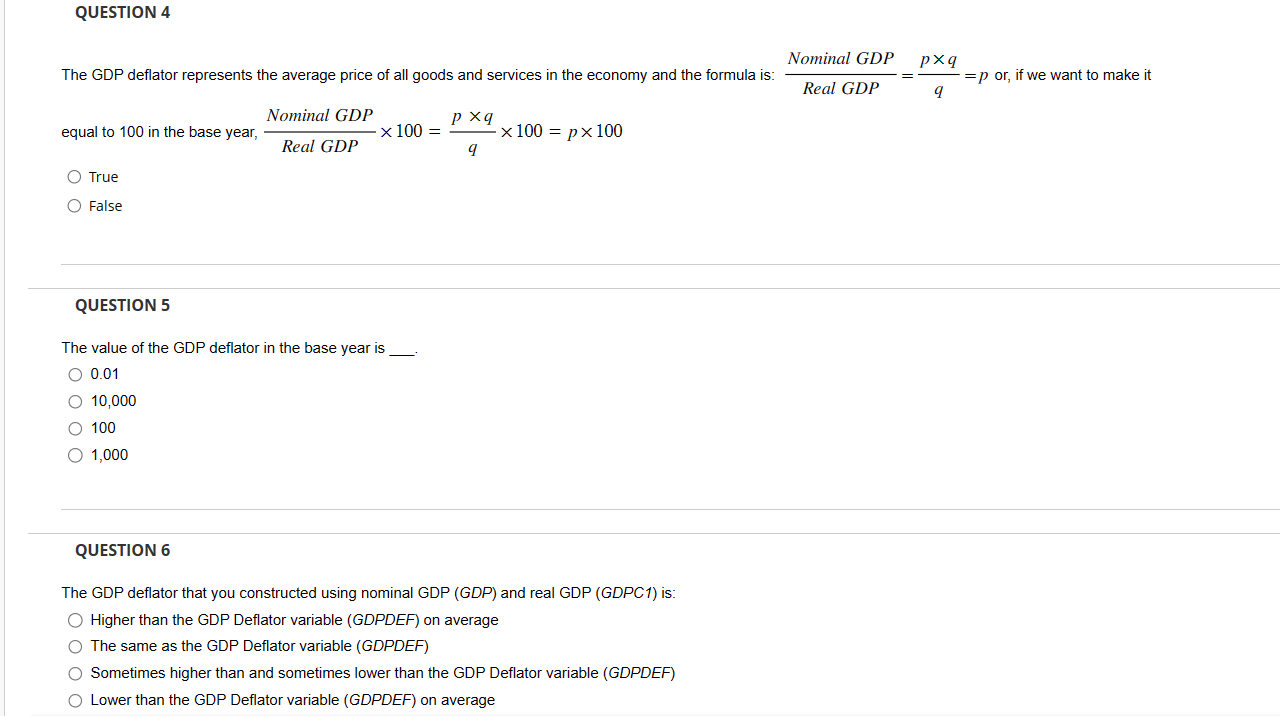
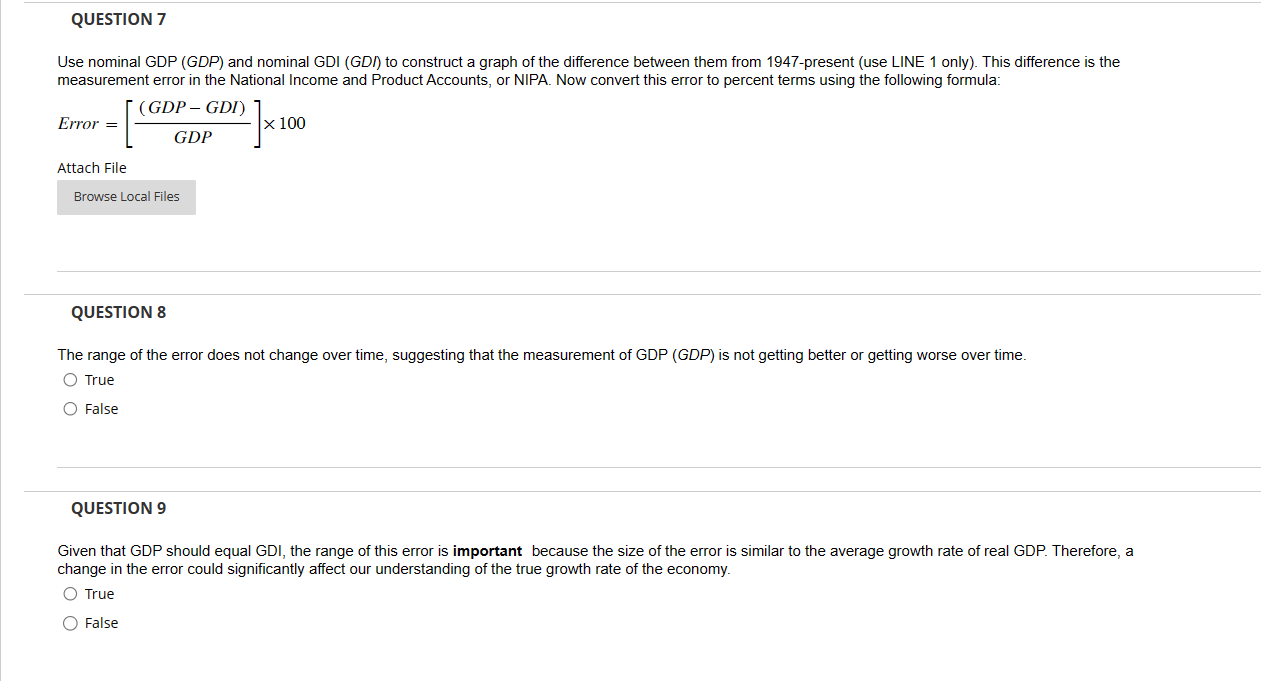
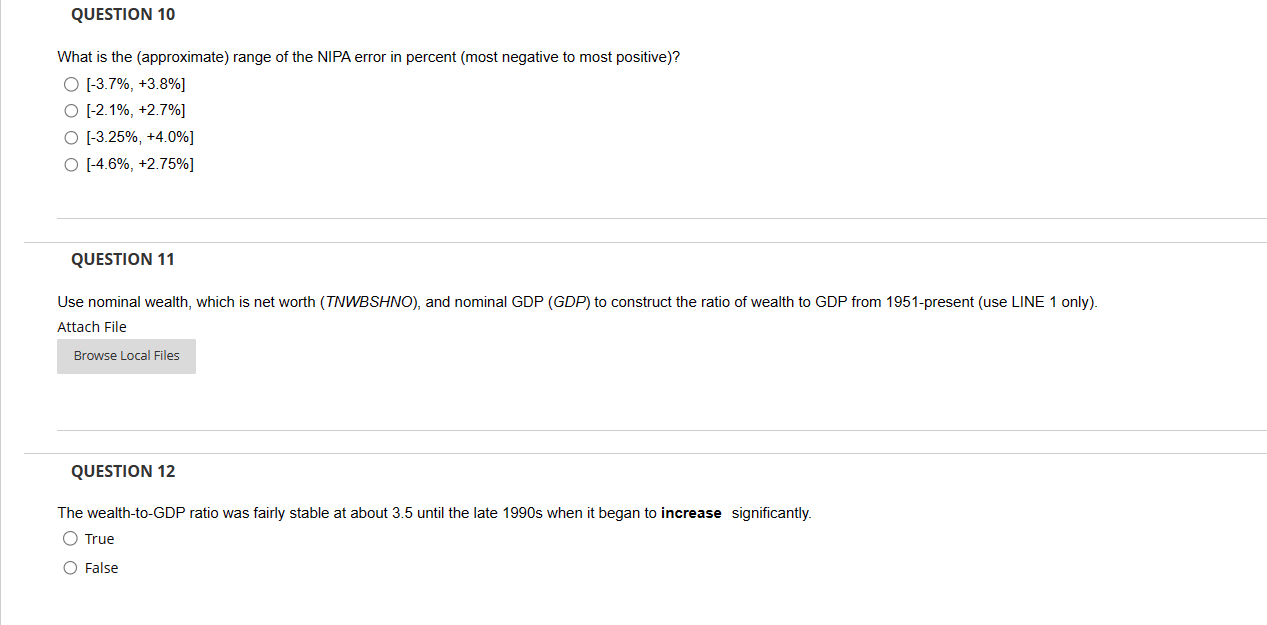
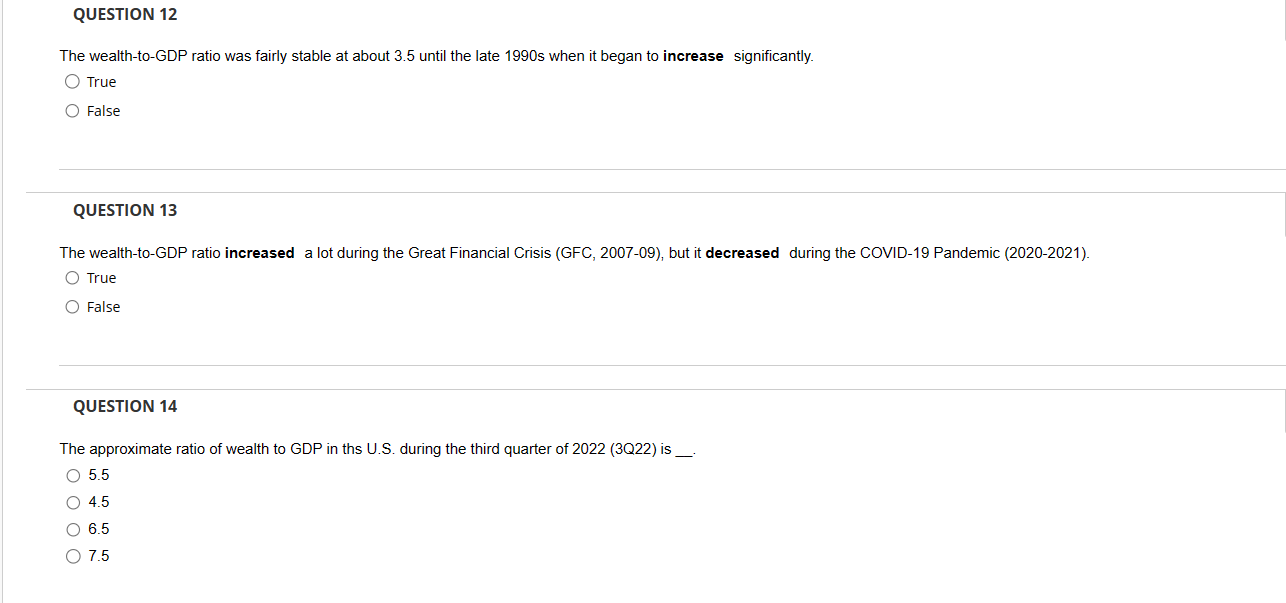
QUESTION 1 Use nominal GDP (GDP) and real GDP (GDPC1) to construct a graph of the GDP deflator from 1947-present (use LINE 1 only). Now check your work by adding LINE 2 with the GDP deflator variable (GDPDEF) for the same time period. NOTE: When calculating the GDP Deflator using nominal GDP and real GDP, make sure to multiply the result by 100 so that the scales match when making your comparison. Attach File Browse Local Files QUESTION 2 The base year of the GDP deflator is O 2013 O 2012 O 2011 O 2014 O 2010 QUESTION 3 The GDP deflator is falling over time due to deflation, which is defined as the steady decrease in prices due to decreases in the money supply over the long run. O True O FalseQUESTION 4 Nominal GDP pxq The GDP deflator represents the average price of all goods and services in the economy and the formula is: =p or, if we want to make it Real GDP Nominal GDP p xq equal to 100 in the base year, x 100 = - x 100 = p x 100 Real GDP O True O False QUESTION 5 The value of the GDP deflator in the base year is O 0.01 O 10,000 O 100 O 1,000 QUESTION 6 The GDP deflator that you constructed using nominal GDP (GDP) and real GDP (GDPC1) is: O Higher than the GDP Deflator variable (GDPDEF) on average O The same as the GDP Deflator variable (GDPDEF) O Sometimes higher than and sometimes lower than the GDP Deflator variable (GDPDEF) O Lower than the GDP Deflator variable (GDPDEF) on averageQUESTION 7 Use nominal GDP (GDP) and nominal GDI (GD/) to construct a graph of the difference between them from 1947-present (use LINE 1 only). This difference is the measurement error in the National Income and Product Accounts, or NIPA. Now convert this error to percent terms using the following formula: (GDP - GDI) Error = x 100 GDP Attach File Browse Local Files QUESTION 8 The range of the error does not change over time, suggesting that the measurement of GDP (GDP) is not getting better or getting worse over time. O True O False QUESTION 9 Given that GDP should equal GDI, the range of this error is important because the size of the error is similar to the average growth rate of real GDP. Therefore, a change in the error could significantly affect our understanding of the true growth rate of the economy. O True O FalseQUESTION 10 What is the (approximate) range of the NIPA error in percent [most negative to most positive)? C [-3.?%, +3 8%] C} [-2.1%, +2 7%] C) [625%, +4 0%] C} [-4.6%, +2 T593] QUESTION 11 Use nominal wealth, which IS net worth (TNWBSHNO), and nomrnal GDP (GDP) to construct the ratio of wealth to GDP from 1951present (use LINE 1 only). Attach File Browse Local Files QUESTION 12 The wealth-to-GDP ratio was fairly stable at about 3.5 untrl the late 19905 when it began to increase significantly. C True if.) False QUESTION 12 The wealth-to-GDP ratio was fairly stable at about 3.5 until the late 1990s when it began to increase significantly. O True O False QUESTION 13 The wealth-to-GDP ratio increased a lot during the Great Financial Crisis (GFC, 2007-09), but it decreased during the COVID-19 Pandemic (2020-2021). O True O False QUESTION 14 The approximate ratio of wealth to GDP in ths U.S. during the third quarter of 2022 (3Q22) is O 5.5 O 4.5 O 6.5 O 7.5
Step by Step Solution
There are 3 Steps involved in it

Get step-by-step solutions from verified subject matter experts
 Study Help