







Question: Can someone help to explain this proof with easier words, since tis kind of difficult to understand.I want to understand from 0.3 of u is
Can someone help to explain this proof with easier words, since tis kind of difficult to understand.I want to understand from 0.3
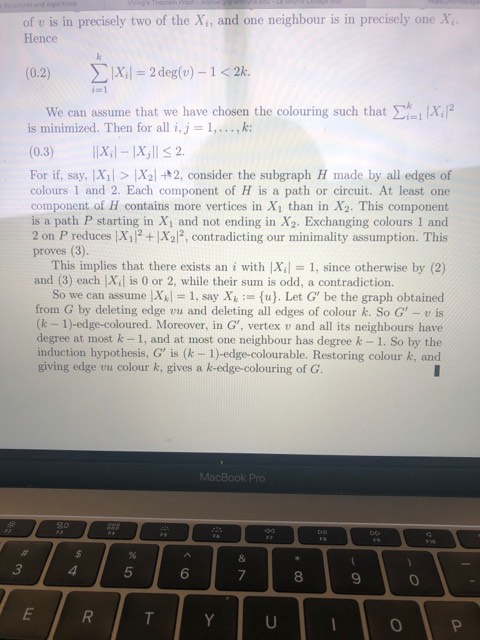
of u is in precisely two of the X,, and one neighbour is in precisely one X. Hence (0.2) EIXil = 2 deg(v) - 1 |X2) +2, consider the subgraph H made by all edges of colours 1 and 2. Each component of H is a path or circuit. At least one component of H contains more vertices in X1 than in X2. This component is a path P starting in X, and not ending in X2. Exchanging colours 1 and 2 on P reduces (Xi|2 + |X2|3, contradicting our minimality assumption. This proves (3). This implies that there exists an i with |X,| = 1, since otherwise by (2) and (3) each [X, | is 0 or 2, while their sum is odd, a contradiction. So we can assume [Xi| = 1, say Xx := {u}. Let G' be the graph obtained from G by deleting edge vu and deleting all edges of colour k. So G' - v is (k - 1)-edge-coloured. Moreover, in G', vertex v and all its neighbours have degree at most k - 1, and at most one neighbour has degree k - 1. So by the induction hypothesis, G" is (k - 1)-edge-colourable. Restoring colour k, and giving edge vu colour k, gives a k-edge-colouring of G. MacBook Pro A 4 6 9 E R T Y U O P
Step by Step Solution
There are 3 Steps involved in it

Get step-by-step solutions from verified subject matter experts
 Study Help