







Question: Can someone please do the assignment highlighted in green above so I can understand how to do it? And please type the table, don't write
 Can someone please do the assignment highlighted in green above so I can understand how to do it? And please type the table, don't write it.
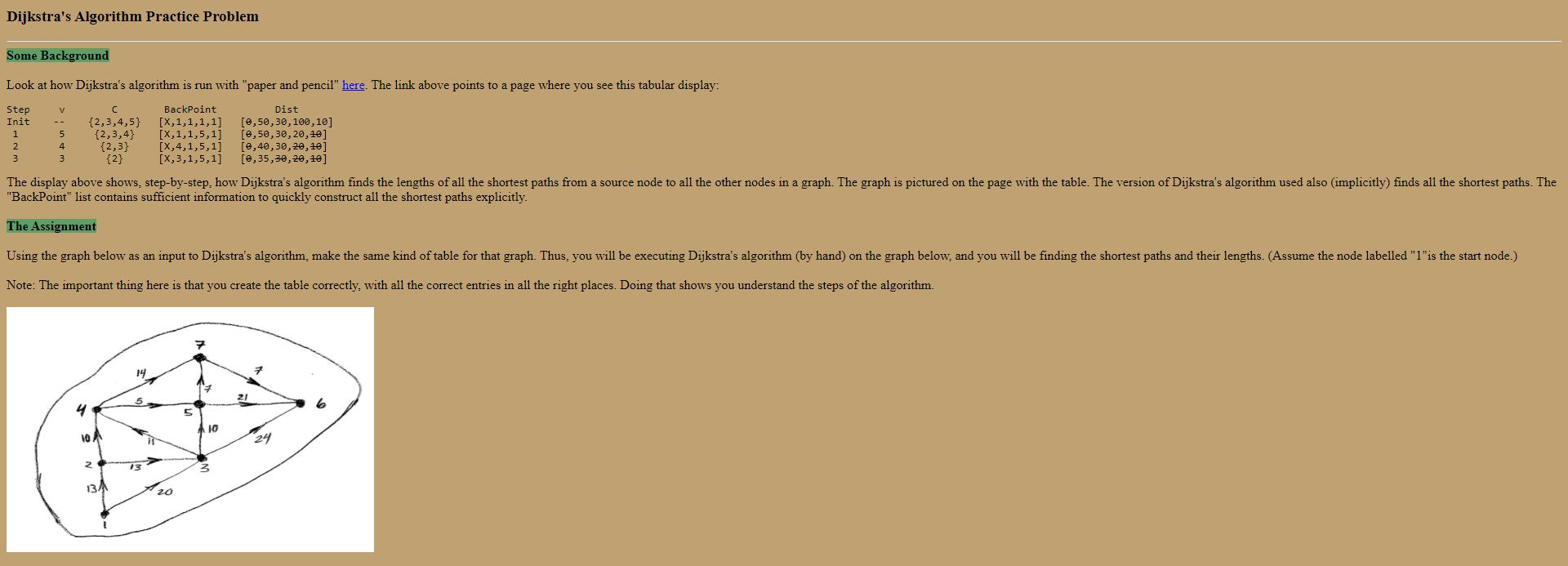
Dijkstra's Algorithm Practice Problem Some Background Look at how Dijkstra's algorithm is run with "paper and pencil" here. The link above points to a page where you see this tabular display: V Step Init -- 5 C {2,3,4,5} {2,3,4} {2,3} {2} BackPoint [X,1,1,1,1] [X,1,1,5,1] [X,4,1,5,1] [X,3,1,5,1] Dist [0,50,30,100,10] [0,50,30,20,10] [2,40,30,20,10] [2,35,30,20,10] The display above shows, step-by-step, how Dijkstra's algorithm finds the lengths of all the shortest paths from a source node to all the other nodes in a graph. The graph is pictured on the page with the table. The version of Dijkstra's algorithm used also implicitly) finds all the shortest paths. The "BackPoint" list contains sufficient information to quickly construct all the shortest paths explicitly. The Assignment Using the graph below as an input to Dijkstra's algorithm, make the same kind of table for that graph. Thus, you will be executing Dijkstra's algorithm (by hand) on the graph below, and you will be finding the shortest paths and their lengths. (Assume the node labelled "1"is the start node.) Note: The important thing here is that you create the table correctly, with all the correct entries in all the right places. Doing that shows you understand the steps of the algorithm. Dijkstra's Algorithm Practice Problem Some Background Look at how Dijkstra's algorithm is run with "paper and pencil" here. The link above points to a page where you see this tabular display: V Step Init -- 5 C {2,3,4,5} {2,3,4} {2,3} {2} BackPoint [X,1,1,1,1] [X,1,1,5,1] [X,4,1,5,1] [X,3,1,5,1] Dist [0,50,30,100,10] [0,50,30,20,10] [2,40,30,20,10] [2,35,30,20,10] The display above shows, step-by-step, how Dijkstra's algorithm finds the lengths of all the shortest paths from a source node to all the other nodes in a graph. The graph is pictured on the page with the table. The version of Dijkstra's algorithm used also implicitly) finds all the shortest paths. The "BackPoint" list contains sufficient information to quickly construct all the shortest paths explicitly. The Assignment Using the graph below as an input to Dijkstra's algorithm, make the same kind of table for that graph. Thus, you will be executing Dijkstra's algorithm (by hand) on the graph below, and you will be finding the shortest paths and their lengths. (Assume the node labelled "1"is the start node.) Note: The important thing here is that you create the table correctly, with all the correct entries in all the right places. Doing that shows you understand the steps of the algorithm
Step by Step Solution
There are 3 Steps involved in it

Get step-by-step solutions from verified subject matter experts
 Study Help