



Question: Can someone please elaborate and explain how to get the answer for Q3) thanks The following is the model you should study in the following
Can someone please elaborate and explain how to get the answer for Q3) thanks
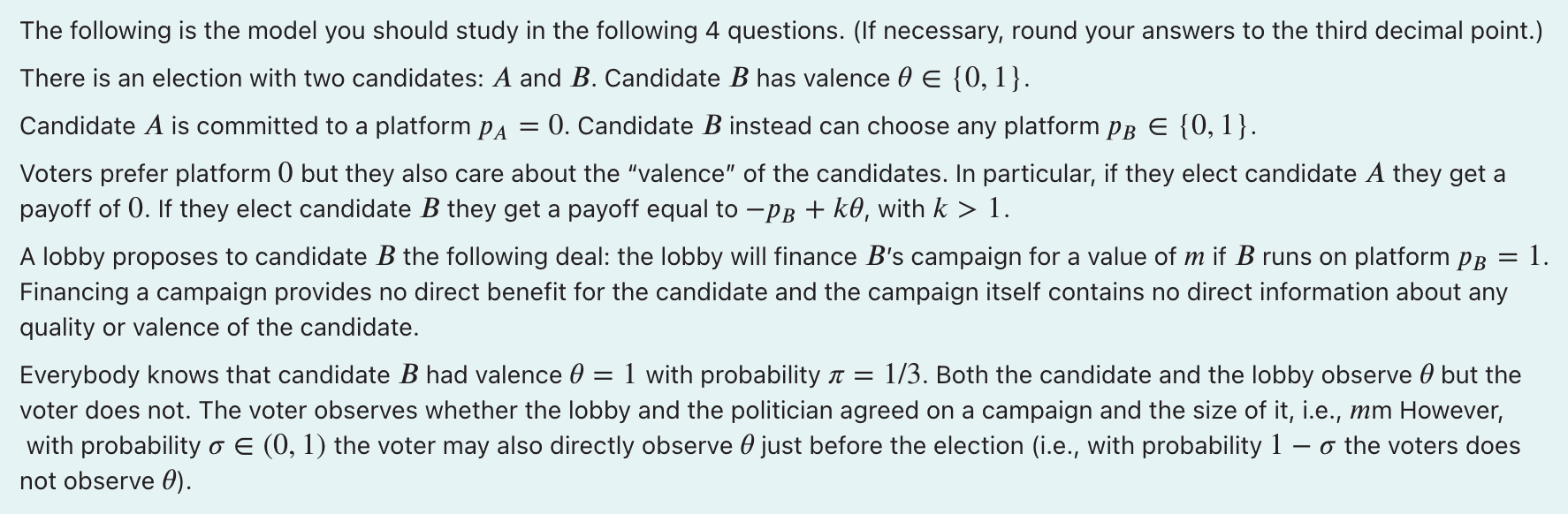
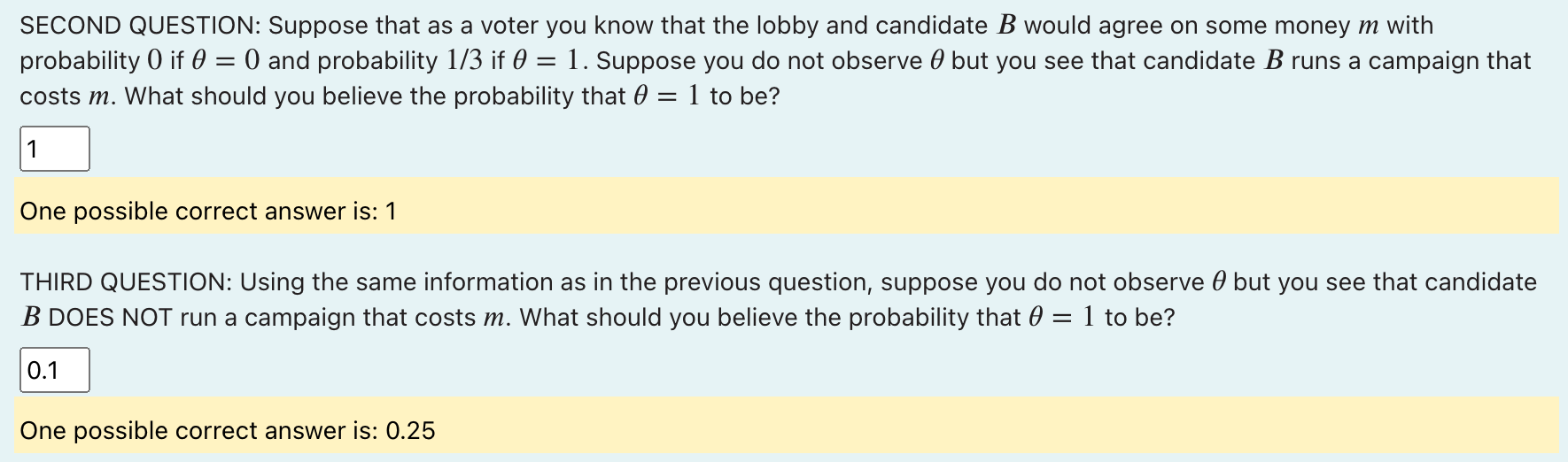
The following is the model you should study in the following 4 questions. (If necessary, round your answers to the third decimal point.) There is an election with two candidates: A and B. Candidate B has valence 6 E {0, 1}. Candidate A is committed to a platform 13;; = 0. Candidate B instead can choose any platform [)3 E {0, 1}. Voters prefer platform 0 but they also care about the "valence" of the candidates. In particular, if they elect candidate A they get a payoff of 0. If they elect candidate B they get a payoff equal to pB + [(9, with k > 1. A lobby proposes to candidate B the following deal: the lobby will finance B's campaign for a value of m if B runs on platform p3 = 1. Financing a campaign provides no direct benefit for the candidate and the campaign itself contains no direct information about any quality or valence of the candidate. Everybody knows that candidate B had valence 6 = 1 with probability 71' = 1/3. Both the candidate and the lobby observe 9 but the voter does not. The voter observes whether the lobby and the politician agreed on a campaign and the size of it, i.e., mm However, with probability 0' E (0, 1) the voter may also directly observe 6 just before the election lie, with probability 1 0' the voters does not observe 6). SECOND QUESTION: Suppose that as a voter you know that the lobby and candidate B would agree on some money m with probability 0 if 9 = 0 and probability 1/3 if 6 = 1. Suppose you do not observe 0 but you see that candidate B runs a campaign that costs m. What should you believe the probability that 9 = 1 to be? One possible correct answer is: 1 THIRD QUESTION: Using the same information as in the previous question, suppose you do not observe 9 but you see that candidate B DOES NOT run a campaign that costs m. What should you believe the probability that 9 = 1 to be? One possible correct answer is: 0.25
Step by Step Solution
There are 3 Steps involved in it

Get step-by-step solutions from verified subject matter experts