







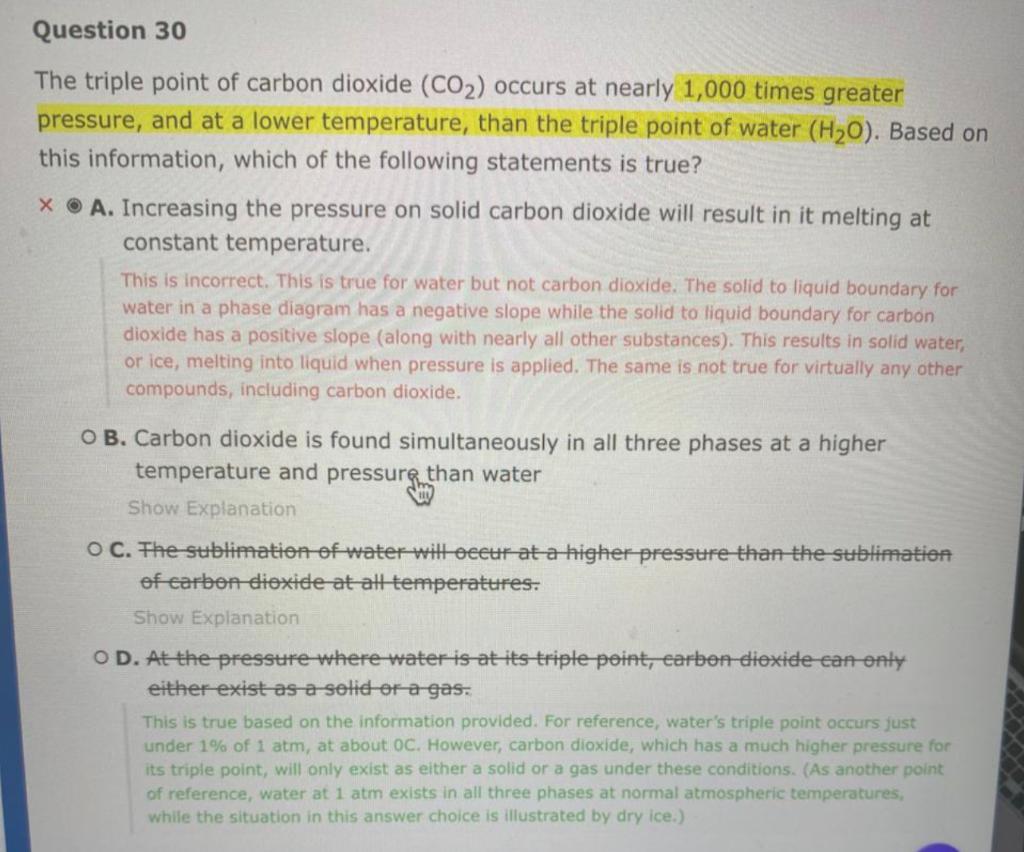
Question: can someone please explain in a different way why D is correct? The triple point of carbon dioxide (CO2) occurs at nearly 1,000 times greater
 can someone please explain in a different way why D is correct?
The triple point of carbon dioxide (CO2) occurs at nearly 1,000 times greater pressure, and at a lower temperature, than the triple point of water (H2O). Based on this information, which of the following statements is true? x - A. Increasing the pressure on solid carbon dioxide will result in it melting at constant temperature. This is incorrect. This is true for water but not carbon dioxide. The solid to liquid boundary for water in a phase diagram has a negative slope while the solid to liquid boundary for carbon dioxide has a positive slope (along with nearly all other substances). This results in solid water, or ice, melting into liquid when pressure is applied. The same is not true for virtually any other compounds, including carbon dioxide. B. Carbon dioxide is found simultaneously in all three phases at a higher temperature and pressurg than water Show Explanation C. Fhe sublimation of water will ocur at a higher pressure than the sublimation Show Explanation D. At the pressure where water is at its triple point, carbon diexide can only This is true based on the information provided. For reference, water's triple point occurs just under 1% of 1atm, at about oC. However, carbon dioxide, which has a much higher pressure for its triple point, will only exist as either a solid or a gas under these conditions. (As another point of reference, water at 1atm exists in all three phases at normal atmospheric temperatures, while the situation in this answer choice is illustrated by dry ice.)
Step by Step Solution
There are 3 Steps involved in it

Get step-by-step solutions from verified subject matter experts
 Study Help