Question: Can someone please help me solve problems 1-6? I'm not just looking for answers but explanations to understand the process. Problem 1. Purchasing requests arrive
Can someone please help me solve problems 1-6? I'm not just looking for answers but explanations to understand the process.
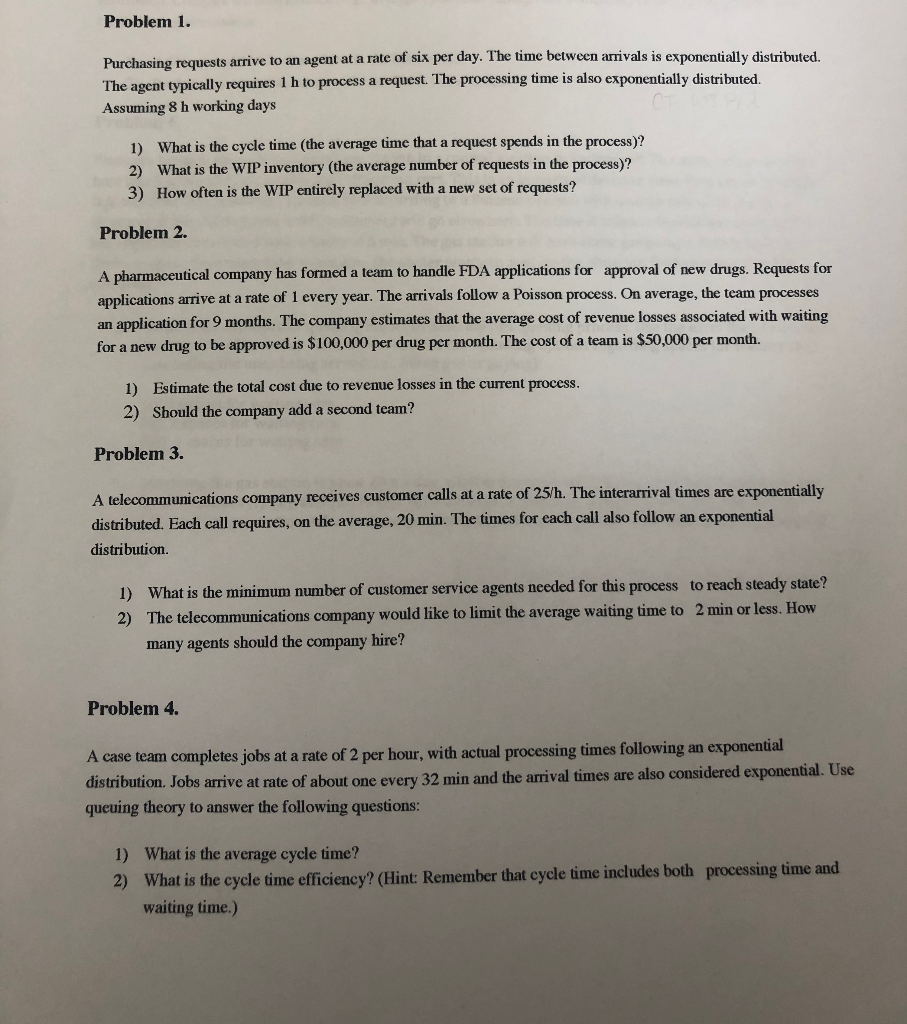
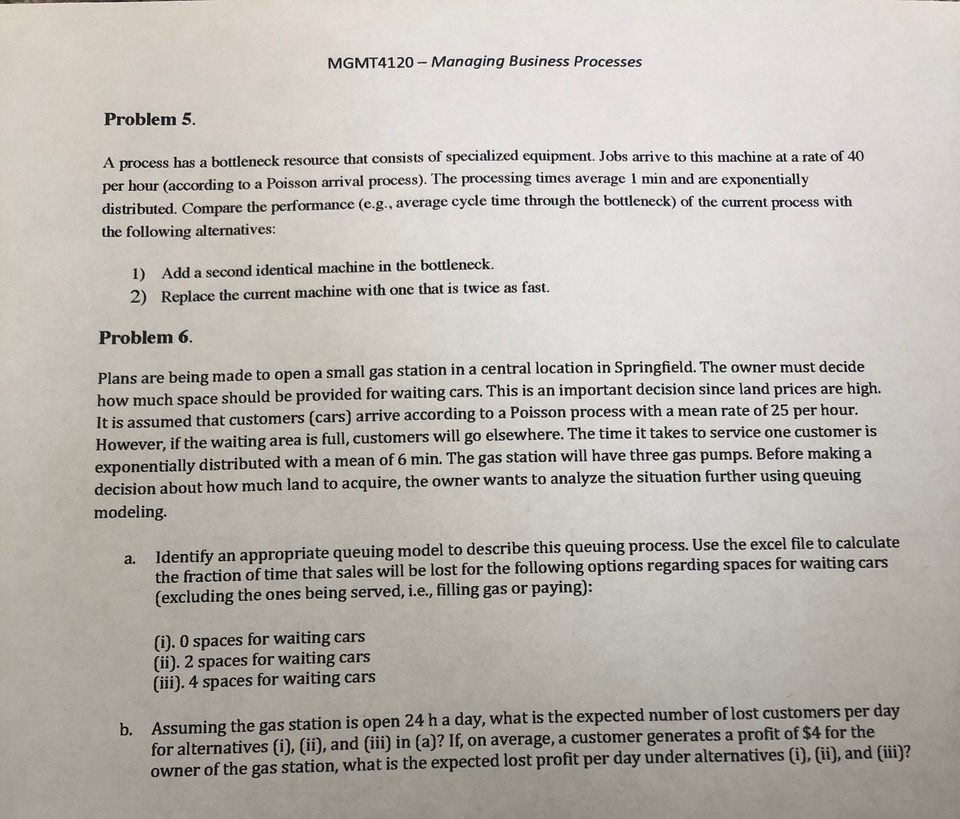
Problem 1. Purchasing requests arrive to an agent at a rate of six per day. The time between arrivals is exponentially distributed The agent typically requires 1 h to process a request. The processing time is also exponentially distributed, Assuming 8 h working days 1) What is the cycle time (the average time that a request spends in the process)? 2) What is the WIP inventory (the average number of requests in the process)? 3) How often is the WIP entirely replaced with a new set of requests? Problem 2. A pharmaceutical company has formed a team to handle FDA applications for approval of new drugs. Requests for applications arrive at a rate of 1 every year. The arrivals follow a Poisson process. On average, the team processes an application for 9 months. The company estimates that the average cost of revenue losses associated with waiting for a new drug to be approved is $100,000 per drug per month. The cost of a team is $50,000 per month. 1) Estimate the total cost due to revenue losses in the current process. 2) Should the company add a second team? Problem 3. A telecommunications company receives customer calls at a rate of 25/h. The interarrival times are exponentially distributed. Each call requires, on the average, 20 min. The times for each call also follow an exponential distribution 1) What is the minimum number of customer service agents needed for this process to reach steady state? 2) The telecommunications company would like to limit the average waiting time to 2 min or less. How many agents should the company hire? Problem 4. A case team completes jobs at a rate of 2 per hour, with actual processing times following an exponential distribution. Jobs arrive at rate of about one every 32 min and the arrival times are also considered exponential. Use queuing theory to answer the following questions: 1) What is the average cycle time? 2) What is the cycle time efficiency? (Hint: Remember that cycle time includes both processing time and waiting time.) MGMT4120 - Managing Business Processes Problem 5. A process has a bottleneck resource that consists of specialized equipment. Jobs arrive to this machine at a rate of 40 per hour (according to a Poisson arrival process). The processing times average 1 min and are exponentially distributed. Compare the performance (e.g., average cycle time through the bottleneck) of the current process with the following alternatives: 1) Add a second identical machine in the bottleneck. 2) Replace the current machine with one that is twice as fast. Problem 6. Plans are being made to open a small gas station in a central location in Springfield. The owner must decide how much space should be provided for waiting cars. This is an important decision since land prices are high. It is assumed that customers (cars) arrive according to a Poisson process with a mean rate of 25 per hour. However, if the waiting area is full, customers will go elsewhere. The time it takes to service one customer is exponentially distributed with a mean of 6 min. The gas station will have three gas pumps. Before making a decision about how much land to acquire, the owner wants to analyze the situation further using queuing modeling. a. Identify an appropriate queuing model to describe this queuing process. Use the excel file to calculate the fraction of time that sales will be lost for the following options regarding spaces for waiting cars (excluding the ones being served, i.e., filling gas or paying): (i). O spaces for waiting cars (ii). 2 spaces for waiting cars (iii). 4 spaces for waiting cars b. A Assuming the gas station is open 24 h a day, what is the expected number of lost customers per day for alternatives (i), (ii), and (iii) in (a)? If, on average, a customer generates a profit of $4 for the owner of the gas station, what is the expected lost profit per day under alternatives (i), (ii), and (iii)? Problem 1. Purchasing requests arrive to an agent at a rate of six per day. The time between arrivals is exponentially distributed The agent typically requires 1 h to process a request. The processing time is also exponentially distributed, Assuming 8 h working days 1) What is the cycle time (the average time that a request spends in the process)? 2) What is the WIP inventory (the average number of requests in the process)? 3) How often is the WIP entirely replaced with a new set of requests? Problem 2. A pharmaceutical company has formed a team to handle FDA applications for approval of new drugs. Requests for applications arrive at a rate of 1 every year. The arrivals follow a Poisson process. On average, the team processes an application for 9 months. The company estimates that the average cost of revenue losses associated with waiting for a new drug to be approved is $100,000 per drug per month. The cost of a team is $50,000 per month. 1) Estimate the total cost due to revenue losses in the current process. 2) Should the company add a second team? Problem 3. A telecommunications company receives customer calls at a rate of 25/h. The interarrival times are exponentially distributed. Each call requires, on the average, 20 min. The times for each call also follow an exponential distribution 1) What is the minimum number of customer service agents needed for this process to reach steady state? 2) The telecommunications company would like to limit the average waiting time to 2 min or less. How many agents should the company hire? Problem 4. A case team completes jobs at a rate of 2 per hour, with actual processing times following an exponential distribution. Jobs arrive at rate of about one every 32 min and the arrival times are also considered exponential. Use queuing theory to answer the following questions: 1) What is the average cycle time? 2) What is the cycle time efficiency? (Hint: Remember that cycle time includes both processing time and waiting time.) MGMT4120 - Managing Business Processes Problem 5. A process has a bottleneck resource that consists of specialized equipment. Jobs arrive to this machine at a rate of 40 per hour (according to a Poisson arrival process). The processing times average 1 min and are exponentially distributed. Compare the performance (e.g., average cycle time through the bottleneck) of the current process with the following alternatives: 1) Add a second identical machine in the bottleneck. 2) Replace the current machine with one that is twice as fast. Problem 6. Plans are being made to open a small gas station in a central location in Springfield. The owner must decide how much space should be provided for waiting cars. This is an important decision since land prices are high. It is assumed that customers (cars) arrive according to a Poisson process with a mean rate of 25 per hour. However, if the waiting area is full, customers will go elsewhere. The time it takes to service one customer is exponentially distributed with a mean of 6 min. The gas station will have three gas pumps. Before making a decision about how much land to acquire, the owner wants to analyze the situation further using queuing modeling. a. Identify an appropriate queuing model to describe this queuing process. Use the excel file to calculate the fraction of time that sales will be lost for the following options regarding spaces for waiting cars (excluding the ones being served, i.e., filling gas or paying): (i). O spaces for waiting cars (ii). 2 spaces for waiting cars (iii). 4 spaces for waiting cars b. A Assuming the gas station is open 24 h a day, what is the expected number of lost customers per day for alternatives (i), (ii), and (iii) in (a)? If, on average, a customer generates a profit of $4 for the owner of the gas station, what is the expected lost profit per day under alternatives (i), (ii), and (iii)









 Study Help