Question: Critical Thinking Homework 1212 unread replies.1212 replies. Why do you think critical thinking skills lacking in business professionals? Why? What critical thinking skills do you
Critical Thinking Homework
1212 unread replies.1212 replies.
Why do you think critical thinking skills lacking in business professionals? Why?
What critical thinking skills do you believe you possess? Why
What critical thinking skills do you believe you need to improve upon? Why?
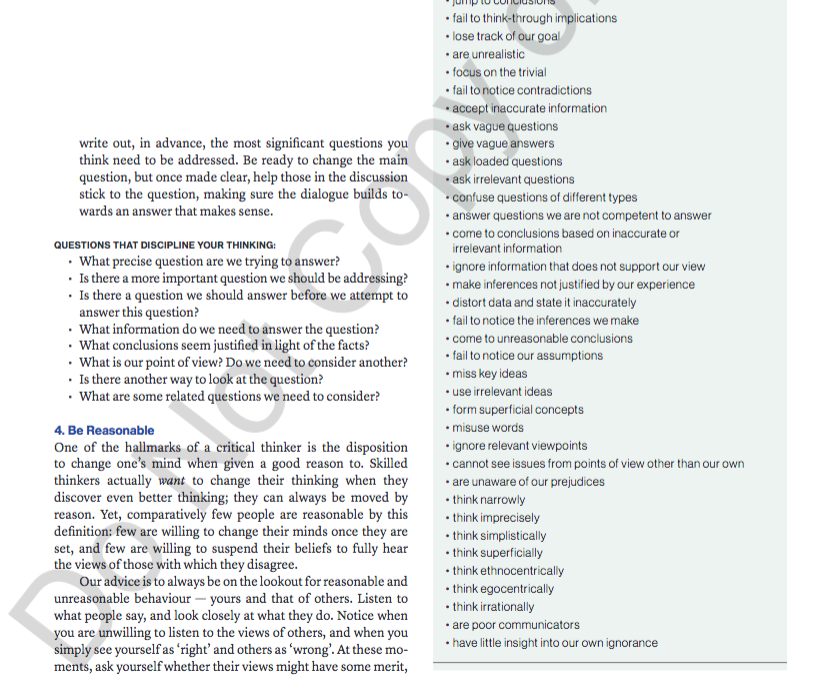
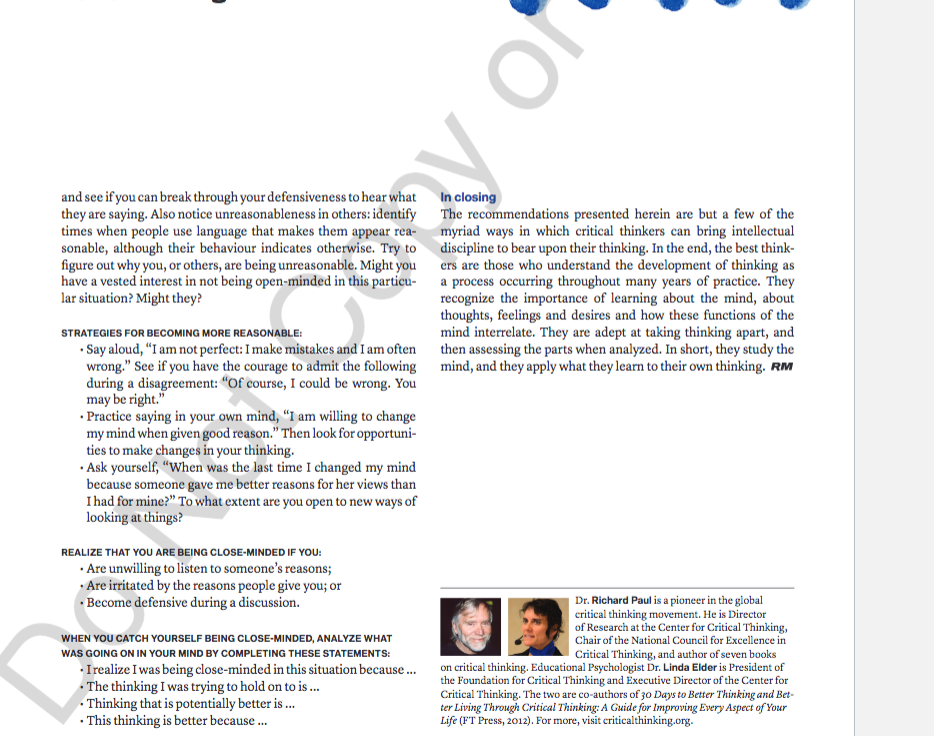
The MNCs we studied are all founding members of industry associations focused on developing sustainability standards, providing assessment tools, and offering training to first- and lower-tier suppliers. One notable association is the Responsible Business Alliance (RBA), whose members include Intel, HP, IBM, Dell, Philips, and Apple. Collaborative initiatives have many benefits. They can increase efficiencies for suppliers, who can use a standard- ized self-assessment or audit to satisfy many customers and thus avoid duplication. These initiatives can also draw in more suppliers, because suppliers that have many customers with the same sustainability requirements tend to be more willing to participate. And collaboration can make sus- tainability initiatives more feasible, because industrywide training is subsidized by members. Additionally, when MNCs help their first-tier suppliers become full members of an industry association, those suppliers must then comply with industry standards, which means they have to assess their own suppliers' sustainability. The RBA, for example, requires its full members to conduct approved audits annually for at least 25% of their own high- risk facilities and 25% of their high-risk suppliers' facilities. (Risk here is assessed along labor, health and safety, environ- mental, and ethical dimensions.) Industry associations have a unique power over both first- and lower-tier suppliers, as most of their members are major players in their sectors. Consider the electronics maker Flex, a full member of the RBA and a first-tier supplier for many MNCs. A second-tier electronics supplier is unlikely to refuse a request from Flex for a compliance audit, because it knows that Flex itself has passed this audit and that most other top- tier electronics suppliers, to stay competitive, will probably start issuing similar audit requests. IN THE MIDST OF OUR CHAOTIC WORLD, no matter what your circum- Learning About Thinking stances or goals, we can assure you of one thing: you will be bet- Ask yourself these rather unusual questions: What do you know ter off if you are a skilled thinker. As a manager, leader, employ- about how the mind processes information? What do you really ce, citizen, friend, parent - in every realm and situation of your know about how to analyze, evaluate or reconstruct your think- life - good thinking pays off. Poor thinking, in turn, inevitably ing? Where does your thinking come from? How much of it is causes problems, wastes time and energy and engenders frustra- of good quality, and how much of it is vague, muddled, incon- tion and pain. sistent, inaccurate, illogical or superficial? Are you, in any real Critical thinking is the disciplined art of ensuring that you sense, in control of your thinking? use the best thinking you are capable of in any set of circum- If you are like most people, the only honest answers to these stances, which entails asking yourself questions such as, What is questions will run along the lines of, 'Well, I suppose I really really going on in this situation? Am I deceiving myself when I don't know much about my thinking or about thinking in gen- believe that ...? What are the likely consequences of failing to...? eral. I suppose in my life I have more or less taken my thinking If I want to do X, what is the best way to prepare for it? How can I for granted. I don't really know how it works. I have never really be more successful in doing Y? Is this really my biggest problem, studied it. I don't know how I test it, or even if I do test it. It just or do I need to focus my attention somewhere else? happens in my mind automatically.' Successfully responding to such questions is the daily work It is important to realize that the serious study of thinking - of thinking. However, to maximize the quality of your thinking, serious thinking about thinking is rare. It is not a subject in most you must first learn to become an effective critic' ofit; and to be universities, and it is seldom found in our culture. But if you come an effective critic of your thinking, you have to make learn- focus your attention for a moment on the role that your think- ing about thinking a priority. In this article, we will help you get ing plays in your life, you will come to recognize that, in fact, started on this path. everything you do, want or feel is influenced by your thinking. And if you become persuaded of that, you will be surprised that you have to look not only on the surface, but also beneath the humans show so little interest in thinking. surface. There are various ways to do this: try to figure out the To make significant gains in the quality of your thinking, real meaning of important news stories, or explain your under- you will have to engage in a kind of work that most of us find un- standing of an issue to someone to help clarify it in your own pleasant, if not painful: intellectual work. Once this heavy lifting mind. Here's what you can do to begin: when people explain is done and we move our thinking to a higher level of quality, it things to you, summarize, in your own words, what you think is not hard to keep it at that level. Still, there is the price you have they just said. When you cannot do this to their satisfaction, you to pay to step up to the next level: one doesn't become a skillful haven't really understood what they said. Likewise, when they critic of thinking overnight, any more than one becomes a skill- cannot summarize what you have said to your satisfaction, they ful basketball player or musician overnight. To become better at don't really understand what you said. Try it, and see what hap- thinking, you must be willing to put the work into thinking that pens. The fact is, you should neither agree nor disagree with skilled improvement always requires. anyone until you clearly understand them. This means you must be willing to practice special acts' of thinking that are, initially at least, uncomfortable, and some- STRATEGIES FOR CLARIFYING YOUR THINKING: times challenging. You have to learn to do with your mind State one point at a time. moves' analogous to what accomplished athletes learn to do Elaborate on what you mean. (through practice and feedback) with their bodies. Improvement . Give examples that connect your thoughts to life experiences. in thinking, in other words, is similar to improvement in other Use analogies and metaphors to help people connect your domains of performance, where progress is a product of sound ideas to a variety of things that they already understand. For theory, commitment, hard work and practice. example, 'critical thinking is like an onion': there are many In this article we will present four recommendations which, layers to it. Just when you think you have it basically figured when applied, result in a mind practicing skilled thinking. Al- out, you realize there is another layer, and another, and so though we have selected these particular four, many others on and so on. could have instead been chosen. There is no magic in these spe- cific ideas: it is important to understand them as a sampling of EXERCISE: all the possible ways in which the mind can work to discipline I think (state your main point). itself, to think at a higher level of quality and to function better . In other words, (elaborate your main point). in the world. For example, (give an example of your main point). 1. Clarify Your Thinking To give you an analogy, (give an illustration of your Our own thinking usually seems clear to us, even when it is not. main point). Vague, ambiguous, muddled, deceptive or misleading thinking is a significant problem in life. If we are to develop as thinkers, TO HELP TO CLARIFY SOMEONE ELSE'S THINKING, CONSIDER ASKING we must learn the art of clarifying our thinking, of pinning it THE FOLLOWING: down, spelling it out, and giving it a specific meaning. . Can you restate your point in other words? I didn't quite un- To figure out the real meaning of what people are saying, derstand you. Where do I need to focus my attention? . Are we being diverted to unrelated matters? Am I failing to consider relevant viewpoints? What facts are going to help us answer the question? Does this truly bear on the question? How does it connect? . Can you provide an example? Let me tell you what I understand you to be saying. Did I un- derstand you correctly? 2. Stick to the Point Disciplined thinking intervenes when thoughts wander from what is pertinent and germane, concentrating the mind on only those things that help it figure out what it needs to figure out. Undisciplined thinking is often guided by associations ('this reminds me of that, and that reminds me of this other thing') rather than what is logically connected ("If a and b are true, then c must also be true'). When thinking is relevant, it is focused on the main task at hand. It selects what is salient, pertinent and related. It is on the alert for everything that connects to the issue, and sets aside what is immaterial, extraneous and beside the point. What is relevant directly bears upon (and helps solve) the problem you are trying to solve. When thinking drifts away from what is relevant, it needs to be brought back to what truly makes a difference. Always be on the lookout for fragmented thinking-think- ing that leaps about with no logical connections, and start no- ticing when you or others fail to stay focused on what is rel- evant. Focus on finding what will aid you in truly solving a problem. When someone brings up a point (however true) that doesn't seem pertinent to the issue at hand, ask, 'How is that relevant to the issue?' When you are working through a problem, make sure you stay focused on what sheds light on the problem. Don't allow your mind to wander to unrelated matters, and don't allow others to stray from the main issue. Frequently ask, What is the central question here? Is this or that relevant to it? How so? 3. Question Questions Most of us accept the world as it is presented to us and are not skilled questioners. Even when we do question something, our questions are often superficial or loaded' , which doesn't help one solve problems or make better decisions. Good thinkers routinely ask questions in order to under- stand and effectively deal with the world around them. They question the status quo on a regular basis, because they know that things are often different from the way they are presented. Their questions penetrate images, masks, fronts and propa- ganda, make real problems explicit and discipline their think- ing through those problems. If you become a student of questions, you can learn to ask powerful questions that lead to a deeper and more fulfilling life. Our advice is to be on the lookout for questions - the ones you ask, and the ones you fail to ask. Listen to other people, and begin to notice when they question and when they fail to question. Look closely at the questions being asked. Which questions do you ask, and which ones should you ask? Exam- ine the extent to which you are a questioner, or simply one who accepts the definitions of situations given by others. STRATEGIES FOR FORMULATING MORE POWERFUL QUESTIONS: Whenever you don't understand something, ask a question of clarification. Whenever you are dealing with a complex problem, formu- late the question you are trying to answer in several differ- ent ways (being as precise as you can) until you hit upon the way that best addresses the problem at hand. Whenever you plan to discuss an important issue or problem, EXERCISE: ASK YOURSELF . Am I focused on the main problem or task? Does my information directly relate to the problem or task? Rotman Management Winter 2014/ 43 write out, in advance, the most significant questions you think need to be addressed. Be ready to change the main question, but once made clear, help those in the discussion stick to the question, making sure the dialogue builds to- wards an answer that makes sense. QUESTIONS THAT DISCIPLINE YOUR THINKING: What precise question are we trying to answer? Is there a more important question we should be addressing? Is there a question we should answer before we attempt to answer this question? What information do we need to answer the question? What conclusions seem justified in light of the facts? What is our point of view? Do we need to consider another? Is there another way to look at the question? What are some related questions we need to consider? 4. Be Reasonable One of the hallmarks of a critical thinker is the disposition to change one's mind when given a good reason to. Skilled thinkers actually want to change their thinking when they discover even better thinking; they can always be moved by reason. Yet, comparatively few people are reasonable by this definition: few are willing to change their minds once they are set, and few are willing to suspend their beliefs to fully hear the views of those with which they disagree. Our advice is to always be on the lookout for reasonable and unreasonable behaviour - yours and that of others. Listen to what people say, and look closely at what they do. Notice when you are unwilling to listen to the views of others, and when you simply see yourself as 'right' and others as 'wrong'. At these mo- ments, ask yourself whether their views might have some merit, fail to think-through implications lose track of our goal are unrealistic focus on the trivial . fail to notice contradictions accept inaccurate information ask vague questions give vague answers ask loaded questions ask irrelevant questions confuse questions of different types answer questions we are not competent to answer come to conclusions based on inaccurate or irrelevant information ignore information that does not support our view make inferences not justified by our experience distort data and state it inaccurately fail to notice the inferences we make come to unreasonable conclusions fail to notice our assumptions miss key ideas use irrelevant ideas form superficial concepts misuse words ignore relevant viewpoints cannot see issues from points of view other than our own are unaware of our prejudices think narrowly think imprecisely think simplistically think superficially think ethnocentrically think egocentrically think irrationally are poor communicators have little insight into our own ignorance OT and see if you can break through your defensiveness to hear what in closing they are saying. Also notice unreasonableness in others: identify The recommendations presented herein are but a few of the times when people use language that makes them appear rea- myriad ways in which critical thinkers can bring intellectual sonable, although their behaviour indicates otherwise. Try to discipline to bear upon their thinking. In the end, the best think- figure out why you, or others, are being unreasonable. Might you ers are those who understand the development of thinking as have a vested interest in not being open-minded in this particu- a process occurring throughout many years of practice. They lar situation? Might they? recognize the importance of learning about the mind, about thoughts, feelings and desires and how these functions of the STRATEGIES FOR BECOMING MORE REASONABLE: mind interrelate. They are adept at taking thinking apart, and Say aloud, "I am not perfect: I make mistakes and I am often then assessing the parts when analyzed. In short, they study the wrong." See if you have the courage to admit the following mind, and they apply what they learn to their own thinking. RM during a disagreement: "Of course, I could be wrong. You may be right." Practice saying in your own mind, I am willing to change my mind when given good reason." Then look for opportuni- ties to make changes in your thinking. Ask yourself, "When was the last time I changed my mind because someone gave me better reasons for her views than I had for mine?" To what extent are you open to new ways of looking at things? REALIZE THAT YOU ARE BEING CLOSE-MINDED IF YOU: Are unwilling to listen to someone's reasons; Are irritated by the reasons people give you; or Become defensive during a discussion. WHEN YOU CATCH YOURSELF BEING CLOSE-MINDED, ANALYZE WHAT WAS GOING ON IN YOUR MIND BY COMPLETING THESE STATEMENTS: I realize I was being close-minded in this situation because ... The thinking I was trying to hold on to is ... Thinking that is potentially better is ... . This thinking is better because ... Dr. Richard Paul is a pioneer in the global critical thinking movement. He is Director of Research at the Center for Critical Thinking, Chair of the National Council for Excellence in Critical Thinking, and author of seven books on critical thinking. Educational Psychologist Dr. Linda Elder is President of the Foundation for Critical Thinking and Executive Director of the Center for Critical Thinking. The two are co-authors of 30 Days to Better Thinking and Bet- ter Living Through Critical Thinking: A Guide for Improving Every Aspect of Your Life (FT Press, 2012). For more, visit criticalthinking.org









 Study Help