







Question: Can someone please help me with this Multi-part question are? solve it with all steps and explanations Thanks Q1: The wireless LAN IEEE802.11n can operate
Can someone please help me with this Multi-part question are? solve it with all steps and explanations
Thanks
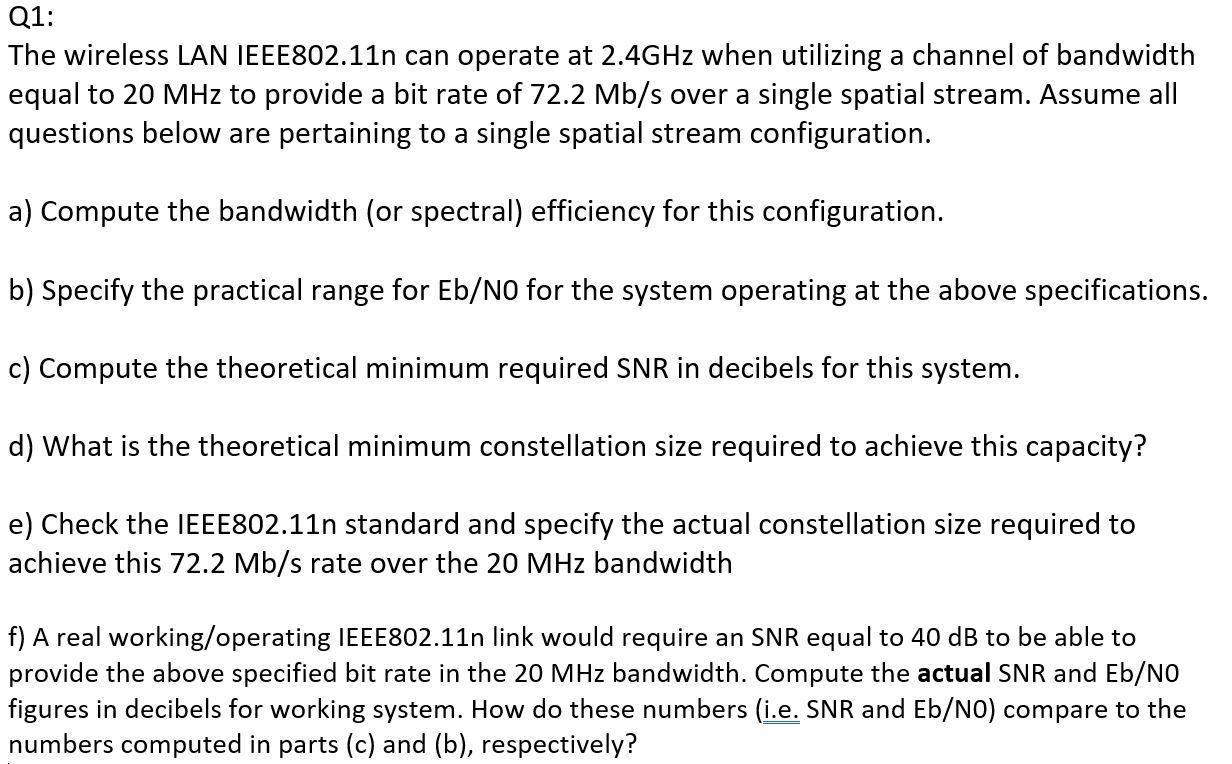
Q1: The wireless LAN IEEE802.11n can operate at 2.4GHz when utilizing a channel of bandwidth equal to 20 MHz to provide a bit rate of 72.2 Mb/s over a single spatial stream. Assume all questions below are pertaining to a single spatial stream configuration. a) Compute the bandwidth (or spectral) efficiency for this configuration. b) Specify the practical range for Eb/NO for the system operating at the above specifications. c) Compute the theoretical minimum required SNR in decibels for this system. d) What is the theoretical minimum constellation size required to achieve this capacity? e) Check the IEEE802.11n standard and specify the actual constellation size required to achieve this 72.2 Mb/s rate over the 20 MHz bandwidth f) A real working/operating IEEE802.11n link would require an SNR equal to 40 dB to be able to provide the above specified bit rate in the 20 MHz bandwidth. Compute the actual SNR and Eb/NO figures in decibels for working system. How do these numbers (i.e. SNR and Eb/NO) compare to the numbers computed in parts (c) and (b), respectively? Q1: The wireless LAN IEEE802.11n can operate at 2.4GHz when utilizing a channel of bandwidth equal to 20 MHz to provide a bit rate of 72.2 Mb/s over a single spatial stream. Assume all questions below are pertaining to a single spatial stream configuration. a) Compute the bandwidth (or spectral) efficiency for this configuration. b) Specify the practical range for Eb/NO for the system operating at the above specifications. c) Compute the theoretical minimum required SNR in decibels for this system. d) What is the theoretical minimum constellation size required to achieve this capacity? e) Check the IEEE802.11n standard and specify the actual constellation size required to achieve this 72.2 Mb/s rate over the 20 MHz bandwidth f) A real working/operating IEEE802.11n link would require an SNR equal to 40 dB to be able to provide the above specified bit rate in the 20 MHz bandwidth. Compute the actual SNR and Eb/NO figures in decibels for working system. How do these numbers (i.e. SNR and Eb/NO) compare to the numbers computed in parts (c) and (b), respectively
Step by Step Solution
There are 3 Steps involved in it

Get step-by-step solutions from verified subject matter experts
 Study Help