







Question: Can someone please help me with three questions at the bottom please. 28. Decision Rules I: Introduction to Decision Rules It is early in the
Can someone please help me with three questions at the bottom please. 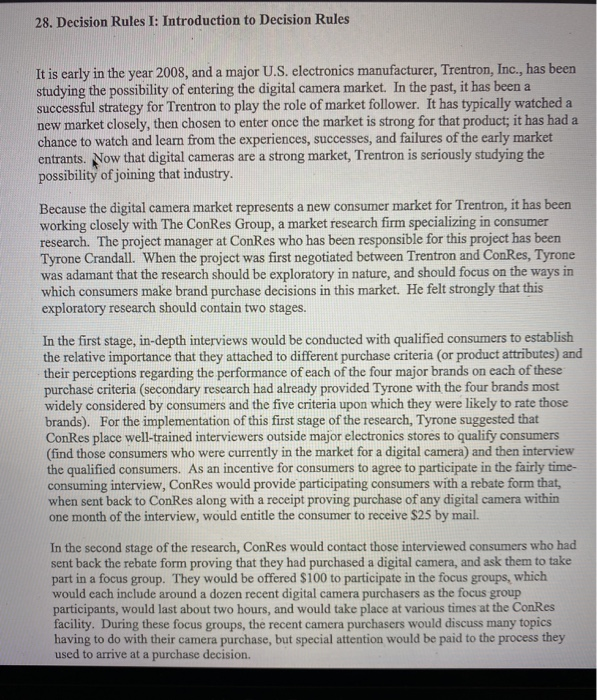
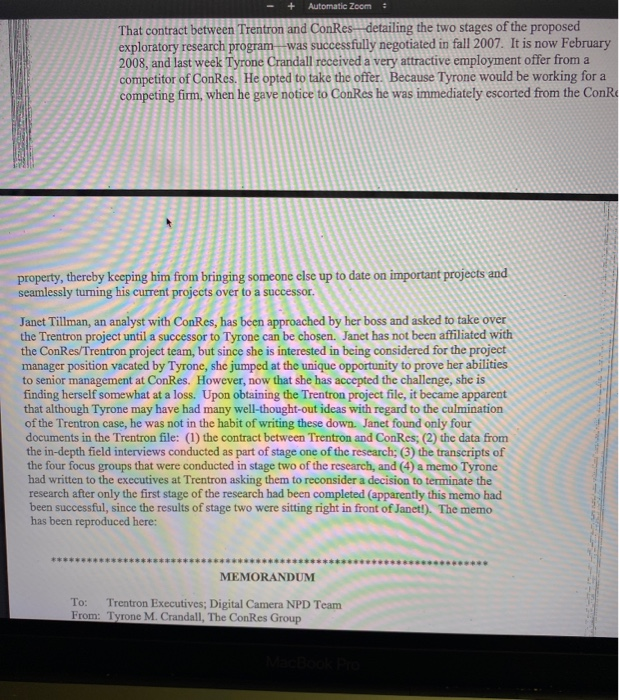

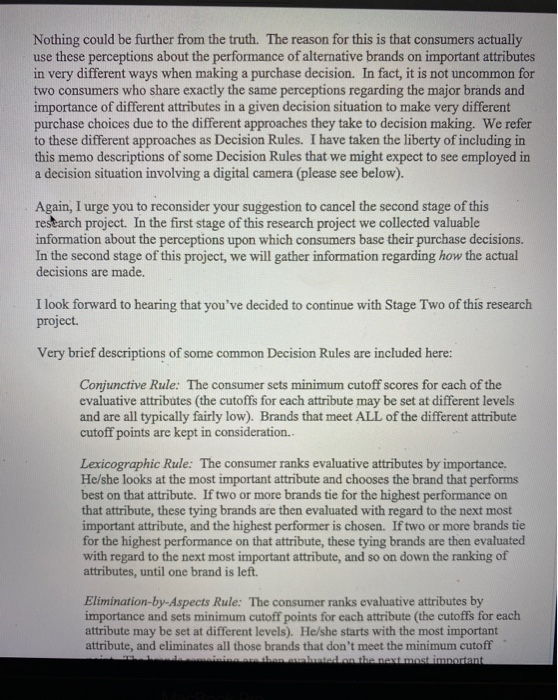
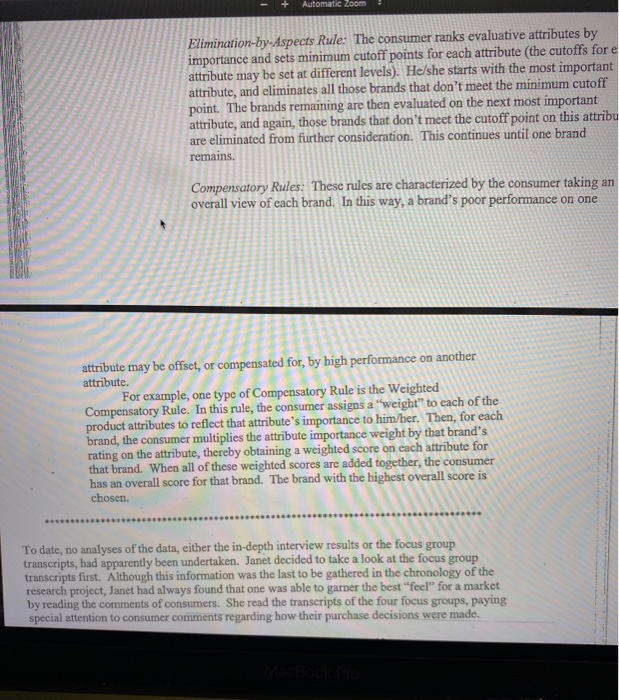
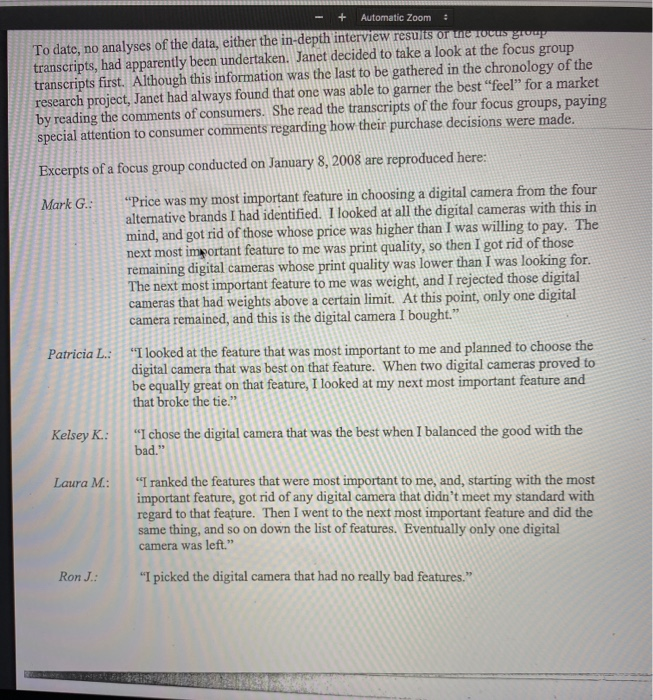
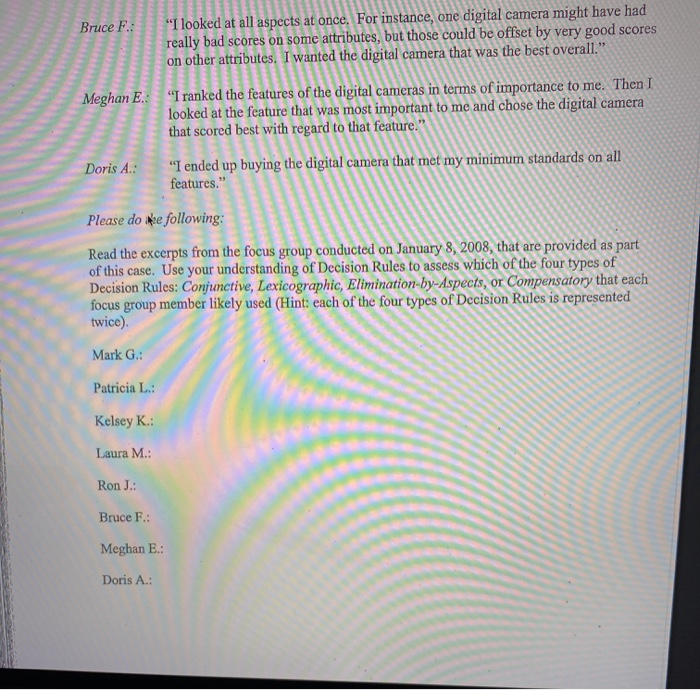
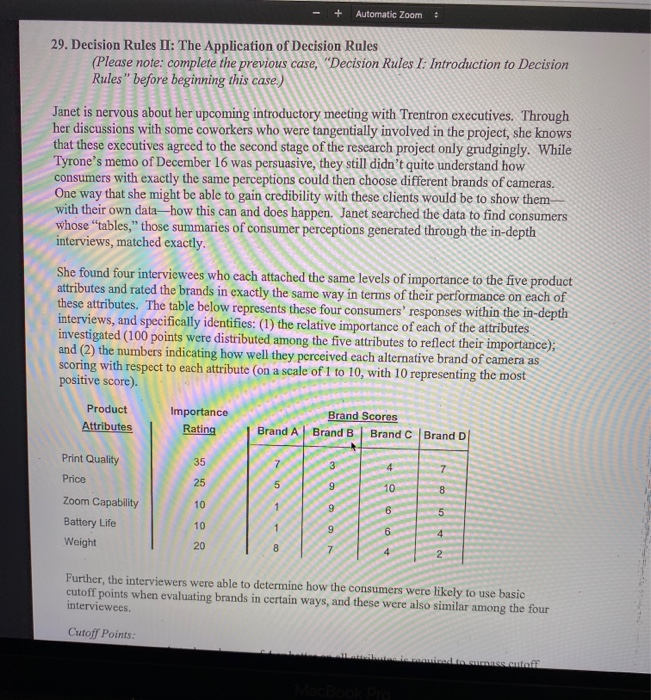
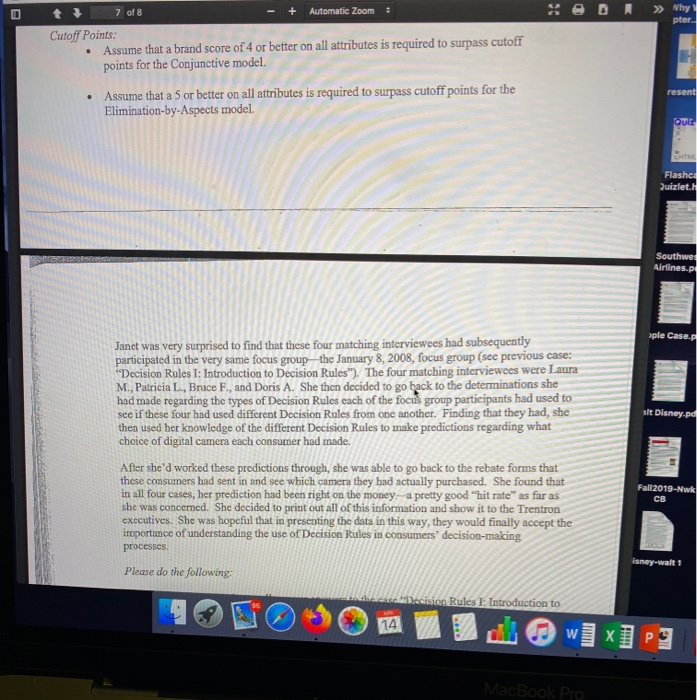

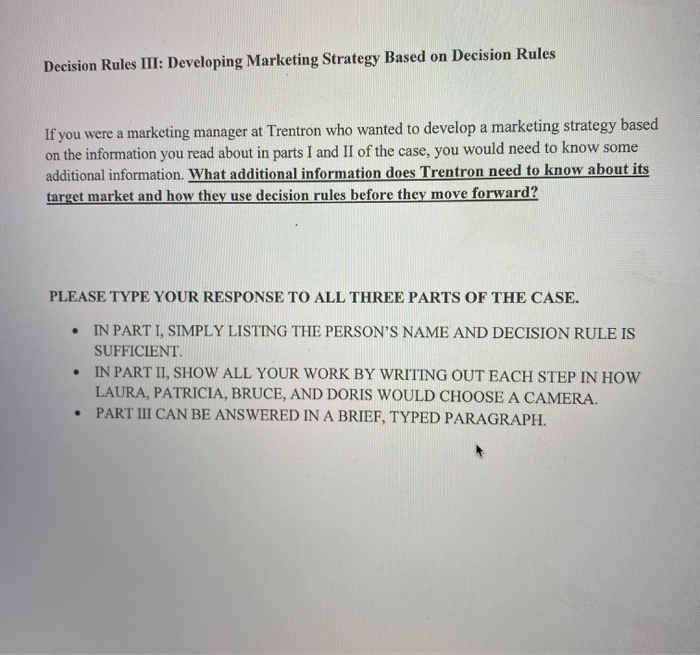
28. Decision Rules I: Introduction to Decision Rules It is early in the year 2008, and a major U.S. electronics manufacturer, Trentron, Inc., has been studying the possibility of entering the digital camera market. In the past, it has been a successful strategy for Trentron to play the role of market follower. It has typically watched a new market closely, then chosen to enter once the market is strong for that product; it has had a chance to watch and learn from the experiences, successes, and failures of the early market entrants. Now that digital cameras are a strong market, Trentron is seriously studying the possibility of joining that industry. Because the digital camera market represents a new consumer market for Trentron, it has been working closely with The ConRes Group, a market research firm specializing in consumer research. The project manager at ConRes who has been responsible for this project has been Tyrone Crandall. When the project was first negotiated between Trentron and ConRes, Tyrone was adamant that the research should be exploratory in nature, and should focus on the ways in which consumers make brand purchase decisions in this market. He felt strongly that this exploratory research should contain two stages. In the first stage, in-depth interviews would be conducted with qualified consumers to establish the relative importance that they attached to different purchase criteria (or product attributes) and their perceptions regarding the performance of each of the four major brands on each of these purchase criteria (secondary research had already provided Tyrone with the four brands most widely considered by consumers and the five criteria upon which they were likely to rate those brands). For the implementation of this first stage of the research, Tyrone suggested that ConRes place well-trained interviewers outside major electronics stores to qualify consumers (find those consumers who were currently in the market for a digital camera) and then interview the qualified consumers. As an incentive for consumers to agree to participate in the fairly time- consuming interview, ConRes would provide participating consumers with a rebate form that, when sent back to ConRes along with a receipt proving purchase of any digital camera within one month of the interview, would entitle the consumer to receive $25 by mail. In the second stage of the research, ConRes would contact those interviewed consumers who had sent back the rebate form proving that they had purchased a digital camera, and ask them to take part in a focus group. They would be offered $100 to participate in the focus groups, which would each include around a dozen recent digital camera purchasers as the focus group participants, would last about two hours, and would take place at various times at the ConRes facility. During these focus groups, the recent camera purchasers would discuss many topics having to do with their camera purchase, but special attention would be paid to the process they used to arrive at a purchase decision. - + Automatic Zoom : That contract between Trentron and ConRes detailing the two stages of the proposed exploratory research program was successfully negotiated in fall 2007. It is now February 2008, and last week Tyrone Crandall received a very attractive employment offer from a competitor of ConRes. He opted to take the offer. Because Tyrone would be working for a competing firm, when he gave notice to ConRes he was immediately escorted from the ConR EEE property, thereby keeping him from bringing someone seamlessly tuming his current projects over to a successor. date on important projects and Janet Tillman, an analyst with ConRes, has been approached by her boss and asked to take over the Trentron project until a successor to Tyrone can be chosen. Janet has not been affiliated with the ConRes/Trentron project team, but since she is interested in being considered for the project manager position vacated by Tyrone, she jumped at the unique opportunity to prove her abilities to senior management at ConRes. However, now that she has accepted the challenge, she is finding herself somewhat at a loss. Upon obtaining the Trentron project file, it became apparent that although Tyrone may have had many well-thought-out ideas with regard to the culmination of the Trentron case, he was not in the habit of writing these down. Janet found only four documents in the Trentron file: (1) the contract between Trentron and ConRes; (2) the data from the in-depth field interviews conducted as part of stage one of the research; (3) the transcripts of the four focus groups that were conducted in stage two of the research, and (4) a memo Tyrone had written to the executives at Trentron asking them to reconsider a decision to terminate the research after only the first stage of the research had been completed (apparently this memo had been successful, since the results of stage two were sitting right in front of Janet!). The memo has been reproduced here: MEMORANDUM To: Trentron Executives; Digital Camera NPD Team From: Tyrone M. Crandall, The ConRes Group : - + Automatic Zoom MEMORANDUM To: Trentron Executives; Digital Camera NPD Team From: Tyrone M. Crandall, The ConRes Group Date: December 16, 2007 Re: Necessity of completing second stage of exploratory research Let me begin by saying that I fully understand your concern regarding the cost overruns encountered in the first stage of this exploratory research. At times it can be difficult to accurately predict consumer response to our efforts, and that was certainly the case here. Although it is unusual for us to see the very high response rates we encountered in this project (nearly one-third of those qualified consumers who were asked to participate in an in-depth interview by our trained interviewers agreed to do so), and even more unusual to encounter the high number of consumers who took advantage of our rebate incentive (over half of those interviewed sent in the rebate form within one month), I urge you to see both of these surprises as happy circumstances. These numbers provide us with fertile ground for the next, necessary, stage of this research project. Whereas it may be tempting to conclude that we have obtained, through the interviews, enough information to terminate this research project, I must argue strongly that this is not the case. As you know, the first stage of this project involved the collection of information including consumers' perceptions regarding the importance of various product attributes, and how they saw each of four leading brands performing on those attributes. It is always tempting to believe that once we have collected this detailed information, we can, with confidence, predict the choice that a consumer will make. Nothing could be further from the truth. The reason for this is that consumers actually ions about the performance of alternative brands on important attributes in very different ways when making a purchase decision. In fact, it is not uncommon for the same percentions avanding the maior brands and Nothing could be further from the truth. The reason for this is that consumers actually use these perceptions about the performance of alternative brands on important attributes in very different ways when making a purchase decision. In fact, it is not uncommon for two consumers who share exactly the same perceptions regarding the major brands and importance of different attributes in a given decision situation to make very different purchase choices due to the different approaches they take to decision making. We refer to these different approaches as Decision Rules. I have taken the liberty of including in this memo descriptions of some Decision Rules that we might expect to see employed in a decision situation involving a digital camera (please see belo Again, I urge you to reconsider your suggestion to cancel the second stage of this restarch project. In the first stage of this research project we collected valuable information about the perceptions upon which consumers base their purchase decisions. In the second stage of this project, we will gather information regarding how the actual decisions are made. I look forward to hearing that you've decided to continue with Stage Two of this research project. Very brief descriptions of some common Decision Rules are included here: Conjunctive Rule: The consumer sets minimum cutoff scores for each of the evaluative attributes (the cutoffs for each attribute may be set at different levels and are all typically fairly low). Brands that meet ALL of the different attribute cutoff points are kept in consideration.. exicographic Rule: The consumer ranks evaluative attributes by importance. He/she looks at the most important attribute and chooses the brand that performs best on that attribute. If two or more brands tie for the highest performance on that attribute, these tying brands are then evaluated with regard to the next most important attribute, and the highest performer is chosen. If two or more brands tie for the highest performance on that attribute, these tying brands are then evaluated with regard to the next most important attribute, and so on down the ranking of attributes, until one brand is left. Elimination-by-Aspects Rule: The consumer ranks evaluative attributes by importance and sets minimum cutoff points for each attribute the cutoffs for each attribute may be set at different levels). He/she starts with the most important attribute, and eliminates all those brands that don't meet the minimum cutoff them ented on the next most important - + Automatic Zoom ! Elimination-by-Aspects Rule: The consumer ranks evaluative attributes by importance and sets minimum cutoff points for each attribute the cutoffs for e attribute may be set at different levels). He/she starts with the most important attribute, and eliminates all those brands that don't meet the minimum cutoff point. The brands remaining are then evaluated on the next most important attribute, and again, those brands that don't meet the cutoff point on this attribu are eliminated from further consideration. This continues until one brand remains. Compensatory Rules: These rules are characterized by the consumer taking an overall view of each brand. In this way, a brand's poor performance on one 3 SIE DU attribute may be offset, or compensated for, by high attribute. . For example, one type of Compensatory Rule is the Weighted Compensatory Rule. In this rule, the consumer assigns a "weight" to each of the product attributes to reflect that attribute's importance to him/her. Then, for each brand, the consumer multiplies the attribute importance weight by that brand's rating on the attribute, thereby obtaining a weighted score on each attribute for that brand. When all of these weighted scores are added together, the consumer has an overall score for that brand. The brand with the highest overall score is chosen. To date, no analyses of the data, either the in-depth interview results or the focus group transcripts, had apparently been undertaken. Janet decided to take a look at the focus group transcripts first. Although this information was the last to be gathered in the chronology of the research project, Janet had always found that one was able to garner the best "feel" for a market by reading the comments of consumers. She read the transcripts of the four focus groups, paying special attention to consumer comments regarding how their purchase decisions were made. - + Automatic Zoom : To date, no analyses of the data, either the in-depth interview results or te TOUS Your transcripts, had apparently been undertaken. Janet decided to take a look at the focus group transcripts first. Although this information was the last to be gathered in the chronology of the research project, Janet had always found that one was able to garner the best "feel" for a market by reading the comments of consumers. She read the transcripts of the four focus groups, paying special attention to consumer comments regarding how their purchase decisions were made. Excerpts of a focus group conducted on January 8, 2008 are reproduced here: Mark G. "Price was my most important feature in choosing a digital camera from the four alternative brands I had identified. I looked at all the digital cameras with this in mind, and got rid of those whose price was higher than I was willing to pay. The next most important feature to me was print quality, so then I got rid of those remaining digital cameras whose print quality was lower than I was looking for. The next most important feature to me was weight, and I rejected those digital cameras that had weights above a certain limit. At this point, only one digital camera remained, and this is the digital camera I bought." Patricia L. "I looked at the feature that was most important to me and planned to choose the digital camera that was best on that feature. When two digital cameras proved to be equally great on that feature, I looked at my next most important feature and that broke the tie." Kelsey K.: "I chose the digital camera that was the best when I balanced the good with the bad. Laura M.: "I ranked the features that were most important to me, and, starting with the most important feature, got rid of any digital camera that didn't meet my standard with regard to that feature. Then I went to the next most important feature and did the same thing, and so on down the list of features. Eventually only one digital camera was left." Ron J.: "I picked the digital camera that had no really bad features." "I looked at all aspects at once. For instance, one digital camera might have had really bad scores on some attributes, but those could be offset by very good scores on other attributes. I wanted the digital camera that was the best overall." "I ranked the features of the digital cameras in terms of importance to me. Then I looked at the feature that was most important to me and chose the digital camera that scored best with regard to that feature. "I ended up buying the digital camera that met my minimum standards on all features. Doris A.: Please do ke following: Read the excerpts from the focus group conducted on January 8, 2008, that are provided as part of this case. Use your understanding of Decision Rules to assess which of the four types of Decision Rules: Conjunctive, Lexicographic, Elimination-by-Aspects, or Compensatory that each focus group member likely used (Hint: each of the four types of Decision Rules is represented twice) Mark G. Patricia L.: Kelsey K: Laura M.: Ron J.: Bruce F.: Meghan E.: Doris A.: + Automatic Zoom : 29. Decision Rules II: The Application of Decision Rules (Please note: complete the previous case, "Decision Rules I: Introduction to Decision Rules" before beginning this case) Janet is nervous about her upcoming introductory meeting with Trentron executives. Through her discussions with some coworkers who were tangentially involved in the project, she knows that these executives agreed to the second stage of the research project only grudgingly. While Tyrone's memo of December 16 was persuasive, they still didn't quite understand how consumers with exactly the same perceptions could then choose different brands of cameras. One way that she might be able to gain credibility with these clients would be to show them with their own data-how this can and does happen. Janet searched the data to find consumers whose "tables," those summaries of consumer perceptions generated through the in-depth interviews, matched exactly She found four interviewees who each attached the same levels of importance to the five product attributes and rated the brands in exactly the same way in terms of their performance on each of these attributes. The table below represents these four consumers' responses within the in-depth interviews, and specifically identifies: (1) the relative importance of each of the attributes investigated (100 points were distributed among the five attributes to reflect their importance); and (2) the numbers indicating how well they perceived each alternative brand of camera as scoring with respect to each attribute (on a scale of 1 to 10, with 10 representing the most positive score). Product Attributes Importance Rating | Brand A Brand Scores Brand B | Brand C Brand D WWW CO Print Quality Price Zoom Capability Battery Life Weight Further, the interviewers were able to determine how the consumers were likely to use basic cutoff points when evaluating brands in certain ways, and these were also similar among the four interviewees. Cutoff Points: mit Scute & D >> Why i pter tt 7 of 8 - + Automatic Zoom : Cutoff Points: Assume that a brand score of 4 or better on all attributes is required to surpass cutoff points for the Conjunctive model resent Assume that a 5 or better on all attributes is required to surpass cutoff points for the Elimination-by-Aspects model. QUIE Flashca Quizlet. Southwes Airlines.pl aple Case. Janet was very surprised to find that these four matching interviewees had subsequently participated in the very same focus group- the January 8, 2008, focus group (see previous case: "Decision Rules I: Introduction to Decision Rules"). The four matching interviewees were Laura M., Patricia L., Bruce F., and Doris A. She then decided to go back to the determinations she had made regarding the types of Decision Rules each of the focus group participants had used to sce if these four had used different Decision Rules from one another. Finding that they had, she then used her knowledge of the different Decision Rules to make predictions regarding what choice of digital camera each consumer had made. alt Disney.pd Fall 2019-Nw After she'd worked these predictions through, she was able to go back to the rebate forms that these consumers had sent in and see which camera they had actually purchased. She found that in all four cases, her prediction had been right on the money a pretty good "hit rate as far as she was concerned. She decided to print out all of this information and show it to the Trentron executives. She was hopeful that in presenting the data in this way, they would finally accept the importance of understanding the use of Decision Rules in consumers' decision-making processes isney-walt 1 Please do the following: Decision Rules 1. Introduction to O Zoom Please do the following: Using the table provided, as well as your answers to the case "Decision Rules I: Introduction to Decision Rules," to ascertain which brand of camera each of these four consumers (Laura M., Patricia L., Bruce F., and Doris A) likely purchased (where a compensatory Decision Rule was used, assume that this was a weighted compensatory rule). Please show all of your work (i.e.. show each step in the decision process for each of the four consumers). Decision Rules III: Developing Marketing Strategy Based on Decision Rules If you were a marketing manager at Trentron who wanted to develop a marketing strategy based on the information you read about in parts I and II of the case, you would need to know some additional information. What additional information does Trentron need to know about its target market and how they use decision rules before they move forward? PLEASE TYPE YOUR RESPONSE TO ALL THREE PARTS OF THE CASE. IN PART I, SIMPLY LISTING THE PERSON'S NAME AND DECISION RULE IS SUFFICIENT IN PART II, SHOW ALL YOUR WORK BY WRITING OUT EACH STEP IN HOW LAURA, PATRICIA, BRUCE, AND DORIS WOULD CHOOSE A CAMERA. PART III CAN BE ANSWERED IN A BRIEF, TYPED PARAGRAPH Step by Step Solution
There are 3 Steps involved in it
1 Expert Approved Answer
Step: 1 Unlock

Question Has Been Solved by an Expert!
Get step-by-step solutions from verified subject matter experts
Step: 2 Unlock
Step: 3 Unlock
 Study Help