







Question: can someone plz help me with post lab question number 3? thank you Lab - Minivoltaic Cells Any lub M3 In electrochemistry, a voltaic cell
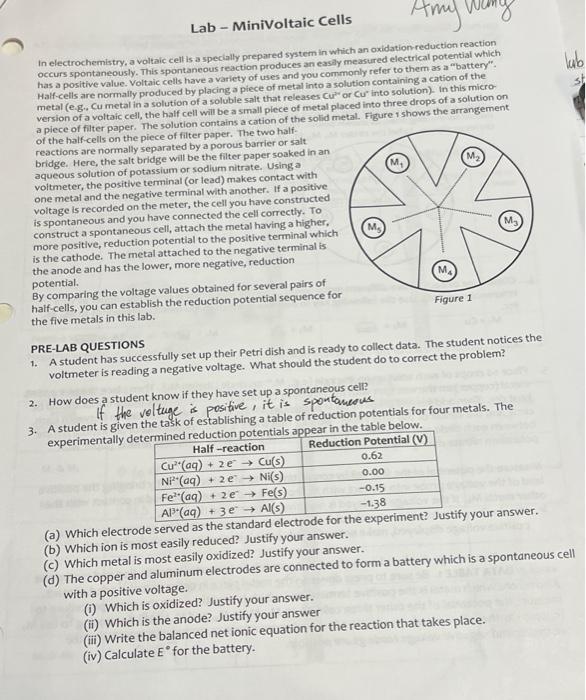
Lab - Minivoltaic Cells Any lub M3 In electrochemistry, a voltaic cell is a specially prepared system in which an oxidation reduction reaction occurs spontaneously. This spontaneous reaction produces an easily measured electrical potential which has a positive value. Voltaic cells have a variety of uses and you commonly refer to them as a "battery". Half-cells are normally produced by placing a piece of metal into a solution containing a cation of the metal (eg. Cu metal in a solution of a soluble salt that releases Cutor Cu into solution). In this micro version of a voltaic cell, the half cell will be a small piece of metal placed into three drops of a solution on a piece of filter paper. The solution contains a cation of the solid metal. Figure 1 shows the arrangement of the half-cells on the piece of filter paper. The two half- reactions are normally separated by a porous barrier or salt bridge. Here, the salt bridge will be the filter paper soaked in an aqueous solution of potassium or sodium nitrate. Using a M voltmeter, the positive terminal (or lead) makes contact with one metal and the negative terminal with another. If a positive voltage is recorded on the meter, the cell you have constructed is spontaneous and you have connected the cell correctly. To construct a spontaneous cell, attach the metal having a higher, more positive, reduction potential to the positive terminal which (M) is the cathode. The metal attached to the negative terminal is the anode and has the lower, more negative, reduction potential. M By comparing the voltage values obtained for several pairs of half-cells, you can establish the reduction potential sequence for the five metals in this lab. Figure 1 PRE-LAB QUESTIONS A student has successfully set up their Petri dish and is ready to collect data. The student notices the voltmeter is reading a negative voltage. What should the student do to correct the problem? 2. How does a student know if they have set up a spontaneous cell? If the voltage & positive, it is 1 spontaneous 3. A student is given the task of establishing a table of reduction potentials for four metals. The experimentally determined reduction potentials appear in the table below. Half-reaction Reduction Potential (V) Cu* (aq) + + 2e Cu(s) 0.62 NP"(aq) + 2e Ni(s) 0.00 Fe*(aq) + 2e Fe(s) -0.15 Al(aq) + 3e + Al(s) -1.38 (a) Which electrode served as the standard electrode for the experiment? Justify your answer. (b) Which ion is most easily reduced? Justify your answer. (c) Which metal is most easily oxidized? Justify your answer. (d) The copper and aluminum electrodes are connected to form a battery which is a spontaneous cell with a positive voltage. (1) Which is oxidized? Justify your answer. (1) Which is the anode? Justify your answer (11) Write the balanced net ionic equation for the reaction that takes place. (iv) Calculate for the battery. 1
Step by Step Solution
There are 3 Steps involved in it

Get step-by-step solutions from verified subject matter experts
 Study Help