Question: can u answer questions 3 till 7 AXA Case Study - A global insurance company example of a world class IT alignment governance process AXA
can u answer questions 3 till 7
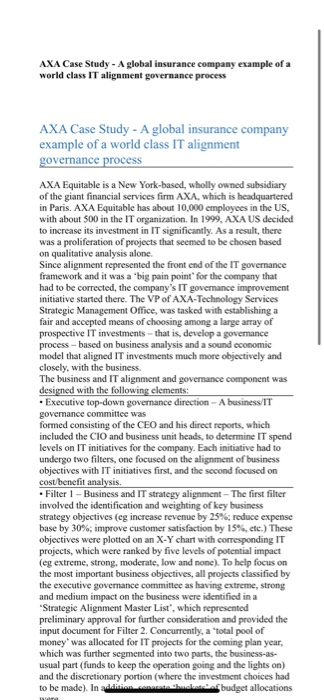
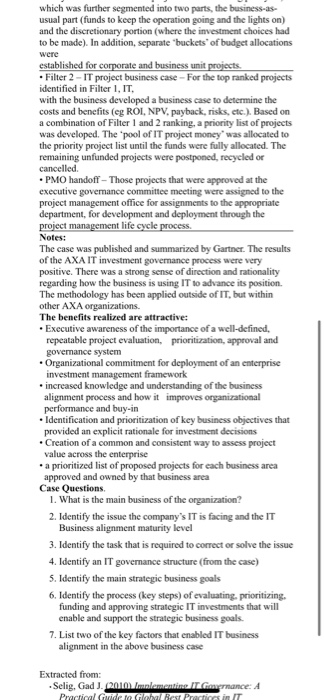
AXA Case Study - A global insurance company example of a world class IT alignment governance process AXA Case Study - A global insurance company example of a world class IT alignment governance process AXA Equitable is a New York-based, wholly owned subsidiary of the giant financial services firm AXA, which is headquartered in Paris. AXA Equitable has about 10,000 employees in the US, with about 500 in the IT organization. In 1999, AXA US decided to increase its investment in IT significantly. As a result, there was a proliferation of projects that seemed to be chosen based on qualitative analysis alone. Since alignment represented the front end of the IT governance framework and it was a big pain point for the company that had to be corrected, the company's IT governance improvement initiative started there. The VP of AXA-Technology Services Strategic Management Office, was tasked with establishing a fair and accepted means of choosing among a large array of prospective IT investments - that is, develop a governance process - based on business analysis and a sound economic model that aligned IT investments much more objectively and closely with the business The business and IT alignment and governance component was designed with the following elements: Executive top-down governance direction - A business/IT govemance committee was formed consisting of the CEO and his direct reports, which included the CIO and business unit heads, to determine IT spend levels on IT initiatives for the company. Each initiative had to undergo two filters, one focused on the alignment of business objectives with IT initiatives first, and the second focused on cost/benefit analysis. Filter 1 - Business and IT strategy alignment - The first filter involved the identification and weighting of key business strategy objectives (eg increase revenue by 25%, reduce expense base by 30%; improve customer satisfaction by 15%, etc.) These objectives were plotted on an X-Y chart with corresponding IT projects, which were ranked by five levels of potential impact (eg extreme, strong, moderate, low and none). To help focus on the most important business objectives, all projects classified by the executive governance committee as having extreme, strong and medium impact on the business were identified in a Strategic Alignment Master List', which represented preliminary approval for further consideration and provided the input document for Filter 2. Concurrently, a total pool of money' was allocated for IT projects for the coming plan year, which was further segmented into two parts, the business-as- usual part (funds to keep the operation going and the lights on) and the discretionary portion (where the investment choices had to be made). In addition cenaste budget allocations which was further segmented into two parts, the business-as- usual part (funds to keep the operation going and the lights on) and the discretionary portion (where the investment choices had to be made). In addition, separate 'buckets of budget allocations were established for corporate and business unit projects. Filter 2 - IT project business case - For the top ranked projects identified in Filter I, IT, with the business developed a business case to determine the costs and benefits (eg ROI, NPV. payback, risks, etc.). Based on a combination of Filter 1 and 2 ranking, a priority list of projects was developed. The pool of IT project money was allocated to the priority project list until the funds were fully allocated. The remaining unfunded projects were postponed, recycled or cancelled. PMO handoff - Those projects that were approved at the executive govemance committee meeting were assigned to the project management office for assignments to the appropriate department, for development and deployment through the project management life cycle process Notes: The case was published and summarized by Gartner. The results of the AXA IT investment governance process were very positive. There was a strong sense of direction and rationality regarding how the business is using IT to advance its position. The methodology has been applied outside of IT, but within other AXA organizations. The benefits realized are attractive: Executive awareness of the importance of a well-defined, repeatable project evaluation, prioritization, approval and governance system Organizational commitment for deployment of an enterprise investment management framework increased knowledge and understanding of the business alignment process and how it improves organizational performance and buy-in Identification and prioritization of key business objectives that provided an explicit rationale for investment decisions Creation of a common and consistent way to assess project value across the enterprise . a prioritized list of proposed projects for each business area approved and owned by that business area Case Questions 1. What is the main business of the organization? 2. Identify the issue the company's IT is facing and the IT Business alignment maturity level 3. Identify the task that is required to correct or solve the issue 4. Identify an IT governance structure (from the case) 5. Identify the main strategic business goals 6. Identify the process (key steps) of evaluating prioritizing. funding and approving strategic IT investments that will enable and support the strategic business goals. 7. List two of the key factors that enabled IT business alignment in the above business case Extracted from: Selig, Gad J. 2010 Implementing IT Governance: A Practical Guide to Global Best Practices in IT









 Study Help