



Question: can u answer these question ? 3. Consider a closed economy that can be described by the following functions: Y = C+k+G NO DATE C=
can u answer these question ?
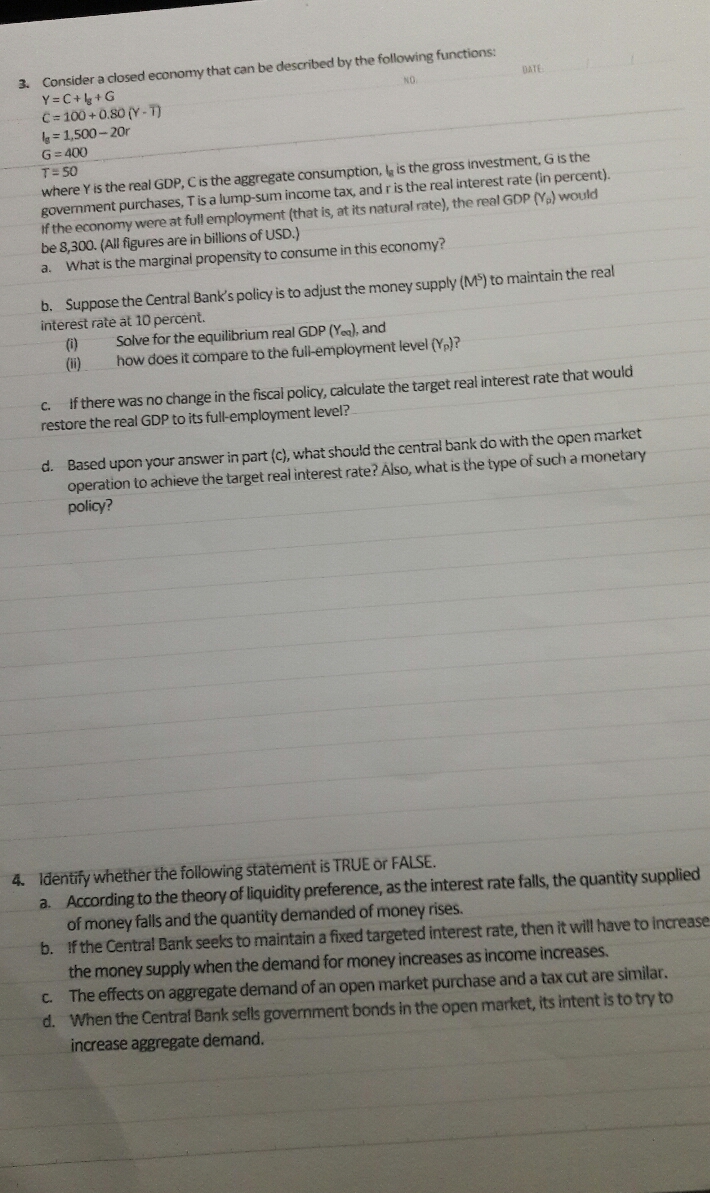
3. Consider a closed economy that can be described by the following functions: Y = C+k+G NO DATE C= 100 +0.80 (Y - T) lg = 1,500-20r G =400 T= 50 where Y is the real GDP, C is the aggregate consumption, i, is the gross investment, G is the government purchases, Tis a lump-sum income tax, and r is the real interest rate (in percent). If the economy were at full employment (that is, at its natural rate), the real GDP (Yp) would be 8,300. (All figures are in billions of USD.) a. What is the marginal propensity to consume in this economy? b. Suppose the Central Bank's policy is to adjust the money supply (MS) to maintain the real interest rate at 10 percent. (i) Solve for the equilibrium real GDP (Yea), and (ii) how does it compare to the full-employment level (Yp)? c. If there was no change in the fiscal policy, calculate the target real interest rate that would restore the real GDP to its full-employment level? d. Based upon your answer in part (c), what should the central bank do with the open market operation to achieve the target real interest rate? Also, what is the type of such a monetary policy? 4. Identify whether the following statement is TRUE or FALSE. a. According to the theory of liquidity preference, as the interest rate falls, the quantity supplied of money falls and the quantity demanded of money rises. b. If the Central Bank seeks to maintain a fixed targeted interest rate, then it will have to increase the money supply when the demand for money increases as income increases. c. The effects on aggregate demand of an open market purchase and a tax cut are similar. d. When the Central Bank sells government bonds in the open market, its intent is to try to increase aggregate demand
Step by Step Solution
There are 3 Steps involved in it

Get step-by-step solutions from verified subject matter experts