







Question: can you answer 1-4 in full sentences. Thinking Critically 7.1 500 EURO 200 100 50 >> QUESTIONABLE MOTIVES Bradley Birkenfeld was born in the Boston
can you answer 1-4 in full sentences. 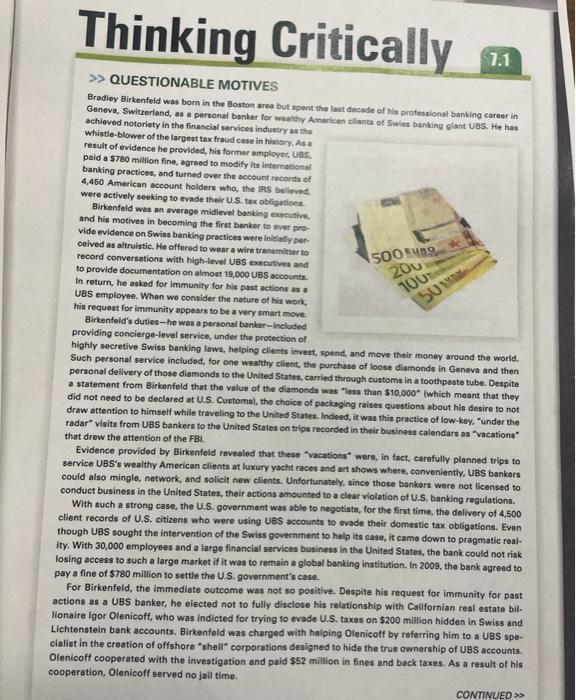
Thinking Critically 7.1 500 EURO 200 100 50 >> QUESTIONABLE MOTIVES Bradley Birkenfeld was born in the Boston area but spent the last decade of his professional banking career in Geneva, Switzerland, as a personal banker forway American clients of Swiss banking glont UBS. He has achieved notoriety in the financial services industry as the whistle blower of the largest tax fraud case in history. As a result of evidence he provided, his former employer, UBS paid a $780 million fine, agreed to modify its international banking practices, and turned over the account records of 4,450 American account holders who, the IRS beloved were actively seeking to evade their U.S.tax obligations Birkenfeld was an average midlevel bancing executive and his motives in becoming the first banker toever pro- vide evidence on Swiss banking practices were in per ceived as altruistic. He offered to wear a wire transmitter to record conversations with high-level UBS Executives and to provide documentation on almost 19.000 UBS accounts In return, he asked for immunity for his past actions as a UBS employee. When we consider the nature of his work, his request for immunity appears to be a very smart move Birkenfeld's duties-he was a personal banker-included providing concierge-level service, under the protection of highly secretive Swiss banking laws, helping clients invest, spend, and move their money around the world. Such personal service included, for one wealthy client, the purchase of loose diamonds in Geneva and then personal delivery of those diamonds to the United States, carried through customs in a toothpaste tube. Despite a statement from Birkenfeld that the value of the diamonds was less than $10,000" (which meant that they did not need to be declared at U.S. Customs, the choice of packaging raises questions about his desire to not draw attention to himself while traveling to the United States. Indeed, it was this practice of low-key. "under the radar" visits from UBS bankers to the United States on trips recorded in their business calendars as "vacations that drew the attention of the FBI. Evidence provided by Birkenfeld revealed that these "vacations were, in fact, carefully planned trips to service UBS's wealthy American clients at luxury yacht races and art shows where, conveniently. UBS bankers could also mingle, network, and solicit new clients. Unfortunately, since those bankers were not licensed to conduct business in the United States, their actions amounted to a clear violation of U.S. banking regulations. With such a strong case, the U.S. government was able to negotiate for the first time, the delivery of 4,500 client records of U.S. citizens who were using UBS accounts to evade their domestic tax obligations. Even though UBS sought the intervention of the Swiss government to help its case, it came down to pragmatic real- ity. With 30,000 employees and a large financial services business in the United States, the bank could not risk losing access to such a large market if it was to remain a global banking institution. In 2009, the bank agreed to pay a fine of $780 million to settle the U.S. government's case. For Birkenfeld, the immediate outcome was not so positive. Despite his request for immunity for past actions as a UBS banker, he elected not to fully disclose his relationship with Californian real estate bil- lionaire Igor Olenicoff, who was indicted for trying to evade U.S. taxes on $200 million hidden in Swiss and Lichtenstein bank accounts. Birkenfeld was charged with helping Olenicotf by referring him to a UBS spe- cialist in the creation of offshore "shell" corporations designed to hide the true ownership of UBS accounts. Olenicoff cooperated with the investigation and paid $52 million in fines and back taxes. As a result of his cooperation, Olenicoff served no jall time. CONTINUED >> Birkenfeld, on the other hand, was charged with conspiracy to commit tax fraud, pleaded guilty, and received a sentence of 40 months in prison, beginning in January 2010. While he does not dispute his relationship with Olenicoft, Birkenfeld maintained that his involvement was only as a referral to another UBS specialist. As such, he felt strongly that his jail time was unjust given his altruistic services to the U.S. government in providing evidence against UBS. The Department of Justice officials who indicted Birkenfeld stated that if he had fully disclosed the nature of his relationship with Olenicoft, it's unlikely that he would have been prosecuted, which brings us back to the question of Birkenfeld's true motives in coming forward as a whistle-blower-was it really altruism, or was he looking for a way to handle the mess that the Olenicoft case had created for him? In either event, there was a definite silver lining in Birkenfeld's cloud. As a key figure in the qui tam lawsuit between the U.S. government and UBS, he was eligible for up to 30 percent of the money recovered from UBS. On September 11, 2012, the IRS announced that he would receive $104 million for his assistance in the UBS case. Birkenfeld was unable to be present at the press conference announcing the award since he was under house arrest until November 2012. One last ironic fact in Mr. Birkenfeld's battle with his former employer and the U.S. government-his award was taxable. QUESTIONS 1. Birkenfeld was adamant that his prison sentence was unfair when compared to the fact that no one else (e.g., Olenicoff or UBS bankers) went to jail. Did he have a point? 2. Why did UBS elect to settle with the U.S. government? 3. Given that there was an immunity agreement in place, what did the Department of Justice gain from prosecuting Birkenfeld? 4. Critics are concerned that even with the large qui tam award, Birkenfeld's prison sentence will discourage other tax whistle blowers from coming forward. Is that a valid concern? Why or why not? Sources: Janet Novack, "Banker Charged with Helping Billionaire Dodge Taxes," Forbes, May 13, 2008: Ken Stier, "Why is the UBS Whistle-Blower Headed to Prison?" Time, October 6, 2009, Stephen M. Kohn, "Whistleblowing: A Get Rich-Quick Schemer Forbes, December 4, 2009, Haig Simonian, "The Price of a Whistleblower," Financial Times, February 9, 2010: Ken Stier. *U.S. vs. Swiss Tax Cheats: A Whistleblower Ignored," Time, February 13, 2010; David Voreacos, "Banker Who Blew Whistle over Tax Cheats Seeks Pardon, Bloomberg, June 24, 2010, CBS, "A Crack in the Swiss Vault." 60 Minutes, August 15, 2010; and The Economist "The UBS Whistleblower Bradley's Winnings." September 15, 2012
Step by Step Solution
There are 3 Steps involved in it
1 Expert Approved Answer
Step: 1 Unlock

Question Has Been Solved by an Expert!
Get step-by-step solutions from verified subject matter experts
Step: 2 Unlock
Step: 3 Unlock
 Study Help