







Question: Can you answer Chapter 7, Case 25 CASES CASE 7-25 Comprehensive Activity-Based Costing [LO2,LO3,LO5 Kolbec Community College (KCC) has 4,000 full-time students and offers a
Can you answer Chapter 7, Case 25
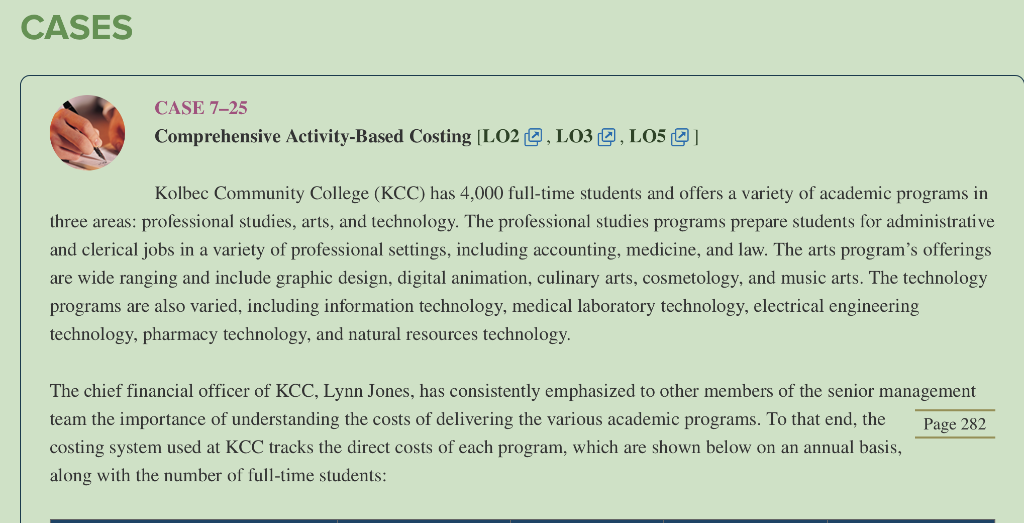
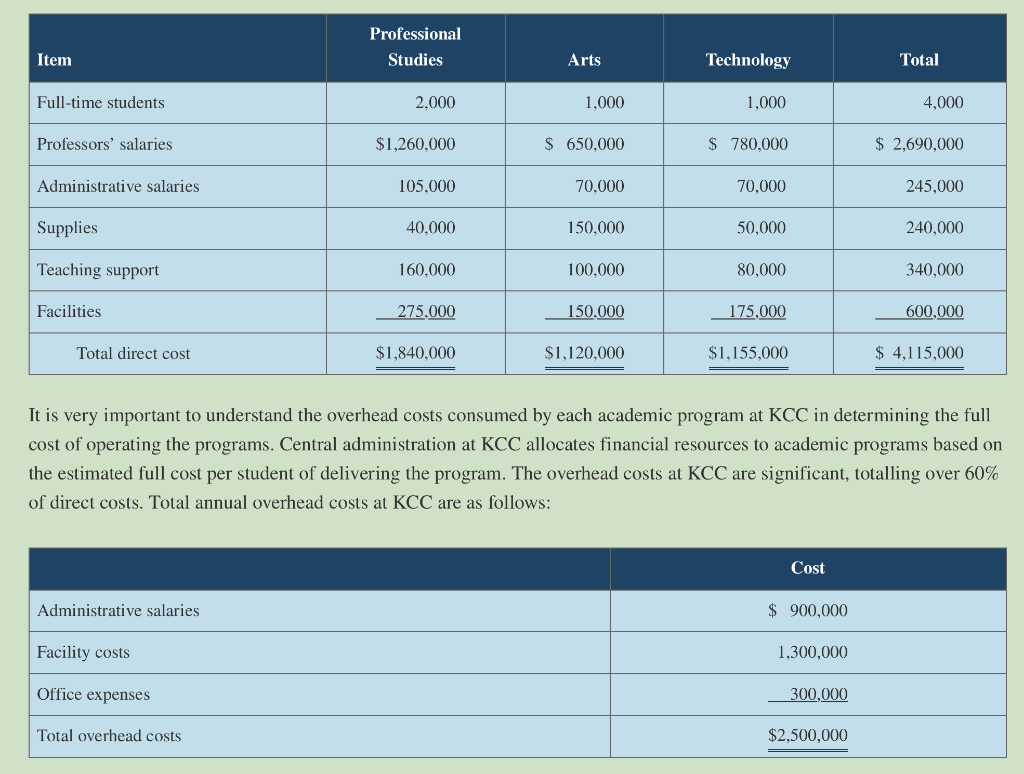
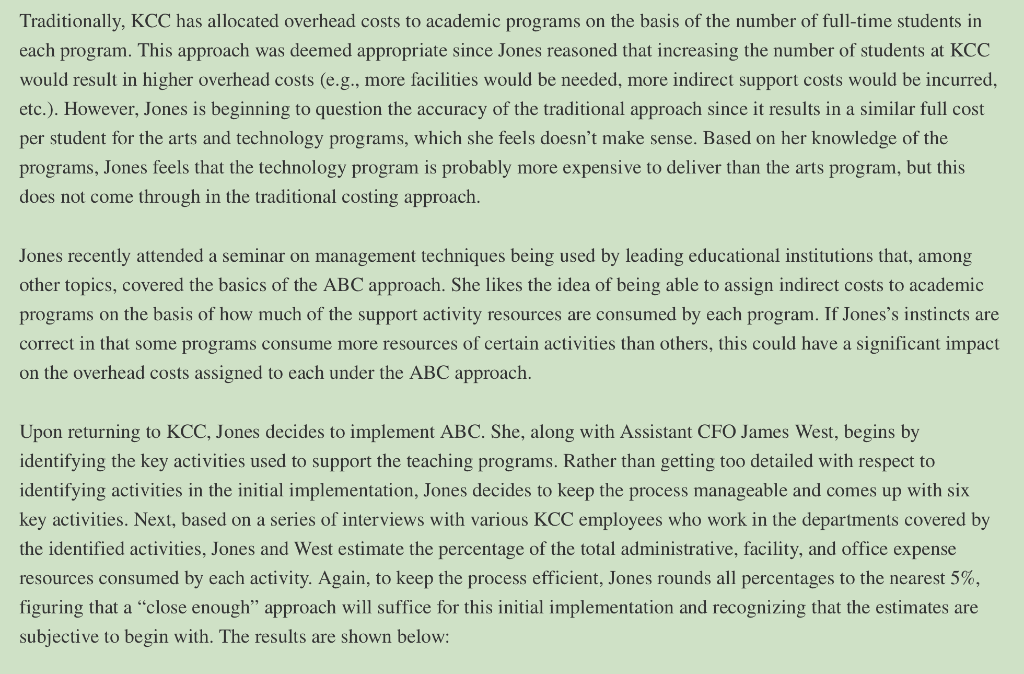
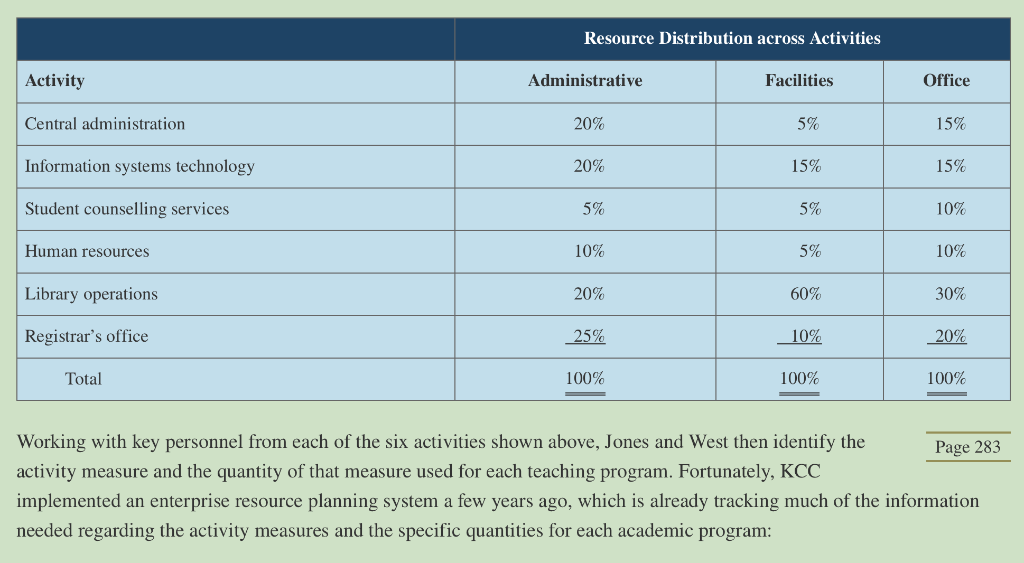
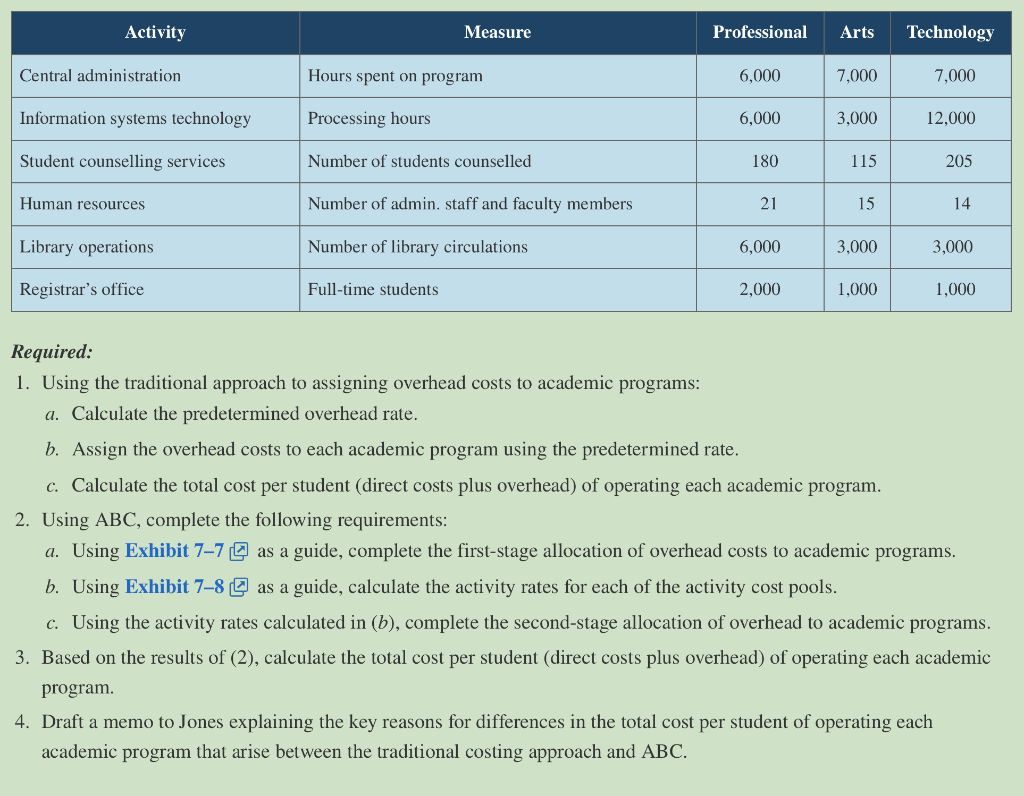
CASES CASE 7-25 Comprehensive Activity-Based Costing [LO2,LO3,LO5 Kolbec Community College (KCC) has 4,000 full-time students and offers a variety of academic programs in three areas: professional studies, arts, and technology. The professional studies programs prepare students for administrative and clerical jobs in a variety of professional settings, including accounting, medicine, and law. The arts program's offerings are wide ranging and include graphic design, digital animation, culinary arts, cosmetology, and music arts. The technology programs are also varied, including information technology, medical laboratory technology, electrical engineering technology pharmacy technology, and natural resources technology The chief financial officer of KCC, Lynn Jones, has consistently emphasized to other members of the senior management team the importance of understanding the costs of delivering the various academic programs. To that end, the costing system used at KCC tracks the direct costs of each program, which are shown below on an annual basis, along with the number of full-time students: age Professional Studies Item Arts Technology 1,000 S 780,000 70,000 50,000 80,000 Total Full-time students Professors' salaries Administrative salaries Supplies Teaching support Facilities 2,000 $1,260,000 105,000 40,000 1,000 S 650,000 70.000 150,000 100,000 150,000 $1,120,000 4,000 2,690,000 245,000 240,000 340,000 600,000 $ 4,115,000 160,000 275,000 $1,840,000 175,000 Total direct cost $1,155,000 It is very important to understand the overhead costs consumed by each academic program at KCC in determining the ful cost of operating the programs. Central administration at KCC allocates financial resources to academic programs based on the estimated full cost per student of delivering the program. The overhead costs at KCC are significant, totaling over 60% of direct costs. Total annual overhead costs at KCC are as follows: Cost 900,000 1,300,000 300,000 $2,500,000 Administrative salaries Facility costs Office expenses Total overhead costs Traditionally, KCC has allocated overhead costs to academic programs on the basis of the number of full-time students in each program. This approach was deemed appropriate since Jones reasoned that increasing the number of students at KCC would result in higher overhead costs (e.g., more facilities would be needed, more indirect support costs would be incurred etc.). However, Jones is beginning to question the accuracy of the traditional approach since it results in a similar full cost per student for the arts and technology programs, which she feels doesn't make sense. Based on her knowledge of the programs, Jones feels that the technology program is probably more expensive to deliver than the arts program, but this does not come through in the traditional costing approach. Jones recently attended a seminar on management techniques being used by leading educational institutions that, among other topics, covered the basics of the ABC approach. She likes the idea of being able to assign indirect costs to academic programs on the basis of how much of the support activity resources are consumed by each program. If Jones's instincts are correct in that some programs consume more resources of certain activities than others, this could have a significant impact on the overhead costs assigned to each under the ABC approach. Upon returning to KCC, Jones decides to implement ABC. She, along with Assistant CFO James West, begins by identifying the key activities used to support the teaching programs. Rather than getting too detailed with respect to identifying activities in the initial implementation, Jones decides to keep the process manageable and comes up with six key activities. Next, based on a series of interviews with various KCC employees who work in the departments covered by the identified activities, Jones and West estimate the percentage of the total administrative, facility, and office expense resources consumed by each activity. Again, to keep the process efficient, Jones rounds all percentages to the nearest 5% figuring that a "close enough" approach will suffice for this initial implementation and recognizing that the estimates are subjective to begin with. The results are shown below: Resource Distribution across Activities Activity Central administration Information systems technology Student counselling services Human resources Library operations Registrar's office Office 15% 15% 10% 10% 30% 20% 100% Administrative Facilities 20% 20% 5% 10% 20% 25% 100% 5% 15% 5% 5% 10% Total 100% Working with key personnel from each of the six activities shown above, Jones and West then identify the activity measure and the quantity of that measure used for each teaching program. Fortunately, KCC implemented an enterprise resource planning system a few years ago, which is already tracking much of the information needed regarding the activity measures and the specific quantities for each academic program Page 283 Activity Measure Professional Arts Technology 6,000 6,000 180 21 6,000 2,000 7,000 12,000 205 14 3,000 1,000 Central administration Information systems technology Student counselling services Hours spent on program Processing hours Number of students counselled Number of admin. staff and faculty members Number of library circulations Full-time students 7,000 3,000 115 15 3,000 1,000 Human resources Library operations Registrar's office Required.: 1. Using the traditional approach to assigning overhead costs to academic programs a. Calculate the predetermined overhead rate. b. Assign the overhead costs to each academic program using the predetermined rate c. Calculate the total cost per student (direct costs plus overhead) of operating each academic program 2. Using ABC, complete the following requirements a. Using Exhibit 7-7 as a guide, complete the first-stage allocation of overhead costs to academic programs b. Using Exhibit 7-8 as a guide, calculate the activity rates for each of the activity cost pools c. Using the activity rates calculated in (b), complete the second-stage allocation of overhead to academic programs 3. Based on the results of (2), calculate the total cost per student (direct costs plus overhead) of operating each academic programm 4. Draft a memo to Jones explaining the key reasons for differences in the total cost per student of operating each academic program that arise between the traditional costing approach and ABC
Step by Step Solution
There are 3 Steps involved in it

Get step-by-step solutions from verified subject matter experts
 Study Help