







Question: Can you do these two questions step by step based on Wesfarmers's annual report 2022 Profile of an investor of the company Describe who would
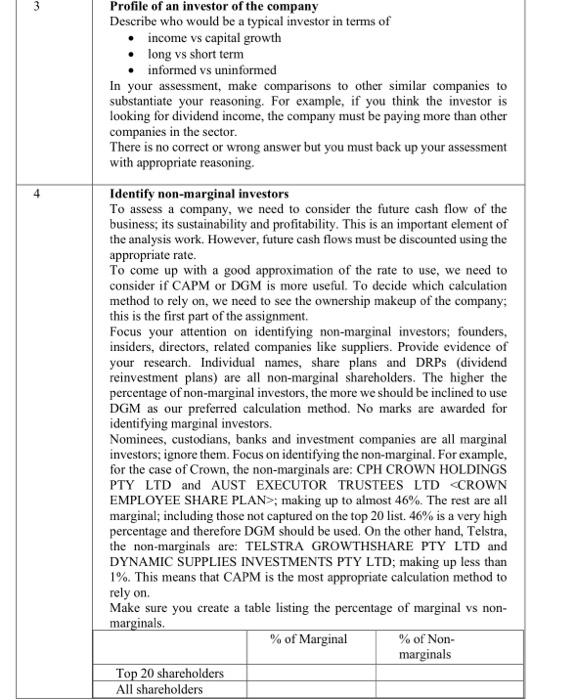
Profile of an investor of the company Describe who would be a typical investor in terms of - income vs capital growth - long vs short term - informed vs uninformed In your assessment, make comparisons to other similar companies to substantiate your reasoning. For example, if you think the investor is looking for dividend income, the company must be paying more than other companies in the sector. There is no correct or wrong answer but you must back up your assessment with appropriate reasoning. Identify non-marginal investors To assess a company, we need to consider the future cash flow of the business; its sustainability and profitability. This is an important element of the analysis work. However, future cash flows must be discounted using the appropriate rate. To come up with a good approximation of the rate to use, we need to consider if CAPM or DGM is more useful. To decide which calculation method to rely on, we need to see the ownership makeup of the company; this is the first part of the assignment. Focus your attention on identifying non-marginal investors; founders, insiders, directors, related companies like suppliers. Provide evidence of your research. Individual names, share plans and DRPs (dividend reinvestment plans) are all non-marginal shareholders. The higher the percentage of non-marginal investors, the more we should be inclined to use DGM as our preferred calculation method. No marks are awarded for identifying marginal investors. Nominees, custodians, banks and investment companies are all marginal investors; ignore them. Focus on identifying the non-marginal. For example, for the case of Crown, the non-marginals are: CPH CROWN HOLDINGS PTY LTD and AUST EXECUTOR TRUSTEES LTD CROWN EMPLOYEE SHARE PLAN>; making up to almost 46%. The rest are all marginal; including those not captured on the top 20 list. 46% is a very high percentage and therefore DGM should be used. On the other hand, Telstra, the non-marginals are: TELSTRA GROWTHSHARE PTY LTD and DYNAMIC SUPPLIES INVESTMENTS PTY LTD; making up less than 1%. This means that CAPM is the most appropriate calculation method to rely on. Make sure you create a table listing the percentage of marginal vs nonmarginals. \begin{tabular}{|l|c|c|} \hline & \% of Marginal & %ofNon-marginals \\ \hline Top 20 shareholders & & \\ \hline All shareholders & & \\ \hline \end{tabular} Profile of an investor of the company Describe who would be a typical investor in terms of - income vs capital growth - long vs short term - informed vs uninformed In your assessment, make comparisons to other similar companies to substantiate your reasoning. For example, if you think the investor is looking for dividend income, the company must be paying more than other companies in the sector. There is no correct or wrong answer but you must back up your assessment with appropriate reasoning. Identify non-marginal investors To assess a company, we need to consider the future cash flow of the business; its sustainability and profitability. This is an important element of the analysis work. However, future cash flows must be discounted using the appropriate rate. To come up with a good approximation of the rate to use, we need to consider if CAPM or DGM is more useful. To decide which calculation method to rely on, we need to see the ownership makeup of the company; this is the first part of the assignment. Focus your attention on identifying non-marginal investors; founders, insiders, directors, related companies like suppliers. Provide evidence of your research. Individual names, share plans and DRPs (dividend reinvestment plans) are all non-marginal shareholders. The higher the percentage of non-marginal investors, the more we should be inclined to use DGM as our preferred calculation method. No marks are awarded for identifying marginal investors. Nominees, custodians, banks and investment companies are all marginal investors; ignore them. Focus on identifying the non-marginal. For example, for the case of Crown, the non-marginals are: CPH CROWN HOLDINGS PTY LTD and AUST EXECUTOR TRUSTEES LTD CROWN EMPLOYEE SHARE PLAN>; making up to almost 46%. The rest are all marginal; including those not captured on the top 20 list. 46% is a very high percentage and therefore DGM should be used. On the other hand, Telstra, the non-marginals are: TELSTRA GROWTHSHARE PTY LTD and DYNAMIC SUPPLIES INVESTMENTS PTY LTD; making up less than 1%. This means that CAPM is the most appropriate calculation method to rely on. Make sure you create a table listing the percentage of marginal vs nonmarginals. \begin{tabular}{|l|c|c|} \hline & \% of Marginal & %ofNon-marginals \\ \hline Top 20 shareholders & & \\ \hline All shareholders & & \\ \hline \end{tabular}
Step by Step Solution
There are 3 Steps involved in it

Get step-by-step solutions from verified subject matter experts
 Study Help