







Question: how to set up this problem by providing a response to each prompt using physics concepts or formulas? Please include each math step so I
how to set up this problem by providing a response to each prompt using physics concepts or formulas? Please include each math step so I can check my own work. This may involve the topic of Potential Energy is other power conversions.
(An LWS tower uses surplus energy to mechanically lift solid weights vertically, typically on a pulley system. When extra energy is needed, the mass is lowered, and the pulley turns the generator)
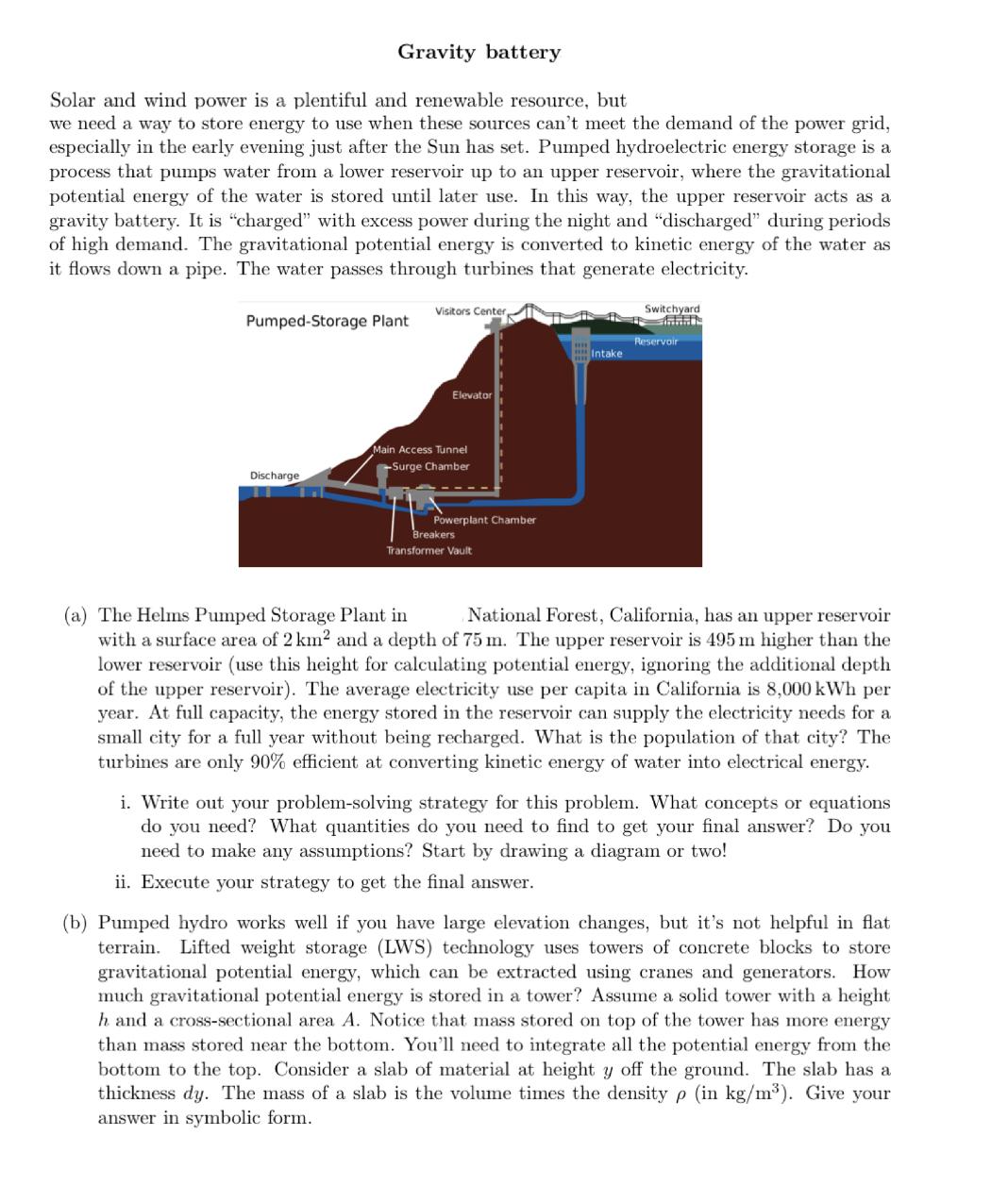
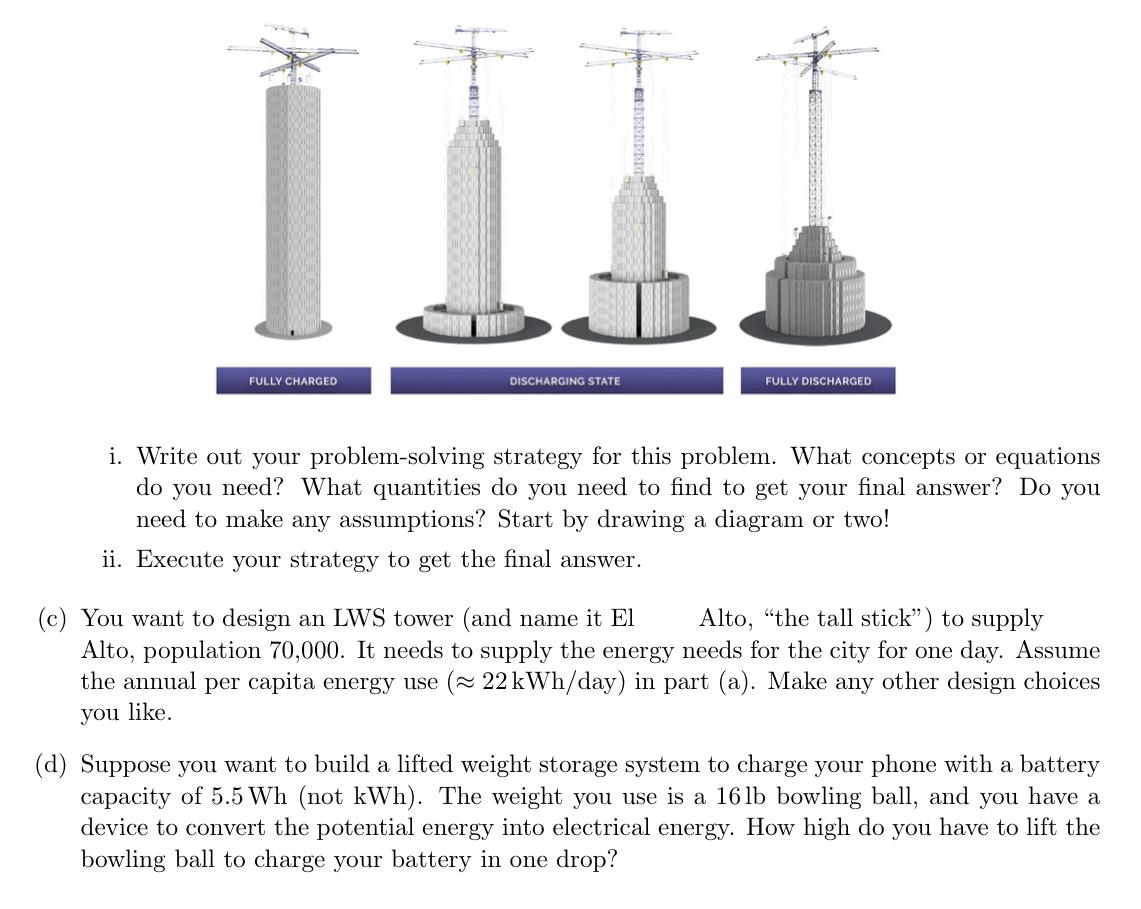
Gravity battery Solar and wind power is a plentiful and renewable resource, but we need a way to store energy to use when these sources can't meet the demand of the power grid, especially in the early evening just after the Sun has set. Pumped hydroelectric energy storage is a process that pumps water from a lower reservoir up to an upper reservoir, where the gravitational potential energy of the water is stored until later use. In this way, the upper reservoir acts as a gravity battery. It is "charged" with excess power during the night and "discharged" during periods of high demand. The gravitational potential energy is converted to kinetic energy of the water as it flows down a pipe. The water passes through turbines that generate electricity. Visitors Center Pumped-Storage Plant Discharge Switchyard Reservoir Intake Elevator Main Access Tunnel Surge Chamber Powerplant Chamber Breakers Transformer Vault (a) The Helms Pumped Storage Plant in National Forest, California, has an upper reservoir with a surface area of 2 km and a depth of 75 m. The upper reservoir is 495 m higher than the lower reservoir (use this height for calculating potential energy, ignoring the additional depth. of the upper reservoir). The average electricity use per capita in California is 8,000 kWh per year. At full capacity, the energy stored in the reservoir can supply the electricity needs for a small city for a full year without being recharged. What is the population of that city? The turbines are only 90% efficient at converting kinetic energy of water into electrical energy. i. Write out your problem-solving strategy for this problem. What concepts or equations do you need? What quantities do you need to find to get your final answer? Do you need to make any assumptions? Start by drawing a diagram or two! ii. Execute your strategy to get the final answer. (b) Pumped hydro works well if you have large elevation changes, but it's not helpful in flat terrain. Lifted weight storage (LWS) technology uses towers of concrete blocks to store gravitational potential energy, which can be extracted using cranes and generators. How much gravitational potential energy is stored in a tower? Assume a solid tower with a height h and a cross-sectional area A. Notice that mass stored on top of the tower has more energy than mass stored near the bottom. You'll need to integrate all the potential energy from the bottom to the top. Consider a slab of material at height y off the ground. The slab has a thickness dy. The mass of a slab is the volume times the density p (in kg/m). Give your answer in symbolic form.
Step by Step Solution
There are 3 Steps involved in it

Get step-by-step solutions from verified subject matter experts
 Study Help