







Question: can you explain me the approach idea.. Write a program that models the movement of an object with mass m (in this exercise it is
can you explain me the approach idea..
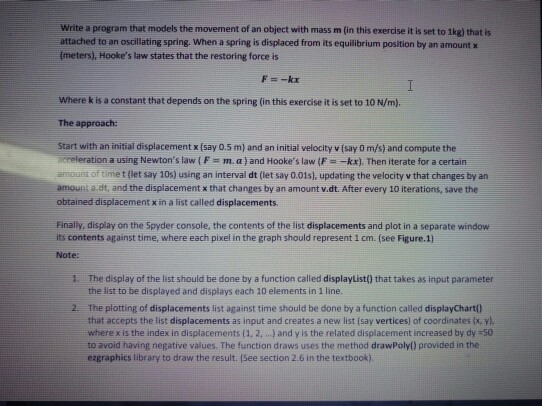
Write a program that models the movement of an object with mass m (in this exercise it is set to 1kg) that is attached to an oscillating spring. When a spring is displaced from its equilibrium position by an amount x (meters), Hooke's law states that the restoring force is F=-kx Where k is a constant that depends on the spring (in this exercise it is set to 10 N/m), The approach Start with an initial displacement x (say 0.5 m) and an initial velocity v (say O m/s) and compute the cceleration a using Newton's law F = m. a ) and Hooke's law (F--kx). Then iterate for a certain amount of time t flet say 10s) using an interval dt (let say 0.01s), updating the velocity v that changes by an amount a.dt, and the displacement x that changes by an amount v.dt. After every 10 iterations, save the obtained displacement x in a list called displacements. Finaly, display on the Spyder console, the contents of the list displacements and plot in a separate window its contents against time, where each pixel in the graph should represent 1 cm. (see Figure.1) Note: The display of the list should be done by a function called displaytist() that takes as input parameter the list to be displayed and displays each 10 elements in 1 line. The plotting of displacements list against time should be done by a function called displayChart) that accepts the list displacements as input and creates a new list (say vertices) of coordinates (x, where x is the index in displacements (1, 2,) and y is the related displacement increased by dy 50 -to avoid having negative values. The function draws uses the method drawPolyD provided in the ezgraphics library to draw the result. (See section 2.6 in the textbook). Write a program that models the movement of an object with mass m (in this exercise it is set to 1kg) that is attached to an oscillating spring. When a spring is displaced from its equilibrium position by an amount x (meters), Hooke's law states that the restoring force is F=-kx Where k is a constant that depends on the spring (in this exercise it is set to 10 N/m), The approach Start with an initial displacement x (say 0.5 m) and an initial velocity v (say O m/s) and compute the cceleration a using Newton's law F = m. a ) and Hooke's law (F--kx). Then iterate for a certain amount of time t flet say 10s) using an interval dt (let say 0.01s), updating the velocity v that changes by an amount a.dt, and the displacement x that changes by an amount v.dt. After every 10 iterations, save the obtained displacement x in a list called displacements. Finaly, display on the Spyder console, the contents of the list displacements and plot in a separate window its contents against time, where each pixel in the graph should represent 1 cm. (see Figure.1) Note: The display of the list should be done by a function called displaytist() that takes as input parameter the list to be displayed and displays each 10 elements in 1 line. The plotting of displacements list against time should be done by a function called displayChart) that accepts the list displacements as input and creates a new list (say vertices) of coordinates (x, where x is the index in displacements (1, 2,) and y is the related displacement increased by dy 50 -to avoid having negative values. The function draws uses the method drawPolyD provided in the ezgraphics library to draw the result. (See section 2.6 in the textbook)
Step by Step Solution
There are 3 Steps involved in it

Get step-by-step solutions from verified subject matter experts
 Study Help