







Question: Can you help me answer question 3 please? I will not accept answer for question one or two. ACSI and Satisfying Global Customers The American
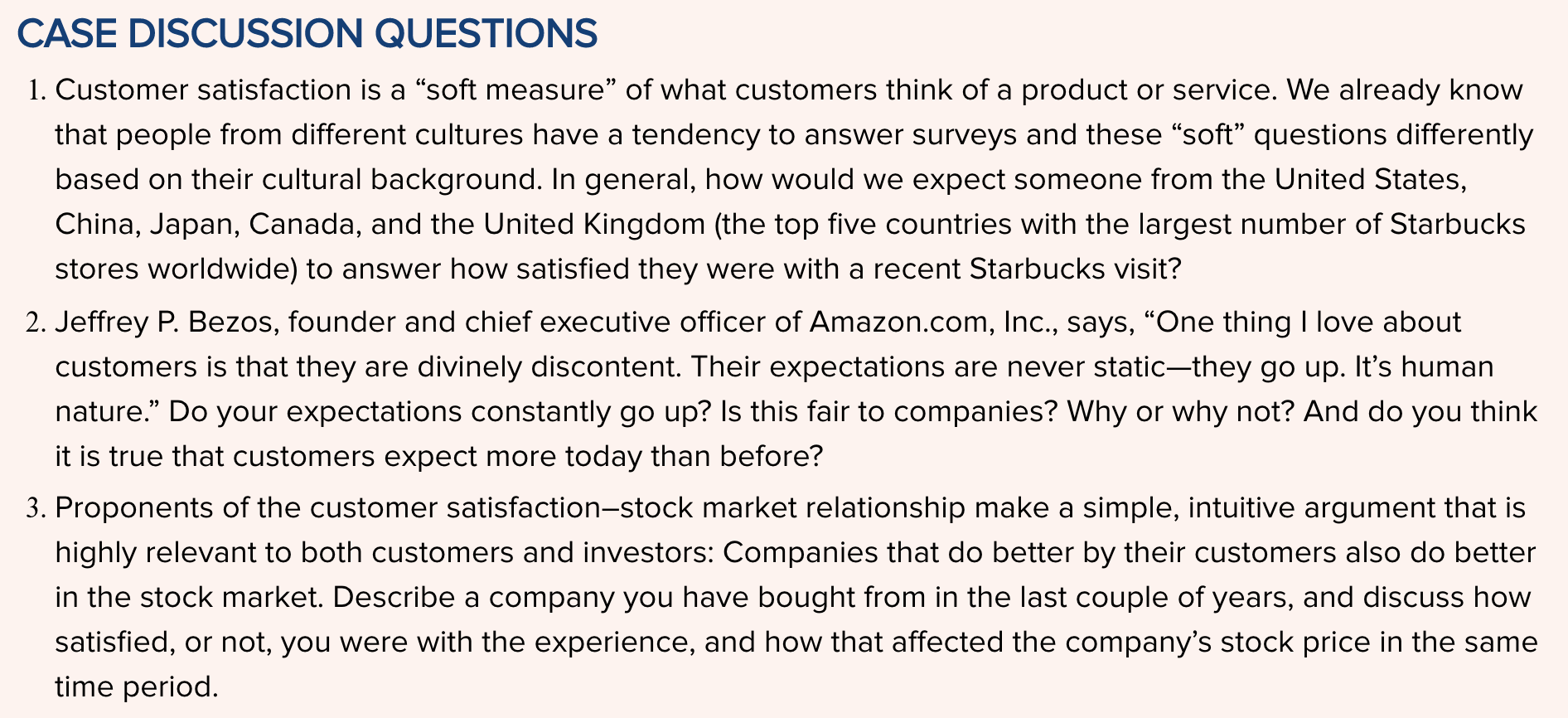
Can you help me answer question 3 please? I will not accept answer for question one or two.
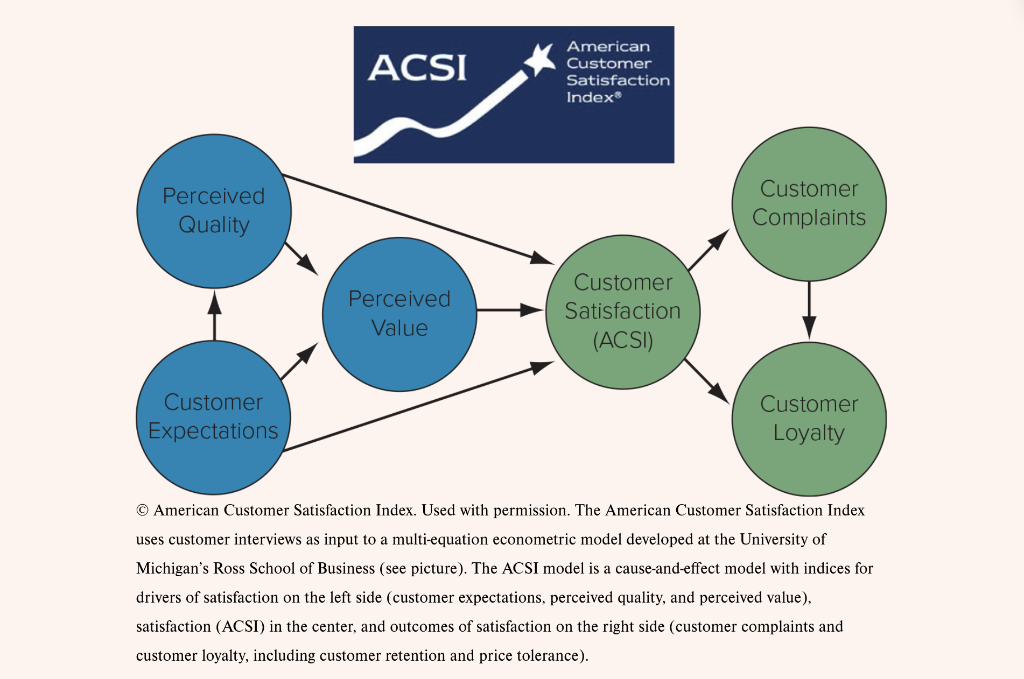
ACSI and Satisfying Global Customers The American Customer Satisfaction Index (ACSI, theacsi.org) is an economic-based index, or indicator, that measures the satisfaction of consumers across the U.S. economy. The ACSI is produced by the American Customer Satisfaction Index (ACSI LLC), which is headquartered in Ann Arbor, Michigan. With the leadership of its founder-Dr. Claes Fornellthe ACSI was created by a team of researchers at the University of Michigan's Ross School of Business in 1994, in cooperation with the American Society for Quality and the CFI Group Inc. The U.S. satisfaction index was modeled after Fornell's Swedish Customer Satisfaction Barometer, which originated in 1989. ACSI scores in the United States are updated monthly on a rolling basis, factoring in annual data from almost 200,000 customers who represent more than 300 companies from 10 economic sectors and 43 industries. Each month, ACSI issues an update on one or more specific industries. Additionally, a quarterly reported national measure of ACSI serves as a macro indicator of the economic health of the national economy. This national ACSI score reflects an aggregate of customer satisfaction from the measured companies that, together, comprise the largest market share in any given industry, producing a gauge of economic utility and consumer demand in the country. Since its beginnings in 1994, the nationwide ACSI score has ranged from a low of 70.7 in Quarter 1 of 1997 to a high of 77.0 in Quarter 1 of 2017 (on a 100-point scale, where 100 is perfectly satisfied and O is not satisfied at all). ACSI American Customer Satisfaction Index Customer Perceived Quality Complaints Perceived Value Customer Satisfaction (ACSI) Customer Customer Loyalty Expectations American Customer Satisfaction Index. Used with permission. The American Customer Satisfaction Index uses customer interviews as input to a multi-equation econometric model developed at the University of Michigan's Ross School of Business (see picture). The ACSI model is a cause-and-effect model with indices for drivers of satisfaction on the left side (customer expectations, perceived quality, and perceived value), satisfaction (ACSI) in the center, and outcomes of satisfaction on the right side (customer complaints and customer loyalty, including customer retention and price tolerance). The Swedish and American customer satisfaction indices have also evolved into Global Customer Satisfaction Indices (Global CSITM). Some of the countries where ACSI has global partners include Australia, Colombia, India, Kuwait, Saudi Arabia, Singapore, South Africa, and South Korea. The Global CSI enables organizations around the world to better understand customer satisfaction via ACSI's scientific methodology, allowing for benchmarking of national economies and multinational corporations' customers worldwide. Globally, customer satisfaction has become an indicator of the health of each country's economy at large and, importantly, a driving force that impacts the financial outlook of individual companies. For example, Amazon uses the ACSI to gauge that it continues to do well on customer satisfaction metrics worldwide. Jeffrey P. Bezos, founder and chief executive officer of Amazon.com, Inc., wrote in the first sentence of his 2017 Letter to Shareholders: The American Customer Satisfaction Index recently announced the results of its annual survey, and for the 8th year in a row customers ranked Amazon #1. For Amazon, which also announced that it has surpassed 100 million Prime members in 2018, constantly having the correct pulse on what customers think is critically important to its business success. (Amazon Prime is a paid subscription service offered by Amazon that gives users access to free two-day delivery, streaming video and music, and other benefits for a monthly or yearly fee.) This "customer pulse" traces back to Bezos's first Letter to Shareholders in 1997, where he focused a whole section on "obsess over customers. The buzzwords and phrases then, as now, for Amazon are "offering our customers compelling value and saves customers money and precious time. But the company also Page 470 wants to be part of the customer journey and accelerate the very process of discovery. Bezos says: One thing I love about customers is that they are divinely discontent. Their expectations are never staticthey go up. It's human nature. These intricate nuances of customers' needs, wants, and attributes make it clear that a core performance outcome for Amazon is customer satisfaction globally. Beyond Amazon's focus on customer satisfaction globally, some of the core takeaways from cross-cultural satisfaction analyses suggest, for example, that customers in traditional societies have higher levels of satisfaction than those in secular-rational societies. Also, customers in self-expressive nations have higher levels of satisfaction scores than those in nations with survival values. Several customer demographics and country infrastructure variables influence customer satisfaction as well: Literacy rate, trade freedom, and business freedom have positive influences on customer satisfaction. On the other hand, per capita gross domestic product (GDP) has a negative effect on satisfaction. At the company level, the effects of customer satisfaction on a variety of important business performance indicators have been studied for more than two decades. Amazon certainly understands this. And more and more companies are getting on board with the idea that customer satisfaction is not just a "feel good thing for companies; it has concrete connection to the bottom-line performance. More than ever, data highlight the importance of the need to satisfy global customers continuously. Previously, a debate about whether companies with superior customer satisfaction also earn better-than-average stock returns had persisted in business circles. Proponents of the customer satisfaction-stock market relationship make a simple, intuitive argument that is highly relevant to both customers and investors: Companies that do better by their customers also do better in the stock market. A 15-year study supports this notion. Cumulative satisfaction portfolio returns over that time period produced results of 518 percent growth compared to only a 31 percent increase in the Standard and Poor's 500 benchmark (S&P 500). On an annual basis, the customer satisfaction portfolio also outperformed the S&P 500 in 14 out of the 15 years. These results take on added importance globally when accounting for the lack of understanding many companies' managers have of their customers' needs and wants. Research indicates that managers generally fail to understand their companies' customers in two important ways: Managers overestimate customers' satisfaction levels as well as the loyalty customers have to the companies' products and services. Managers' understanding of how to satisfy customers is also often disconnected from what the customers actually expect the companies to do. Creating a better connection between multinational corporations and their customers is the job of global marketing professionals. This takes research and development (R&D), global marketing strategy development, and implementation of tactical marketing activities. CASE DISCUSSION QUESTIONS 1. Customer satisfaction is a soft measure of what customers think of a product or service. We already know that people from different cultures have a tendency to answer surveys and these soft questions differently based on their cultural background. In general, how would we expect someone from the United States, China, Japan, Canada, and the United Kingdom (the top five countries with the largest number of Starbucks stores worldwide) to answer how satisfied they were with a recent Starbucks visit? 2. Jeffrey P. Bezos, founder and chief executive officer of Amazon.com, Inc., says, One thing I love about customers is that they are divinely discontent. Their expectations are never staticthey go up. It's human nature. Do your expectations constantly go up? Is this fair to companies? Why or why not? And do you think it is true that customers expect more today than before? 3. Proponents of the customer satisfaction-stock market relationship make a simple, intuitive argument that is highly relevant to both customers and investors: Companies that do better by their customers also do better in the stock market. Describe a company you have bought from in the last couple of years, and discuss how satisfied, or not, you were with the experience, and how that affected the company's stock price in the same time periodStep by Step Solution
There are 3 Steps involved in it
1 Expert Approved Answer
Step: 1 Unlock

Question Has Been Solved by an Expert!
Get step-by-step solutions from verified subject matter experts
Step: 2 Unlock
Step: 3 Unlock
 Study Help