





Question: Can you help me? Options are Compensating controlComplementary controlCorrective controlDeficiency in internal controlDirect controlMaterial weakness in internal controlNATransaction cycleWalk-throughType 1 service auditor report Select the

Can you help me? Options are "Compensating controlComplementary controlCorrective controlDeficiency in internal controlDirect controlMaterial weakness in internal controlNATransaction cycleWalk-throughType 1 service auditor report"
Can you help me? Options are "Compensating
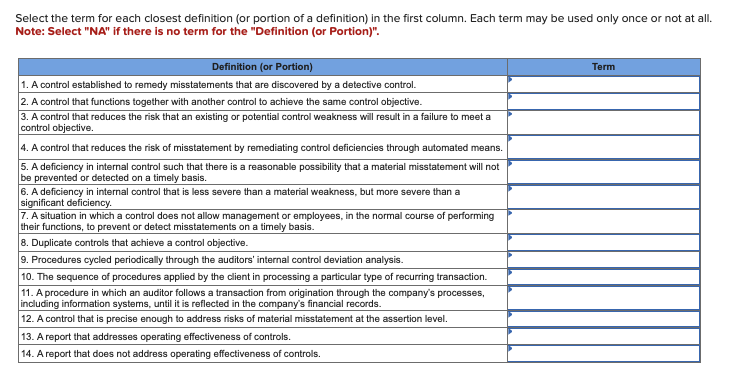
Select the term for each closest definition (or portion of a definition) in the first column. Each term may be used only once or not at all. Note: Select "NA" if there is no term for the "Definition (or Portion)". Definition (or Portion) Term 1. A control established to remedy misstatements that are discovered by a detective control. 2. A control that functions together with another control to achieve the same control objective. 3. A control that reduces the risk that an existing or potential control weakness will result in a failure to meet a control objective. 4. A control that reduces the risk of misstatement by remediating control deficiencies through automated means. 5. A deficiency in internal control such that there is a reasonable possibility that a material misstatement will not be prevented or detected on a timely basis. 6. A deficiency in internal control that is less severe than a material weakness, but more severe than a significant deficiency. 7. A situation in which a control does not allow management or employees, in the normal course of performing their functions, to prevent or detect misstatements on a timely basis. 8. Duplicate controls that achieve a control objective. 9. Procedures cycled periodically through the auditors' internal control deviation analysis. 10. The sequence of procedures applied by the client in processing a particular type of recurring transaction. 11. A procedure in which an auditor follows a transaction from origination through the company's processes, including information systems, until it is reflected in the company's financial records. 12. A control that is precise enough to address risks of material misstatement at the assertion level. 13. A report that addresses operating effectiveness of controls. 14. A report that does not address operating effectiveness of controls

Step by Step Solution

There are 3 Steps involved in it

1 Expert Approved Answer
Step: 1 Unlock blur-text-image

Question Has Been Solved by an Expert!

Get step-by-step solutions from verified subject matter experts

Step: 2 Unlock
Step: 3 Unlock

Students Have Also Explored These Related Accounting Questions!