







Question: Can you help me with part e (and the rest ideally). I end up getting to the same place as a started before taking the
Can you help me with part e (and the rest ideally). I end up getting to the same place as a started before taking the derivative so I don't know where I should stop
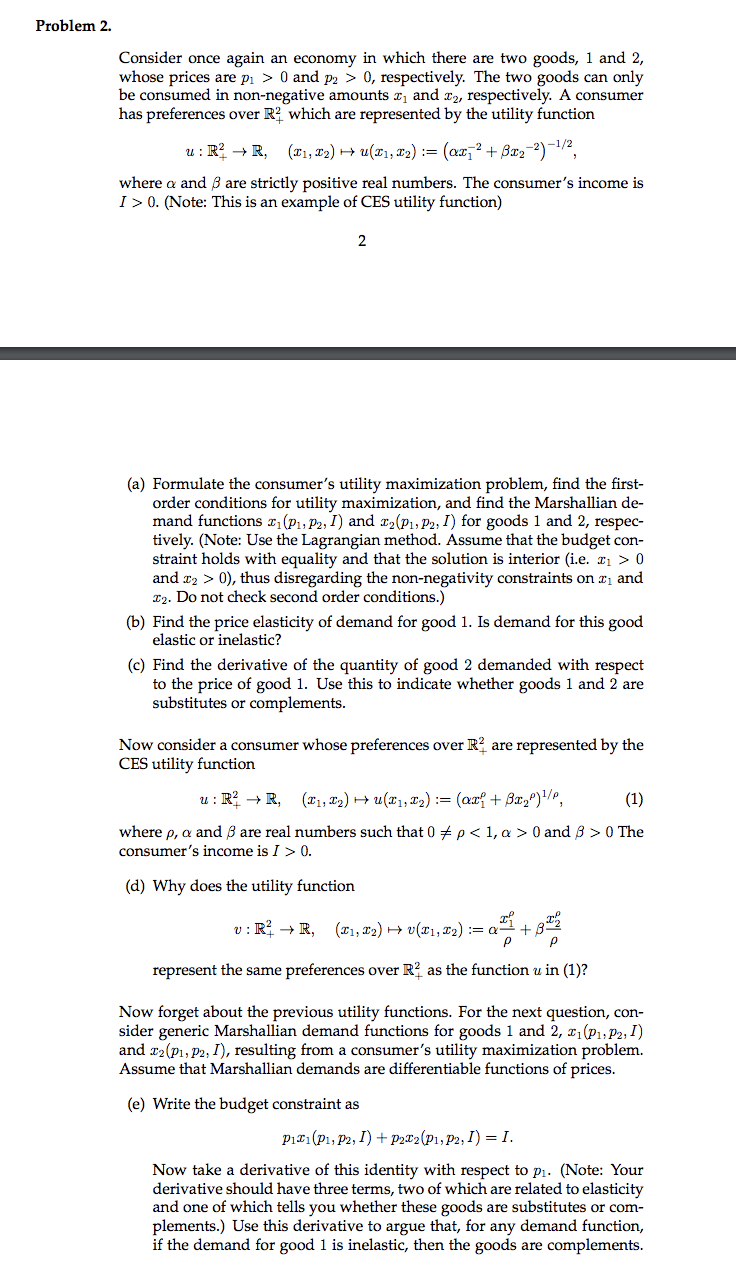
Problem 2. Consider once again an economy in which there are two goods, 1 and 2, whose prices are :31 > 0 and p2 > 0, respectively. The two goods can only be consumed in non-negative amounts $1 and 32, respectively. A consumer has preferences over R1 which are represented by the utility function u : R: t R, ($1, $2] tt u(z1,$g)1= (LEI2 +,8$g_2)_uz, where a and ,8 are strictly positive real numbers. The consumer's income is I :- 0. (Note: This is an example of CBS utility function) 2 (a) Formulate the consumer's utility maximization problem, find the first- order conditions for utility maximization, and nd the Marshallian de- mand functions 1[p1,p2,.l] and 32(p1,p2,f) for goods 1 and 2, respec- tively. (Note: Use the Iagrangian method. Assume that the budget con- straint holds with equality and that the solution is interior (i.e. $1 > O and $2 > 0), thus disregarding the non-negativity constraints on $1 and 32. Do not check second order conditions.) (b) Find the price elasticity of demand for good 1. [s demand for this good elastic or inelastic? (c) Find the derivative of the quantity of good 2 demanded with respect to the price of good 1. Use this to indicate whether goods 1 and 2 are substitutes or complements. Now consider a consumer whose preferences over 1122+ are represented by the CES utility function u : R3. 4 R: (311 $2) H \"($1,322) := (0117:. + xaplupa (1) wherep,aand,8arerealnumberssuchthat07pand'>The consumer's incomeisir :- D. (d) Why does the utility function 39 .0 19:]R13' IR, (E1,$g)|} v($1,2]:= 9;] +31: represent the same preferences over R: as the function u in [1)? Now forget about the previous utility functions. For the next question, con- sider generic Marshallian demand functions for goods 1 and 2, 31(3)],p2J] and MUN: 132,17), resulting from a consumer's utility maximization problem. Assume that Marshallian demands are differentiable functions of prices. (e) Write the budget constraint as 11131031110251) +P2$2(P15P2rn = '1' Now take a derivative of this identity with respect to p1. (Note: Your derivative should have three terms, two of which are related to elasticity and one of which te]ls you whether these goods are substitutes or com- plements.) Use this derivative to argue that, for any demand function. if the demand for good 1 is inelastic, then the goods are complements
Step by Step Solution
There are 3 Steps involved in it

Get step-by-step solutions from verified subject matter experts
 Study Help