



Question: Can you help me with this one question, Part 2,3,4 and 5. Please and thank you! No explanation needed! se sure you have already answered
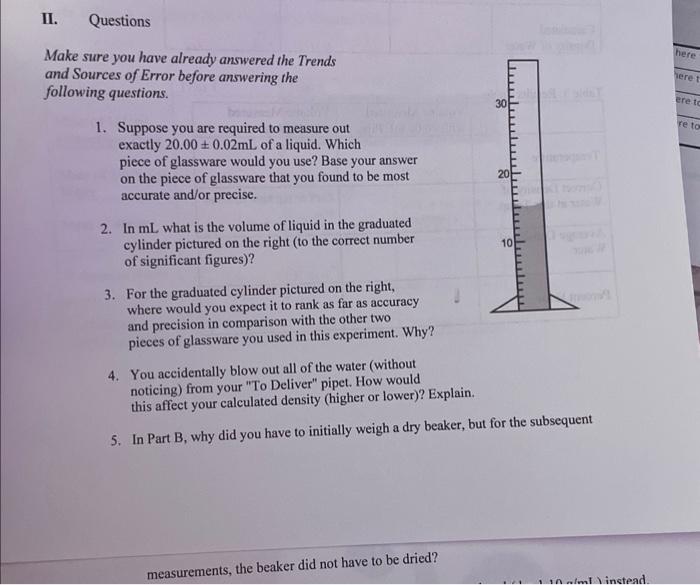
se sure you have already answered the Trends Sources of Error before answering the owing questions. 1. Suppose you are required to measure out exactly 20.000.02mL of a liquid. Which piece of glassware would you use? Base your answer on the piece of glassware that you found to be most accurate and/or precise. 2. In mL what is the volume of liquid in the graduated cylinder pictured on the right (to the correct number of significant figures)? 3. For the graduated cylinder pictured on the right, where would you expect it to rank as far as accuracy and precision in comparison with the other two pieces of glassware you used in this experiment. Why? 4. You accidentally blow out all of the water (without noticing) from your "To Deliver" pipet. How would this affect your calculated density (higher or lower)? Explain. 5. In Part B, why did you have to initially weigh a dry beaker, but for the subsequent measurements, the beaker did not have to be dried? se sure you have already answered the Trends Sources of Error before answering the owing questions. 1. Suppose you are required to measure out exactly 20.000.02mL of a liquid. Which piece of glassware would you use? Base your answer on the piece of glassware that you found to be most accurate and/or precise. 2. In mL what is the volume of liquid in the graduated cylinder pictured on the right (to the correct number of significant figures)? 3. For the graduated cylinder pictured on the right, where would you expect it to rank as far as accuracy and precision in comparison with the other two pieces of glassware you used in this experiment. Why? 4. You accidentally blow out all of the water (without noticing) from your "To Deliver" pipet. How would this affect your calculated density (higher or lower)? Explain. 5. In Part B, why did you have to initially weigh a dry beaker, but for the subsequent measurements, the beaker did not have to be dried
Step by Step Solution
There are 3 Steps involved in it

Get step-by-step solutions from verified subject matter experts